



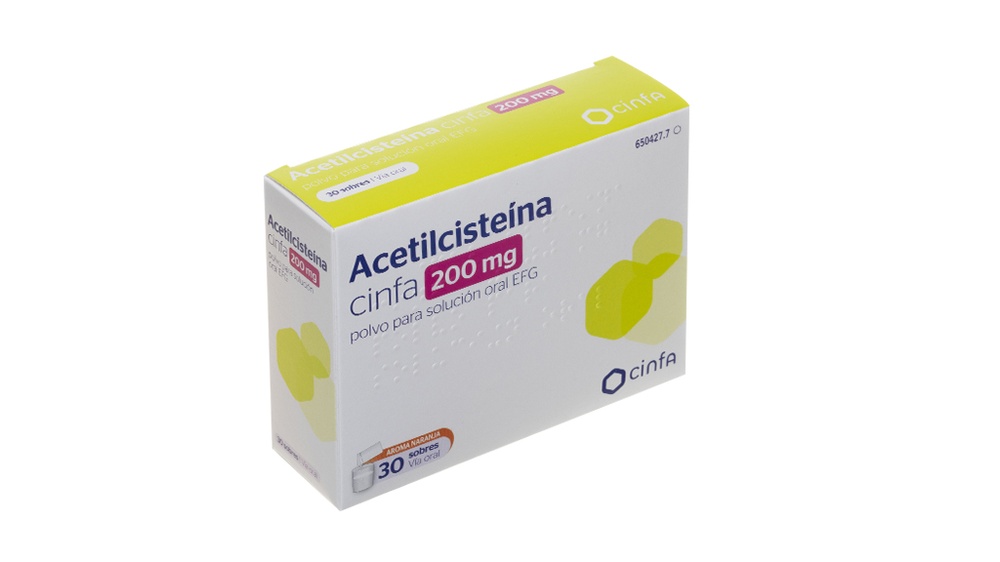
ACETILCISTEINA CINFA 200 mg POLVO PARA SOLUCION ORAL

Revisión de receta online
Un médico revisará tu caso y determinará si la prescripción es médicamente apropiada.

Habla con un médico sobre este medicamento
Comenta tus síntomas y las opciones de tratamiento en una consulta online.



Cómo usar ACETILCISTEINA CINFA 200 mg POLVO PARA SOLUCION ORAL EFG
Contenido del prospecto
- Introducción
- Qué es acetilcisteína cinfa y para qué se utiliza
- Qué necesita saber antes de empezar a tomar acetilcisteína cinfa
- Cómo tomar acetilcisteína cinfa
- Posibles efectos adversos
- Conservación de acetilcisteína cinfa
- Contenido del envase e información adicional
Introducción
Prospecto: información para el usuario
acetilcisteína cinfa 200 mg polvo para solución oral EFG
Lea todo el prospecto detenidamente antes de empezar a tomar este medicamento, porque contiene información importante para usted.
- Conserve este prospecto, ya que puede tener que volver a leerlo.
- Si tiene alguna duda, consulte a su médico o farmacéutico.
- Este medicamento se le ha recetado solamente a usted, y no debe dárselo a otras personas aunque tengan los mismos síntomas que usted, ya que puede perjudicarles.
- Si experimenta efectos adversos, consulte a su médico o farmacéutico, incluso si se trata de efectos adversos que no aparecen en este prospecto. Ver sección 4.
Contenido del prospecto
- Qué es acetilcisteína cinfa y para qué se utiliza
- Qué necesita saber antes de empezar a tomar acetilcisteína cinfa
- Cómo tomar acetilcisteína cinfa
- Posibles efectos adversos
- Conservación de acetilcisteína cinfa
- Contenido del envase e información adicional
1. Qué es acetilcisteína cinfa y para qué se utiliza
Acetilcisteína pertenece al grupo de medicamentos denominados mucolíticos.
Acetilcisteína se utiliza para fluidificar la secreciones bronquiales excesivas y/o espesas. Está indicado en el tratamiento de apoyo de los procesos respiratorios que cursan con hipersecrección, mucosa excesiva o espesa, tales como:
- Bronquitis (inflamación de los bronquios) aguda y crónica.
- Enfermedad pulmonar obstructiva crónica.
- Enfisema (inflamación de los alveolos de los pulmones, que disminuyen la función respiratoria).
- Atelectasia (disminución del volumen pulmonar) debido a obstrucción mucosa.

¿No estás seguro de si este medicamento es adecuado para ti?
Comenta tus síntomas y tratamiento con un médico online.
2. Qué necesita saber antes de empezar a tomar acetilcisteína cinfa
No tome acetilcisteína cinfa
- Si es alérgico a la acetilcisteína o a alguno de los demás componentes de este medicamento (incluidos en la sección 6).
- No administrar a niños menores de 2 años.
Advertencias y precauciones
Consulte a su médico o farmacéutico antes de empezar a tomar acetilcisteína cinfa.
Si es usted asmático o padece una enfermedad respiratoria grave, deberá consultar con el médico antes de tomar este medicamento.
El posible olor azufrado (a huevos podridos) del medicamento es propio del principio activo, pero no indica que el medicamento esté en malas condiciones.
Si al tomar el medicamento observa molestias en el estómago. En ese caso, deberá suspender el tratamiento y consultar al médico. Se recomienda precaución en caso de pacientes con úlcera péptica o antecedentes de úlcera péptica.
Durante los primeros días de tratamiento podrá observar un aumento de mocos y flemas, que irá disminuyendo a lo largo del tratamiento.
Se debe administrar con precaución en el tratamiento de larga duración en pacientes con intolerancia histamínica.
Niños
Está contraindicado en niños menores de 2 años.
Otros medicamentos y acetilcisteína cinfa
Informe a su médico o farmacéutico si está tomando, ha tomado recientemente o pudiera tener que tomar cualquier otro medicamento.
La terapia conjunta con nitroglicerina puede producir dolor de cabeza y se debe controlar la aparición de hipotensión, que puede ser grave.
La administración conjunta con el antiepiléptico carbamazepina puede provocar una disminución de la eficacia de carbamazepina.
No administrar conjuntamente con medicamentos antitusivos (para la tos) o con aquellos que disminuyen las secreciones bronquiales (como los antihistamínicos y los anticolinérgicos), ya que se puede provocar un acúmulo de moco fluidificado.
Cuando esté tomando algún medicamento que contenga minerales como el hierro o calcio, o algún medicamento con antibióticos tipo (anfotericina B, ampicilina sódica, cefalosporinas, lactobionato, eritromicina y algunas tetraciclinas) debe separar su toma de la toma de acetilcisteína al menos 2 horas.
No se recomienda la disolución de acetilcisteína con otros medicamentos.
Toma de acetilcisteína cinfa con alimentos y bebidas
La toma de alimentos y bebidas no afecta a la eficacia de este medicamento.
Embarazo y lactancia
Si está embarazada o en periodo de lactancia, cree que podría estar embarazada o tiene intención de quedarse embarazada, consulte a su médico o farmacéutico antes de utilizar este medicamento.
Como medida de precaución es preferible evitar su uso durante el embarazo.
Se debe evitar su toma durante la lactancia.
Conducción y uso de máquinas
No existe evidencia de efectos sobre la capacidad para conducir y utilizar máquinas.
acetilcisteína cinfa contiene aspartamo. Este medicamento contiene 6,67 mg de aspartamo en cada sobre. El aspartamo contiene una fuente de fenilalanina que puede ser perjudicial en caso de padecer fenilcetonuria (FCN), una enfermedad genética rara en la que la fenilalanina se acumula debido a que el organismo no es capaz de eliminarla correctamente.
acetilcisteína cinfa contiene colorante amarillo anaranjado S. Este medicamento puede producir reacciones alérgicas porque contiene amarillo anaranjado S (E-110). Puede provocar asma, especialmente en pacientes alérgicos al ácido acetilsalicílico.
3. Cómo tomar acetilcisteína cinfa
Siga exactamente las instrucciones de administración de este medicamento indicadas por su médico o farmacéutico. En caso de duda, consulte de nuevo a su médico o farmacéutico.
La dosis recomendada es:
Adultos y niños mayores de 7 años:
200 mg de acetilcisteína (1 sobre de acetilcisteína cinfa 200 mg 3 veces al día), cada 8 horas. No superar la dosis de 3 sobres (600 mg de acetilcisteína) al día.
Niños entre 2 y 7 años:
Las dosis que se recomiendan son menores y esta presentación no es adecuada aunque esta presentación puede usarse en casos de complicación pulmonar de la fibrosis quística.
Complicaciones pulmonares de la fibrosis quística:
La dosis recomendada en estos casos es la siguiente:
Adultos y niños mayores de 7 años: 200 a 400 mg de acetilcisteína cada 8 horas.
Niños entre 2 y 7 años:200 mg de acetilcisteína cada 8 horas.
Acetilcisteína se toma por vía oral.
Los sobres se toman disueltos en un vaso de agua. Se recomienda beber abundante cantidad de líquido durante el día.
Está contraindicado en niños menores de 2 años.
Si toma más acetilcisteína cinfa del que debe
Si toma más acetilcisteína del que debe puede notar: náuseas, vómitos, ardor y dolor de estómago, diarrea o cualquier otro efecto adverso descrito en el apartado 4. Posibles efectos adversos.
En caso de sobredosis o ingestión accidental consulte inmediatamente a su médico o farmacéutico o llame al Servicio de Información Toxicológica, teléfono 91 562 04 20, indicando el medicamento y la cantidad ingerida.
En caso de administración masiva accidental, se recomienda tratamiento sintomático.
Si tiene cualquier otra duda sobre el uso de este medicamento, pregunte a su médico o farmacéutico.

¿Has empezado a tomar el medicamento y tienes preguntas?
Comenta tus síntomas y tratamiento con un médico online.
4. Posibles efectos adversos
Al igual que todos los medicamentos, este medicamento puede producir efectos adversos, aunque no todas las personas los sufran.
Se pueden producir los siguientes efectos adversos:
Poco frecuentes(pueden afectar hasta 1 de cada 100 pacientes): hipersensibilidad, dolor de cabeza, zumbido de oídos, taquicardia, vómitos, diarrea, estomatitis, dolor abdominal, náuseas, urticaria, erupción cutánea, angioedema, prurito, aumento de la temperatura corporal, hipotensión.
Raros(pueden afectar hasta 1 de cada 1.000 pacientes): somnolencia, broncoespasmo, dificultad respiratoria, molestias digestivas.
Muy raros(pueden afectar hasta 1 de cada 10.000 pacientes): reacciones alérgicas, shock anafiláctico, hemorragia, reacciones cutáneas graves como síndrome de Stevens-Johnson y síndrome de Lyell, en ocasiones identificadas con al menos la toma de otro medicamento de forma simultánea.
Frecuencia no conocida(no puede estimarse a partir de los datos disponibles): hinchazón de la cara.
En caso de producirse cualquier alteración en la piel o membranas mucosas, debe interrumpirse inmediatamente la administración de acetilcisteína y solicitar asistencia médica.
Comunicación de efectos adversos
Si experimenta cualquier tipo de efecto adverso, consulte a su médico o farmacéutico, incluso si se trata de posibles efectos adversos que no aparecen en este prospecto. También puede comunicarlos directamente a través del Sistema Español de Farmacovigilancia de Medicamentos de Uso Humano: https://www.notificaram.es. Mediante la comunicación de efectos adversos usted puede contribuir a proporcionar más información sobre la seguridad de este medicamento.
5. Conservación de acetilcisteína cinfa
Mantener este medicamento fuera de la vista y del alcance de los niños.
No conservar a temperatura superior a 30ºC.
No utilice este medicamento después de la fecha de caducidad que aparece en el envase después de CAD. La fecha de caducidad es el último día del mes que se indica.
Los medicamentos no se deben tirar por los desagües ni a la basura. Deposite los envases y los medicamentos que no necesita en el Punto SIGRE de la farmacia. En caso de duda, pregunte a su farmacéutico cómo deshacerse de los envases y de los medicamentos que no necesita. De esta forma, ayudará a proteger el medio ambiente.
6. Contenido del envase e información adicional
Composición de acetilcisteína cinfa
- El principio activo es acetilcisteína. Cada sobre contiene 200 mg de acetilcisteína.
- Los demás componentes son: aspartamo (E-951), manitol (E-421), sílice coloidal anhidra, colorante amarillo anaranjado S (E-110) y aroma de naranja (preparados aromatizantes, sustancias aromatizantes, sustancias aromatizantes naturales, maltodextrina de maíz, goma arábiga (E-414), ácido ascórbico (E-300) y hidroxianisol butilado (BHA) (E-320)).
Aspecto del producto y contenido del envase
Sobres de Alu/Pe Surlyn. Polvo homogéneo de color y sabor naranja.
acetilcisteína cinfa se presenta en forma de sobres que contienen 200 mg de acetilcisteína. Se presenta en envases que contienen 30 o 500 (EC) sobres.
Puede que solamente estén comercializados algunos tamaños de envases.
Titular de la autorización de comercialización y responsable de la fabricación
Laboratorios Cinfa, S.A.
Carretera Olaz-Chipi, 10. Polígono Industrial Areta
31620 Huarte (Navarra) – España
Fecha de la última revisión de este prospecto:Abril 2021
La información detallada y actualizada de este medicamento está disponible en la página web de la Agencia Española de Medicamentos y Productos Sanitarios (AEMPS) http://www.aemps.gob.es/
Puede acceder a información detallada y actualizada sobre este medicamento escaneando con su teléfono móvil (smartphone) el código QR incluido en prospecto y cartonaje. También puede acceder a esta información en la siguiente dirección de internet: https://cima.aemps.es/cima/dochtml/p/66459/P_66459.html
Código QR a: https://cima.aemps.es/cima/dochtml/p/66459/P_66459.html
- País de registro
- Forma farmacéuticaSOLUCIÓN/SUSPENSIÓN ORAL, 200 mg
- Código ATCR05CB01
- Principio activo
- Requiere recetaSí
- Fabricante
- ComposiciónASPARTAMO (E-951) (6,67 mg mg), MANITOL (E-421) (585,0 mg mg), AMARILLO ANARANJADO S (E 110, CI=15985) (0,34 mg mg)
- Esta información es de carácter general y no sustituye la consulta con un profesional sanitario.
- Alternativas a ACETILCISTEINA CINFA 200 mg POLVO PARA SOLUCION ORAL EFGForma farmacéutica: COMPRIMIDO EFERVESCENTE, 600 MGPrincipio activo: AcetilcisteinaFabricante: Kern Pharma S.L.No requiere recetaForma farmacéutica: COMPRIMIDO EFERVESCENTE, 600 mgPrincipio activo: AcetilcisteinaFabricante: Laboratorios Alter S.A.Requiere recetaForma farmacéutica: COMPRIMIDO EFERVESCENTE, 200 mgPrincipio activo: AcetilcisteinaFabricante: Aurovitas Spain, S.A.U.Requiere receta
Médicos online para ACETILCISTEINA CINFA 200 mg POLVO PARA SOLUCION ORAL EFG
Comenta la dosis, los posibles efectos secundarios, interacciones, contraindicaciones o la revisión de receta de ACETILCISTEINA CINFA 200 mg POLVO PARA SOLUCION ORAL EFG, sujeto a valoración médica y a la normativa local.









Obtén una receta de ACETILCISTEINA CINFA 200 mg POLVO PARA SOLUCION ORAL EFG online
Rellena un formulario de 2 minutos
Cuéntanos tus síntomas, historial y el medicamento que necesitas.
Elige un médico o nosotros te asignamos uno
Escoge un especialista o te conectamos con el próximo médico disponible.
El médico revisa tu caso
Normalmente en 30 minutos. Puede hacerte preguntas adicionales por chat.
Recógela en cualquier farmacia
Receta electrónica enviada a tu correo, válida en toda España.
Preguntas frecuentes
ACETILCISTEINA CINFA 200 mg POLVO PARA SOLUCION ORAL EFG requiere receta en España. Puedes confirmarlo con un médico online según tu caso.
El principio activo de ACETILCISTEINA CINFA 200 mg POLVO PARA SOLUCION ORAL EFG es Acetilcisteina. Esta información ayuda a identificar medicamentos con la misma composición pero con diferentes nombres comerciales.
ACETILCISTEINA CINFA 200 mg POLVO PARA SOLUCION ORAL EFG es fabricado por Laboratorios Cinfa S.A.. La marca y el envase pueden variar según el distribuidor.
Los Médicos de familia, Psiquiatras, Dermatólogos, Cardiólogos, Endocrinólogos, Gastroenterólogos, Neumólogos, Nefrólogos, Reumatólogos, Hematólogos, Infectólogos, Alergólogos, Geriatras, Pediatras, Oncólogos pueden valorar la prescripción de ACETILCISTEINA CINFA 200 mg POLVO PARA SOLUCION ORAL EFG cuando esté clínicamente indicado. Puedes reservar una videoconsulta para comentar tu caso y las opciones de tratamiento.
España cuenta con una infraestructura sanitaria bien desarrollada en ciudades principales como Madrid, Barcelona, Valencia y Sevilla. Las farmacias están ampliamente disponibles y operan bajo estrictas regulaciones, garantizando el acceso a medicamentos con receta.
Puedes comprar ACETILCISTEINA CINFA 200 mg POLVO PARA SOLUCION ORAL EFG en Madrid, Barcelona, Sevilla o Valencia en cualquier farmacia local con una receta válida.
Para obtener una receta, puedes utilizar Oladoctor:
Otros medicamentos con el mismo principio activo (Acetilcisteina) incluyen ACETILCISTEINA ABEX 600 MG COMPRIMIDOS EFERVESCENTES, ACETILCISTEINA ALTER 600 MG COMPRIMIDOS EFERVESCENTES EFG, ACETILCISTEINA AUROVITAS 200 MG COMPRIMIDOS EFERVESCENTES EFG. Pueden tener diferentes nombres comerciales o formulaciones, pero contienen el mismo componente terapéutico. Consulta siempre con un médico antes de cambiar o iniciar un nuevo medicamento.
