


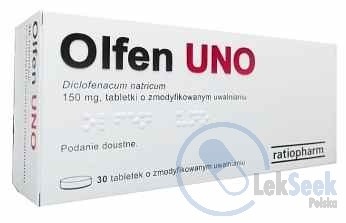
Olfen Uno
Ask a doctor about a prescription for Olfen Uno




How to use Olfen Uno
Leaflet accompanying the packaging: information for the user
Olfen UNO, 150 mg, tablets with modified release
Diclofenac sodium
You should carefully read the contents of the leaflet before using the medicine, as it contains important information for the patient.
- You should keep this leaflet, so that you can read it again if you need to.
- If you have any doubts, you should consult a doctor, pharmacist, or nurse.
- This medicine has been prescribed specifically for you. Do not pass it on to others. The medicine may harm another person, even if their symptoms are the same.
- If the patient experiences any side effects, including any side effects not listed in this leaflet, they should tell their doctor, pharmacist, or nurse. See section 4.
Table of contents of the leaflet
- 1. What is Olfen UNO and what is it used for
- 2. Important information before taking Olfen UNO
- 3. How to take Olfen UNO
- 4. Possible side effects
- 5. How to store Olfen UNO
- 6. Package contents and other information
1. What is Olfen UNO and what is it used for
The medicine contains diclofenac sodium, an active substance belonging to the group of non-steroidal anti-inflammatory drugs (NSAIDs), with anti-inflammatory, analgesic, and antipyretic effects.
The mechanism of action of the medicine involves the inhibition of prostaglandin biosynthesis, which plays a fundamental role in the pathogenesis of the inflammatory process, pain, and fever.
Olfen UNO is used to treat:
- rheumatoid arthritis,
- osteoarthritis,
- ankylosing spondylitis (Bechterew's disease),
- degenerative changes in the spine,
- extra-articular rheumatism (muscle inflammation, tendonitis, bursitis, synovitis),
- pain after injuries and after surgical procedures,
- joint pain or painful menstruation.
2. Important information before taking Olfen UNO
When not to take Olfen UNO
- if the patient has been diagnosed with hypersensitivity to the active substance or to any of the other ingredients of this medicine (listed in section 6)
- if the patient has been diagnosed with hypersensitivity to other non-steroidal anti-inflammatory drugs
- if the patient has been diagnosed with hypersensitivity to acetylsalicylic acid, manifested by asthma attacks, chest pain, skin reactions, allergic rhinitis
- if the patient has blood system disorders
- if the patient has active gastric or intestinal ulcers
- if the patient has bleeding or perforation of gastric or intestinal ulcers
- if the patient has a history of gastrointestinal bleeding or perforation due to the use of painkillers (NSAIDs)
- if the patient is in the third trimester of pregnancy
- if the patient has severe liver, kidney, or heart failure
- if the patient has heart disease (heart failure, coronary heart disease) and/or cerebrovascular disease, e.g., after a heart attack, stroke, transient cerebral ischemia (mini-stroke), or after vascular surgery, or has undergone angioplasty or bypass surgery
- if the patient has had circulatory disorders (peripheral vascular disease).
If any of the above symptoms occur in the patient, they should inform their doctor and not take Olfen UNO until the doctor determines that the medicine is suitable for the patient.
Children and adolescents
Olfen UNO is not recommended for use in children and adolescents.
Warnings and precautions
Before starting treatment with Olfen UNO, the patient should discuss it with their doctor, pharmacist, or nurse.
The patient should inform their doctor:
- if the patient is in the 1st and 2nd trimester of pregnancy
- if the patient is breastfeeding
- if any unusual symptoms occur in the abdominal cavity (especially gastrointestinal bleeding) during treatment with Olfen UNO, the medicine should be discontinued and the doctor should be consulted
- if the patient has a history of gastrointestinal diseases, ulcers, or inflammation of the intestines (ulcerative colitis, Crohn's disease)
- if the patient experiences the first signs of a rash, changes in the mucous membranes, or other symptoms of an allergic reaction, the medicine should be discontinued and the doctor should be consulted (the use of diclofenac may rarely, especially at the beginning of treatment, cause life-threatening skin reactions, such as exfoliative dermatitis, Stevens-Johnson syndrome with widespread rash, high fever, and joint pain, as well as toxic epidermal necrolysis with skin and mucous membrane changes, high fever, and severe general condition)
- if the patient has asthma, allergic rhinitis, nasal polyps, chronic obstructive pulmonary disease, or chronic respiratory infections. This warning also applies to patients allergic to other substances (e.g., those who experience skin reactions, itching, or hives). The medicine should be used with caution (preferably under medical supervision)
- if the patient has porphyria
- if the patient has systemic lupus erythematosus (SLE) or mixed connective tissue disease (collagenosis)
- if the patient has hypertension and/or heart disorders
- if the patient has kidney function disorders
- if the patient has liver function disorders
- if the patient has recently undergone major surgery
- if the patient is elderly.
Before taking diclofenac, the patient should inform their doctor
- if the patient smokes
- if the patient has diabetes
- if the patient has angina pectoris, thrombosis, hypertension, elevated cholesterol, or elevated triglycerides.
Olfen UNO should not be taken simultaneously with other systemic non-steroidal anti-inflammatory drugs, including selective cyclooxygenase-2 inhibitors.
As with other non-steroidal anti-inflammatory drugs (NSAIDs), diclofenac may also rarely cause allergic reactions, including anaphylactic and pseudo-anaphylactic reactions, even if the medicinal product has not been used before.
Before taking Olfen UNO, the patient should tell their doctor if they have recently undergone or are scheduled to undergo stomach or gastrointestinal surgery, as Olfen UNO may sometimes cause impaired wound healing in the intestines after surgery.
The medicine may mask the symptoms of infection (e.g., headache, elevated body temperature) and make it difficult to diagnose. During medical examinations, the patient should inform their doctor about the use of the medicine.
Taking such medicines as Olfen UNO may be associated with a slight increase in the risk of heart attack (myocardial infarction) or stroke. This risk increases with long-term use of high doses of the medicine. The patient should not take higher doses or use the medicine for longer than recommended.
In case of heart problems, a history of stroke, or suspected risk of these disorders (e.g., high blood pressure, diabetes, elevated cholesterol, smoking), the patient should discuss their treatment with their doctor or pharmacist.
The medicine may transiently inhibit platelet aggregation.
The occurrence of side effects can be reduced by using the medicine in the smallest effective dose and for no longer than necessary.
Olfen UNO and other medicines
The patient should tell their doctor about all medicines they are currently taking or have recently taken, as well as any medicines they plan to take, including those available without a prescription.
Lithium: Diclofenac taken simultaneously with lithium may increase its serum concentration.
Monitoring of lithium serum concentration is recommended.
Digoxin: Diclofenac taken simultaneously with digoxin may increase its serum concentration.
Monitoring of digoxin serum concentration is recommended.
Diuretics and antihypertensive drugs: Like other NSAIDs, the simultaneous use of diclofenac with diuretics or antihypertensive drugs, e.g., beta-blockers, angiotensin-converting enzyme (ACE) inhibitors, may reduce their antihypertensive effect.
Therefore, diclofenac should be used with caution when taken simultaneously with diuretics or antihypertensive drugs. In patients, especially the elderly, blood pressure should be regularly monitored. Due to the increased risk of nephrotoxicity, patients should be properly hydrated and their kidney function should be periodically monitored after starting treatment and during combination therapy, especially after the use of diuretics and ACE inhibitors. During the simultaneous use of diclofenac and potassium-sparing diuretics, an increase in potassium serum concentration may occur, so regular monitoring of potassium serum concentration is necessary (see section 4.4).
Other non-steroidal anti-inflammatory drugs (NSAIDs), including COX-2 inhibitors, and corticosteroids: The simultaneous administration of diclofenac and other non-steroidal anti-inflammatory drugs or corticosteroids may increase the frequency of side effects related to the gastrointestinal tract (see section 4.4).
Anticoagulant and antiplatelet drugs: Caution should be exercised, as the simultaneous use of diclofenac may increase the risk of bleeding (see section 4.4). Although clinical trials do not indicate that diclofenac affects the action of anticoagulant drugs, there are individual reports of an increased risk of bleeding when diclofenac is used in combination with anticoagulant drugs. Therefore, in this case, careful monitoring of patients is recommended.
Selective serotonin reuptake inhibitors (SSRIs). The simultaneous use of systemic NSAIDs, including diclofenac, and SSRIs may increase the risk of gastrointestinal bleeding (see section 4.4).
Antidiabetic drugs: Clinical trials have shown that diclofenac can be taken simultaneously with oral antidiabetic drugs without affecting their clinical efficacy.
However, individual cases of both hypoglycemic and hyperglycemic effects have been reported, which required a change in the dosage of antidiabetic drugs during treatment with diclofenac. Therefore, monitoring of blood glucose levels is necessary during combination therapy.
Methotrexate: Diclofenac may inhibit the renal clearance of methotrexate, thereby increasing its blood concentration. Caution should be exercised when using non-steroidal anti-inflammatory drugs during the period shorter than 24 hours before or after methotrexate treatment, as an increase in methotrexate blood concentration and an increase in the toxicity of this substance may occur.
Cyclosporin: Diclofenac, like other non-steroidal anti-inflammatory drugs, may increase the nephrotoxicity of cyclosporin due to its effect on renal prostaglandins. Therefore, diclofenac should be administered in lower doses than in patients not receiving cyclosporin.
Quinolone antibacterial drugs. Individual cases of seizures have been reported, which may have been caused by the simultaneous use of quinolones and NSAIDs.
Probenecid, sulfinpyrazone: Delayed excretion of diclofenac may occur.
Phenytoin: When phenytoin is taken simultaneously with diclofenac, monitoring of phenytoin serum concentration is recommended due to the possible increase in phenytoin exposure.
Cholestyramine, colestipol: These substances may induce prolonged or reduced absorption of diclofenac.
Therefore, it is recommended to take diclofenac at least 1 hour before or 4-6 hours after taking cholestyramine/colestipol.
Strong CYP2C9 inhibitors: Caution is recommended when prescribing diclofenac with strong CYP2C9 inhibitors (such as sulfinpyrazone and voriconazole) due to the possible significant increase in diclofenac concentration and exposure resulting from the inhibition of diclofenac metabolism.
Angiotensin-converting enzyme inhibitors: The administration of diclofenac simultaneously with angiotensin-converting enzyme inhibitors may reduce their effect and increase the risk of kidney function disorders.
Mifepristone: Non-steroidal anti-inflammatory drugs used before the expiration of 8-12 days after the use of mifepristone may reduce its effect.
Acetylsalicylic acid: The simultaneous administration of acetylsalicylic acid reduces the diclofenac blood concentration and reduces its effect.
Diclofenac resin: Since the resin is a basic ion exchanger, the inhibition of absorption of other orally administered drugs should be considered.
Olfen UNO with food and drink
The medicine should be swallowed whole, without chewing, during a meal, washed down with a large amount of liquid.
In patients with stomach irritation, it is recommended to take the medicine during meals.
Pregnancy, breastfeeding, and fertility
If the patient is pregnant or breastfeeding, suspects that they may be pregnant, or plans to have a child, they should consult their doctor or pharmacist before taking this medicine.
Pregnancy
Olfen UNO should not be taken if the patient is in the last 3 months of pregnancy, as it may harm the unborn child or cause complications during delivery. Olfen UNO may cause kidney and heart function disorders in the unborn child. It may also increase the risk of bleeding in the patient and the child and cause delayed or prolonged labor. During the first 6 months of pregnancy, Olfen UNO should not be used unless the doctor considers it absolutely necessary. If treatment is necessary during this period or when trying to conceive, the smallest possible dose should be used for the shortest possible time. From the 20th week of pregnancy, Olfen UNO may cause kidney function disorders in the unborn child if taken for more than a few days - this may lead to a low level of amniotic fluid surrounding the child (oligohydramnios) or narrowing of the arterial duct (ductus arteriosus) in the child's heart. If treatment is required for a longer period, the doctor may recommend additional monitoring.
Breastfeeding
Diclofenac passes into breast milk in small amounts. Therefore, diclofenac should not be used during breastfeeding to avoid side effects in the child.
Fertility
Diclofenac may cause difficulty in conceiving. The patient should consult their doctor for advice if they are planning to conceive, become pregnant, or have problems conceiving while taking diclofenac.
Driving and using machines
Patients taking Olfen UNO who experience vision disturbances, balance disorders, drowsiness, dizziness, vertigo, fatigue, or other central nervous system disorders should stop driving vehicles or operating machinery and inform their doctor or pharmacist.
Olfen UNO contains mannitol and sodium
Mannitol
The medicine contains 36.40 mg of mannitol per tablet. The medicine may have a mild laxative effect.
Sodium
The medicine contains less than 1 mmol (23 mg) of sodium per tablet, which means that the medicine is considered "sodium-free".
3. How to take Olfen UNO
This medicine should always be taken as directed by the doctor or pharmacist.
In case of doubts, the patient should consult their doctor or pharmacist.
The recommended dose should not be exceeded, and the treatment period should not be prolonged.
The general recommendation is for the doctor to adjust the dose individually for each patient and use the smallest effective dose for the shortest possible period.
If the patient feels that the effect of the medicine is too strong or too weak, they should consult their doctor.
The dosage of diclofenac depends on the course and severity of the disease. The recommended daily dose of diclofenac is up to 150 mg.
Adults
1 tablet with modified release per day, which corresponds to 150 mg of diclofenac sodium.
Use in children and adolescents
Due to the high dose, Olfen UNO is not recommended for use in children and adolescents.
Method and duration of administration
The medicine should be swallowed whole, without chewing, during a meal, washed down with a large amount of liquid. In patients with stomach irritation, it is recommended to take the medicine during meals.
The doctor decides on the duration of treatment. In the case of rheumatoid arthritis, long-term use of the medicine may be necessary.
Elderly patients
The medicine should be used with caution in elderly patients.
Overdose of Olfen UNO
Overdose of Olfen UNO does not have characteristic symptoms.
Symptoms of overdose include central nervous system disorders (dizziness and headaches, loss of consciousness, tinnitus, seizures) and gastrointestinal disorders (nausea, vomiting, abdominal pain, gastrointestinal bleeding, diarrhea). In the case of significant poisoning, acute kidney failure and liver damage may occur.
There is no specific antidote. In case of overdose, the patient should immediately consult a doctor, pharmacist, or go to the hospital.
Missed dose of Olfen UNO
The patient should not take a double dose to make up for a missed dose.
Stopping Olfen UNO
In case of any further doubts related to the use of this medicine, the patient should consult their doctor or pharmacist.
4. Possible side effects
Like all medicines, this medicine can cause side effects, although not everybody gets them.
The patient should stop taking Olfen UNO and inform their doctor immediately if they experience:
- Mild abdominal cramps and tenderness occurring shortly after starting treatment with Olfen UNO, followed by rectal bleeding or bloody diarrhea, usually within 24 hours of abdominal pain (symptoms of ischemic colitis) (frequency unknown, cannot be estimated from available data).
During treatment with Olfen UNO, the following side effects have occurred with the following frequency:
Very common: more than 1 in 10 patients; common: from 1 to 10 in 100 patients; uncommon: from 1 to 10 in 1000 patients; rare: from 1 to 10 in 10,000 patients; very rare: less than 1 in 10,000 patients;
Frequency unknown (frequency cannot be estimated from available data).
The following side effects include those reported for Olfen UNO as well as those observed during the use of other diclofenac formulations, used for short or long periods.
Common:headaches, dizziness, vertigo, nausea, vomiting, diarrhea, indigestion, abdominal pain, bloating, loss of appetite, anorexia, increased aminotransferase activity, rash.
Rare:hypersensitivity, anaphylactic and pseudo-anaphylactic reactions (including sudden decrease in blood pressure and shock), drowsiness, sensory disturbances, asthma (including shortness of breath), gastritis, gastrointestinal bleeding, abdominal cramps, bloody vomiting, bloody diarrhea, melena, gastric or duodenal ulcer (with or without bleeding or perforation), proctitis, liver inflammation, jaundice, liver function disorders, hives, edema.
Very rare:thrombocytopenia (decreased platelet count), leukopenia (decreased white blood cell count), anemia (including hemolytic and aplastic anemia), agranulocytosis (lack of granulocytes), angioedema (including facial, tongue, or laryngeal edema with airway narrowing and shortness of breath), disorientation, depression, insomnia, nightmares, irritability, psychotic disorders, memory disorders, anxiety, fatigue, excitement, irritation, anxiety disorders, paresthesia, seizures, anxiety, tremors, aseptic meningitis, taste disorders, stroke, vision disorders, blurred vision, double vision,tinnitus, hearing disorders, palpitations, chest pain, heart failure, myocardial infarction, hypertension, vasculitis, decreased blood pressure to life-threatening shock, pneumonia, colitis (including bloody and exacerbation of ulcerative colitis, Crohn's disease), constipation, oral mucositis (including ulcerative oral mucositis), glossitis, esophageal disorders, intestinal stricture, pancreatitis, exacerbation of hemorrhoids, fulminant hepatitis, liver necrosis, liver failure, bullous rash, urticaria, rash, erythema multiforme, Stevens-Johnson syndrome, toxic epidermal necrolysis (Lyell's syndrome), exfoliative dermatitis, alopecia, photosensitivity reactions, purpura, allergic purpura (Henoch-Schönlein purpura), itching, acute kidney failure, hematuria, proteinuria, nephrotic syndrome, interstitial nephritis, renal papillary necrosis.
Taking such medicines as Olfen UNO in high doses (150 mg per day) for a long time may be associated with a slight increase in the risk of heart attack (myocardial infarction) or stroke.
In case of the above-mentioned or other side effects not listed, the patient should inform their doctor.
If the patient experiences any of the following side effects, they should stop taking Olfen UNO and inform their doctor immediately:
- discomfort in the stomach, heartburn, or pain in the upper abdomen;
- bloody vomiting, blood in the stool, blood in the urine;
- skin problems such as rash or itching;
- shortness of breath or difficulty breathing;
- yellowing of the skin or whites of the eyes;
- prolonged sore throat or high fever;
- swelling of the face, feet, or ankles;
- severe migraine;
- chest pain accompanied by coughing;
- chest pain that may be a symptom of a potentially life-threatening allergic reaction called Kounis syndrome.
Reporting side effects
If the patient experiences any side effects, including those not listed in this leaflet, they should inform their doctor, pharmacist, or nurse. Side effects can be reported directly to the Department of Monitoring of Adverse Reactions to Medicinal Products, Office for Registration of Medicinal Products, Medical Devices, and Biocidal Products, Al. Jerozolimskie 181C, 02-222 Warsaw, Tel: +48 22 49 21 301, Fax: +48 22 49 21 309, website: https://smz.ezdrowie.gov.pl.
Side effects can also be reported to the marketing authorization holder.
Reporting side effects will help to gather more information on the safety of the medicine.
5. How to store Olfen UNO
The medicine should be stored out of sight and reach of children.
Do not store above 25°C.
Do not use this medicine after the expiry date stated on the packaging. "Expiry date" or "EXP" means the last day of the month stated.
The batch number on the packaging is located after "Batch number (Lot)" or "Lot".
Medicines should not be disposed of via wastewater or household waste. The patient should ask their pharmacist how to dispose of medicines that are no longer needed. This will help protect the environment.
6. Package contents and other information
What Olfen UNO contains
- The active substance of the medicine is diclofenac sodium.
- The other ingredients of the medicine are: Modified release layer: hypromellose (Methocel K 4M), hypromellose (Methocel K 100M), mannitol, povidone (Plasdone K 29/32), microcrystalline cellulose (Avicel pH 102), talc, colloidal silica, magnesium stearate. Inactive layer: hypromellose (Methocel K 100M), hydrogenated castor oil (Cutina HR), yellow iron oxide E 172, ethyl cellulose, colloidal silica, magnesium stearate. Rapid release layer: hypromellose (Methocel K 4M), mannitol, sodium starch glycolate (Primojel), microcrystalline cellulose (Avicel pH 102), talc, colloidal silica, magnesium stearate.
What Olfen UNO looks like and contents of the pack
Modified release tablets, 150 mg, round, cylindrical, biconvex.
Packaging
Aluminum/PVDC blisters in a cardboard box.
10, 30, 60 modified release tablets.
Marketing authorization holder and manufacturer
Marketing authorization holder:
ratiopharm GmbH
Graf-Arco-Strasse 3
89079 Ulm, Germany
Manufacturer:
Merckle GmbH
Ludwig-Merckle-Strasse 3
89143 Blaubeuren, Germany
Teva Operations Poland Sp. z o.o.,
ul. Mogilska 80
31-546 Kraków
Poland
To obtain more detailed information about the medicine, the patient should contact the local representative of the marketing authorization holder.
Teva Pharmaceuticals Polska Sp. z o.o.,
ul. Emilii Plater 53,
00-113 Warszawa,
tel. +48 22 345 93 00
Date of last revision of the leaflet:
- Country of registration
- Active substance
- Prescription requiredYes
- Manufacturer
- ImporterMerckle GmbH Teva Operations Polska Sp. z o.o.
- This information is for reference only and does not constitute medical advice. Always consult a licensed doctor before taking any medication. Oladoctor is not responsible for medical decisions based on this content.
- Alternatives to Olfen UnoDosage form: Solution, 25 mg/mlActive substance: diclofenacManufacturer: IBSA Farmaceutici Italia S.r.l.Prescription requiredDosage form: Solution, 50 mg/mlActive substance: diclofenacManufacturer: IBSA Farmaceutici Italia S.r.l.Prescription requiredDosage form: Solution, 75 mg/mlActive substance: diclofenacManufacturer: IBSA Farmaceutici Italia S.r.l.Prescription required
Alternatives to Olfen Uno in other countries
The best alternatives with the same active ingredient and therapeutic effect.
Alternative to Olfen Uno in Ukraine
Alternative to Olfen Uno in Spain
Online doctors for Olfen Uno
Discuss dosage, side effects, interactions, contraindications, and prescription renewal for Olfen Uno – subject to medical assessment and local rules.

Get updates and exclusive offers
Be the first to know about new services, marketplace updates, and subscriber-only promos.

