


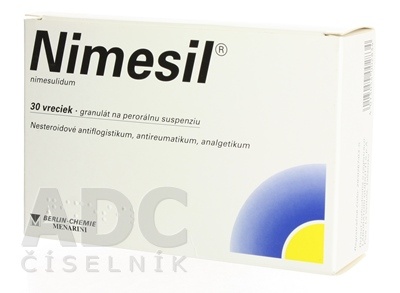
Nimesil
Ask a doctor about a prescription for Nimesil




How to use Nimesil
Package Leaflet: Information for the Patient
Warning! The leaflet should be kept. Information on the immediate packaging in a foreign language.
Nimesil
100 mg, granules for oral suspension preparation
Nimesulidum
Before taking the medicine, carefully read the contents of the leaflet, as it contains important information for the patient.
- The leaflet should be kept so that it can be read again if necessary.
- In case of any doubts, consult a doctor or pharmacist.
- This medicine has been prescribed specifically for one person. Do not pass it on to others. The medicine may harm another person, even if the symptoms of their illness are the same.
- If the patient experiences any side effects, including any side effects not listed in this leaflet, they should inform their doctor, pharmacist, or nurse. See section 4.
Table of Contents of the Leaflet:
- 1. What is Nimesil and what is it used for
- 2. Important information before taking Nimesil
- 3. How to take Nimesil
- 4. Possible side effects
- 5. How to store Nimesil
- 6. Contents of the packaging and other information
1. What is Nimesil and what is it used for
Nimesil is a non-steroidal anti-inflammatory drug (NSAID) with analgesic properties.
Nimesil is indicated for the treatment of acute pain and primary dysmenorrhea.
Before prescribing Nimesil, the doctor will consider whether the benefits of taking the medicine outweigh the risk of side effects.
2. Important information before taking Nimesil
When not to take Nimesil:
- if the patient has been diagnosed with an allergy (hypersensitivity) to nimesulid or any of the other ingredients of this medicine (listed in section 6);
- if the patient has experienced an allergic reaction (e.g., wheezing, nasal discharge or nasal congestion, hives) after taking acetylsalicylic acid or other non-steroidal anti-inflammatory drugs (NSAIDs);
- if the patient has had a liver reaction to nimesulid in the past;
- if the patient is taking other medicines that are known to affect the liver, such as paracetamol, other painkillers, or NSAIDs;
- if the patient is taking addictive medicines or is addicted to medicines or other substances;
- if the patient abuses alcohol;
- if the patient has been diagnosed with liver disease or elevated liver enzyme activity;
- if the patient has been diagnosed with a stomach ulcer (gastric or duodenal ulcer) currently or in the past;
- if the patient has experienced gastrointestinal bleeding;
Page 1 of 6
- if the patient has experienced cerebral bleeding (stroke);
- if the patient has experienced other bleeding disorders or insufficient blood clotting;
- if the patient has heart failure, kidney disease (kidney failure), or any liver disease;
- if the patient currently has a fever or flu (generalized muscle pain, malaise, chills, or fever);
- in patients in the last 3 months of pregnancy;
- in breastfeeding patients.
Nimesil should not be taken in children under 12 years of age.
Warnings and precautions
Nimesil should not be taken or the doctor should be informed before taking Nimesil if the patient has ever experienced a persistent rash (circular or oval patchy redness and skin swelling, blisters, hives, and itching) after taking nimesulid.
If the patient is taking the following medicines that may interfere with the action of Nimesil:
- blood-thinning medicines (anticoagulants, acetylsalicylic acid, or other salicylates);
- diuretics used in heart failure or hypertension;
- lithium, which is used to treat depression and similar disorders;
- methotrexate;
- cyclosporine; the patient should inform their doctor or pharmacist before starting Nimesil.
- If symptoms indicating liver disorders occur during Nimesil treatment, the patient should stop taking the medicine immediately and inform their doctor without delay. Symptoms indicating liver disorders include loss of appetite, nausea, vomiting, abdominal pain, persistent fatigue, or dark urine. If the patient has ever experienced ulcers, gastrointestinal bleeding, ulcerative colitis, or Crohn's disease, they should inform their doctor before starting Nimesil.
- If the patient develops a fever and/or flu-like symptoms (generalized muscle pain, malaise, chills) during Nimesil treatment, they should stop taking the medicine and inform their doctor.
- If the patient has been diagnosed with heart or kidney disease, they should inform their doctor before starting Nimesil. Nimesil may worsen kidney function.
- During treatment of elderly patients, regular check-ups may be necessary to rule out Nimesil's side effects on the stomach, kidneys, heart, or liver.
- If the patient plans to become pregnant, they should inform their doctor, as Nimesil may adversely affect fertility.
Taking medicines like Nimesil may be associated with a small increased risk of heart attack (myocardial infarction) or stroke. This risk increases with long-term use of high doses of the medicine. Do not take higher doses or longer treatment than recommended.
In case of heart disorders, previous stroke, or suspected risk of these disorders (e.g., high blood pressure, diabetes, elevated cholesterol, smoking), the patient should discuss the treatment with their doctor or pharmacist.
Nimesil contains sucrose: this should be taken into account when administering the medicine to patients with diabetes and patients on a low-calorie diet.
Page 2 of 6
If the patient has previously been diagnosed with intolerance to some sugars, they should contact their doctor before taking the medicine. The medicine may harm the teeth.
Nimesil and other medicines
If the patient is taking any of the following medicines that may interfere with the action of Nimesil:
- corticosteroids, e.g., cortisone (anti-inflammatory medicine);
- blood-thinning medicines, e.g., warfarin (anticoagulants, acetylsalicylic acid);
- selective serotonin reuptake inhibitors (antidepressants);
- lithium, used to treat depression and similar disorders;
- methotrexate, a medicine used to treat rheumatoid arthritis and tumors;
- cyclosporine, a medicine used after transplantation or to treat immune system disorders; the patient should inform their doctor or pharmacist before starting Nimesil.
The patient should tell their doctor about all medicines taken recently, including those available without a prescription.
Patients taking Nimesil and treated with other medicines that irritate the gastrointestinal tract should be under closer observation.
Concomitant administration of Nimesil and anticoagulant medicines enhances their effect.
Due to the strong binding of nimesulid to plasma proteins, patients treated with hydantoin and sulfonamides should be under constant control (enhanced effect of hydantoin and sulfonamides due to displacement from protein binding).
Non-steroidal anti-inflammatory drugs may increase the plasma concentration of: digoxin, lithium, methotrexate, and cyclosporine, increasing the toxicity of these medicines. Concomitant administration of nimesulid with other NSAIDs, platelet inhibitors, selective serotonin reuptake inhibitors, or glucocorticoids increases the risk of gastrointestinal side effects.
Concomitant administration of nimesulid with potassium-sparing diuretics may lead to an increase in plasma potassium levels.
Pregnancy, breastfeeding, and fertility
Before taking any medicine, the patient should consult their doctor or pharmacist.
Nimesil should not be taken if the patient is in the last 3 months of pregnancy, as it may harm the unborn child or cause problems during delivery. It may cause kidney and heart disorders in the unborn child. It may increase the risk of bleeding in the patient and child and cause delayed or prolonged delivery. During the first 6 months of pregnancy, Nimesil should not be taken unless the doctor considers it absolutely necessary. If treatment is necessary during this period or when trying to conceive, the lowest possible dose should be used for the shortest possible time.
If taken for more than a few days from the 20th week of pregnancy, Nimesil may cause narrowing of the blood vessel (ductus arteriosus) in the baby's heart or kidney function disorders in the unborn child, which may lead to a decrease in the amount of amniotic fluid surrounding the baby (oligohydramnios). If treatment is necessary for a longer period, the doctor may recommend additional monitoring.
Since it is not known whether nimesulid passes into breast milk, its use during breastfeeding is contraindicated.
Driving and operating machinery
Like other non-steroidal anti-inflammatory drugs, Nimesil may cause drowsiness and dizziness. If these occur, the patient should refrain from activities that require mental and physical fitness.
Page 3 of 6
Patients whose professional activity requires constant concentration should immediately inform their doctor if they experience drowsiness or dizziness during treatment.
Nimesil contains sucrose
If the patient has previously been diagnosed with intolerance to some sugars, they should contact their doctor before taking the medicine.
3. How to take Nimesil
This medicine should always be taken as directed by the doctor. In case of doubts, the patient should consult their doctor or pharmacist.
The recommended dose of Nimesil is 100 mg twice a day (2 times 1 sachet) after meals. The contents of the sachet should be dissolved in an appropriate amount of water (e.g., 1 glass).
Nimesil should be taken for the shortest possible period and not longer than 15 days in one treatment cycle.
Taking the medicine for the shortest possible period necessary to alleviate symptoms reduces the risk of side effects.
Elderly patients: there is no need to reduce the daily dose.
Use in children and adolescents
Children over 12 years of age: there is no need to modify the dosage.
Taking a higher dose of Nimesil than recommended
In case of suspected overdose, the patient should immediately contact their doctor. Symptomatic treatment is recommended. Gastric lavage and administration of activated charcoal may be considered if it has not been more than 4 hours since the overdose. Monitoring of liver and kidney function is required.
Missing a dose of Nimesil
The patient should not take a double dose to make up for a missed dose.
4. Possible side effects
Like all medicines, Nimesil can cause side effects, although not everybody gets them.
Mild and transient side effects related to the gastrointestinal system, such as heartburn, nausea, vomiting, diarrhea, bloating, have been observed. Less frequently, gastrointestinal bleeding, ulcers, and perforation of the duodenum or stomach, as well as gastritis and enteritis, have occurred. Very rarely, the following have occurred: dyspepsia, abdominal pain, stomatitis. These symptoms usually did not require discontinuation of the medicine.
Skin allergic reactions, such as rash, itching, urticaria, skin inflammation, and angioedema, have been reported.
Persistent rash (may appear as circular or oval patchy redness and skin swelling), blisters (urticaria), itching have been reported with unknown frequency.
Central nervous system side effects, such as headache, dizziness, and drowsiness, have been observed very rarely.
Other very rare side effects include oliguria with or without fluid retention and local or generalized edema; hematemesis (probably related to gastrointestinal bleeding and ulcers); petechiae and purpura, especially on the lower limbs, exceptionally associated with thrombocytopenia.
Very rarely, liver damage, mostly transient after discontinuation of therapy, may occur.
Non-steroidal anti-inflammatory drugs have been reported to cause edema, hypertension, and heart failure.
Page 4 of 6
Taking medicines like Nimesil may be associated with a small increased risk of heart attack (myocardial infarction) or stroke.
Like other non-steroidal anti-inflammatory drugs, nimesulid may very rarely cause severe hypersensitivity reactions (such as Stevens-Johnson syndrome, Lyell's syndrome).
If any of the side effects worsen or any side effects not listed in this leaflet occur, the patient should inform their doctor or pharmacist.
Reporting side effects
If any side effects occur, including any side effects not listed in the leaflet, the patient should inform their doctor, pharmacist, or nurse. Side effects can be reported directly to the Department of Adverse Reaction Monitoring of Medicinal Products, Medical Devices, and Biocidal Products
Al. Jerozolimskie 181C, 02-222 Warsaw
tel.: +48 22 49-21-301
fax: +48 22 49-21-309
Website: https://smz.ezdrowie.gov.pl
Reporting side effects will help gather more information on the safety of the medicine.
5. How to store Nimesil
The medicine should be stored out of sight and reach of children.
The medicine should not be taken after the expiry date stated on the packaging. The expiry date refers to the last day of the month stated.
There are no special precautions for storage.
Medicines should not be disposed of via wastewater or household waste. The patient should ask their pharmacist how to dispose of medicines that are no longer used. This will help protect the environment.
6. Contents of the packaging and other information
What Nimesil contains
- The active substance of Nimesil is nimesulid. 1 sachet (2 g granules) contains 100 mg nimesulid.
- The other ingredients are: sucrose, orange flavor and aroma, citric acid, maltodextrin, cetostearyl ether of macrogol.
What Nimesil looks like and what the packaging contains
Nimesil is a granule for oral suspension preparation packaged in sachets and a cardboard box.
The packaging contains 9, 15, or 30 sachets
1 sachet contains 100 mg nimesulid.
For more detailed information, the patient should contact the marketing authorization holder or parallel importer.
Marketing authorization holder in the Czech Republic, the country of export:
Laboratori Guidotti S.p.A
Via Livornese, 897, 56122 Pisa – La Vettola, Italy
Manufacturer:
Laboratorios Menarini S.A.
Alfons XII, 587, 08918 Badalona, Spain
Page 5 of 6
Fine Foods & Pharmaceuticals N.T.M. S.p.A.
Via Berlino, 39, Zingonia-Verdellino (Bergamo), Italy
Parallel importer:
Delfarma Sp. z o.o.
ul. Św. Teresy od Dzieciątka Jezus 111, 91-222 Łódź
Repackaged by:
Delfarma Sp. z o.o.
ul. Św. Teresy od Dzieciątka Jezus 111, 91-222 Łódź
Marketing authorization number in the Czech Republic, the country of export: 29/118/02-C
Parallel import authorization number: 258/18 Date of leaflet approval: 25.05.2023
[Information about the trademark]
Page 6 of 6
- Country of registration
- Active substance
- Prescription requiredYes
- Marketing authorisation holder (MAH)Laboratoria Guidotti S.p.A.
- This information is for reference only and does not constitute medical advice. Always consult a licensed doctor before taking any medication. Oladoctor is not responsible for medical decisions based on this content.
- Alternatives to NimesilDosage form: Tablets, 100 mgActive substance: nimesulideDosage form: Granulate, 100 mgActive substance: nimesulideDosage form: Tablets, 100 mgActive substance: nimesulideManufacturer: Bluepharma Indústria Farmacêutica, S.APrescription required
Alternatives to Nimesil in other countries
The best alternatives with the same active ingredient and therapeutic effect.
Alternative to Nimesil in Ucrania
Alternative to Nimesil in España
Online doctors for Nimesil
Discuss dosage, side effects, interactions, contraindications, and prescription renewal for Nimesil – subject to medical assessment and local rules.

Get updates and exclusive offers
Be the first to know about new services, marketplace updates, and subscriber-only promos.

