



METIZOL 5 mg Tablets

Prescription review online
A doctor will review your case and decide whether a prescription is medically appropriate.

Talk to a doctor about this medicine
Discuss your symptoms and possible next steps in a quick online consultation.



How to use Metizol
Contents of the leaflet
- Package Leaflet: Information for the Patient
- What is Metizol and what is it used for
- Important information before taking Metizol
- How to take Metizol
- Possible side effects
- How to store Metizol
- Package contents and other information
Package Leaflet: Information for the Patient
Metizol, 5 mg, tablets
Thiamazolum
Read the leaflet carefully before taking the medicine, as it contains important information for the patient.
- Keep this leaflet, you may need to read it again.
- In case of any doubts, consult a doctor or pharmacist.
- This medicine has been prescribed specifically for you. Do not pass it on to others. The medicine may harm another person, even if their symptoms are the same.
- If the patient experiences any side effects, including any side effects not listed in this leaflet, they should inform their doctor or pharmacist. See section 4.
Table of Contents of the Leaflet:
- 1. What is Metizol and what is it used for
- 2. Important information before taking Metizol
- 3. How to take Metizol
- 4. Possible side effects
- 5. How to store Metizol
- 6. Package contents and other information
1. What is Metizol and what is it used for
Metizol is a medicine that inhibits the production of thyroid hormones. However, it does not affect the amount of hormones already produced or their release, so the effects of its action appear only after a few days of use.
Thanks to its properties, Metizol is used in hyperthyroidism (regardless of its type), in thyroid crisis, in preparation for thyroidectomy, and as a supportive agent in the treatment of radioactive iodine.

Not sure if this medicine is right for you?
Discuss your symptoms and treatment with a doctor online.
2. Important information before taking Metizol
When not to take Metizol
- if the patient is allergic to thiamazole, substances with a similar structure to thiamazole (thionamide derivatives) or any of the other ingredients of this medicine (listed in section 6);
- if the patient has been diagnosed with a decrease in the number of certain blood cells (granulocytopenia);
- if, before starting treatment with Metizol, the patient has been diagnosed with bile stasis;
- if, in the past, the patient has experienced bone marrow damage after treatment with thiamazole or carbimazole;
- if, in the past, the patient has experienced pancreatitis (acute pancreatitis) after administration of thiamazole or carbimazole.
Thiamazole should not be used simultaneously with thyroid hormones in pregnant women.
Warnings and precautions
Before starting to take Metizol, discuss it with your doctor.
If, in the past, there have been mild allergic reactions to thiamazole, such as allergic rashes or skin itching, inform your doctor – the doctor will decide whether the patient can take Metizol.
In the case of a large thyroid goiter that makes breathing difficult, discuss it with your doctor, as the goiter may enlarge during treatment with Metizol. The doctor may decide to use the medicine for a shorter period and regularly monitor the patient during treatment.
Before starting treatment, the doctor will order blood morphology tests.
Immediately consult a doctor if symptoms such as oral mucosa inflammation, sore throat, fever occur. These symptoms may indicate a serious side effect of the medicine - agranulocytosis (a significant decrease in the number of certain types of white blood cells responsible for immune responses in the body). They usually occur within the first few weeks of treatment, but may also appear after several months of therapy or during the restart of treatment. If such symptoms occur, the doctor will order a blood morphology test and may decide to discontinue the use of Metizol.
Immediately consult a doctor if the patient experiences fever or abdominal pain, as these may be symptoms of pancreatitis (acute pancreatitis). It may be necessary to discontinue the use of Metizol.
In the case of the need to use very high doses of Metizol (about 120 mg per day), the doctor will order control blood tests, as bone marrow damage is possible. If the medicine has a toxic effect on the bone marrow, the doctor may decide to interrupt the treatment and, if necessary, prescribe another medicine.
If, during treatment with Metizol, the goiter enlarges or the thyroid function is excessively weakened, the doctor may modify the dose of Metizol, and if necessary, also order the additional use of thyroid hormones.
Metizol may harm the unborn child. If the patient may become pregnant, she should use a reliable method of contraception from the start of treatment and during therapy.
During treatment, there may also be an occurrence or exacerbation of a eye disease called endocrine orbitopathy, which is not related to treatment with Metizol.
During treatment with Metizol, it is possible to increase body weight. This is a normal reaction of the body. Metizol affects thyroid hormones, which control energy consumption in the body.
Children and adolescents
The safety and efficacy of Metizol in children under 2 years of age have not been studied.
Metizol can be used in children and adolescents from 3 to 17 years of age (see section 3). For additional information, consult a doctor.
Metizol and other medicines
Inform your doctor or pharmacist about all medicines you are currently taking or have recently taken, as well as medicines you plan to take, including those available without a prescription.
The action of thiamazole is reduced by:
- iodine;
- medicines containing iodine (e.g., amiodarone - a medicine used to treat heart rhythm disorders);
- radiological contrast agents.
Thiamazole reduces the uptake of radioactive iodine by the thyroid gland.
In the case of the use of anticoagulant medicines (preventing blood clotting), inform your doctor, as the normalization of thyroid function under the influence of Metizol may affect the action of these medicines.
This may also apply to other medicines. With the return of thyroid hormone levels in the blood to normal values under the influence of Metizol treatment, the concentration in the blood of some medicines used at the same time may change. In connection with this, it may be necessary to change the dosage of the medicines used at the same time.
Metizol with food and drink
Metizol can be taken regardless of meals.
Pregnancy, breastfeeding, and fertility
Metizol may harm the unborn child.
If the patient may become pregnant, she should use a reliable method of contraception from the start of treatment and during therapy.
If the patient is pregnant, suspects she may be pregnant, or plans to have a child, she should immediately consult a doctor.
It may be necessary to continue treatment with Metizol during pregnancy if the potential benefits outweigh the risks to the mother and fetus.
During pregnancy, do not use Metizol and thyroid hormones at the same time.
During breastfeeding, Metizol can be used only in small doses, up to 10 mg per day. However, thyroid hormones should not be taken at the same time. The child of a patient treated with Metizol who is breastfeeding should be regularly examined by a doctor who will monitor the child's thyroid function.
Patients taking large doses of Metizol should not breastfeed.
Driving and using machines
Metizol has a minor effect on the ability to drive vehicles and operate machines. This medicine may cause dizziness (see section 4). Patients who experience this side effect should not drive motor vehicles or operate machines until it has completely resolved.
Metizol contains lactose monohydrate
If the patient has previously been diagnosed with intolerance to some sugars, they should consult a doctor before taking the medicine.
3. How to take Metizol
This medicine should always be taken according to the doctor's recommendations. In case of doubts, consult a doctor or pharmacist.
Recommended dose
The doctor determines the dosage individually for each patient, depending on the severity of hyperthyroidism and the size of the goiter.
The initial daily dose is usually 40 mg to 60 mg (8 to 12 tablets) and is given in 3 or 4 divided doses. This dosage is maintained until the thyroid function is inhibited (usually 2-3 weeks, although sometimes it is necessary to maintain such a dosage for 8 weeks or even longer). Then, the doses of the medicine should be gradually reduced to a maintenance dose of usually 5 mg to 20 mg (1 to 4 tablets) per day. This dose is given in a single daily dose or in 2 divided doses.
In the treatment of thyroid crisis, the medicine is initially given in a dose of 100 mg (20 tablets), and then every 8 hours in a dose of 30 mg (6 tablets).
Treatment of hyperthyroidism with Metizol usually lasts from 6 months to 2 years.
In preparation for thyroidectomy, the medicine is usually used for 3-4 weeks before the procedure.
Elderly patients:
There is no need to change the dosage.
Use in children and adolescents (from 3 to 17 years of age)
In children and adolescents over 3 years of age, the dose is adjusted according to the patient's body weight.
Usually, at the beginning of treatment, 0.5 mg/kg of body weight is used, divided into 2 or 3 equal doses.
Later, the doctor may recommend reducing the dose. Do not exceed the total daily dose of 40 mg.
It is not recommended to use in children under 2 years of age.
Patients with renal impairment:
There is no need to change the dosage.
Patients with hepatic impairment:
In case of liver dysfunction or liver disease, inform your doctor.
In such cases, it may be necessary to reduce the dose of Metizol.
Metizol should be taken regularly.
Using a higher dose of Metizol than recommended
In case of using a higher dose of Metizol than recommended, consult a doctor, who will implement appropriate procedures, including inducing vomiting, gastric lavage, and administration of activated charcoal, as well as symptomatic treatment.
In case of overdose, the following may occur: nausea, vomiting, muscle pain, constipation, headache, menstrual disorders in women, decreased body temperature, enlargement or appearance of goiter (swelling in the front of the neck), excessive drowsiness or lethargy, and fatigue, weight gain, excessive dryness of the skin, and insomnia.
Missing a dose of Metizol
In case of missing a dose of Metizol at the scheduled time, take it as soon as possible. However, if the time for the next dose is approaching, skip the missed dose.
Do not take a double dose to make up for the missed dose.
Stopping the use of Metizol
In case of premature discontinuation of treatment with Metizol, hyperthyroidism may worsen.
In case of doubts related to the use of the medicine, consult a doctor or pharmacist.

Started taking the medicine and have questions?
Discuss your symptoms and treatment with a doctor online.
4. Possible side effects
Like all medicines, Metizol can cause side effects, although not everybody gets them.
Side effects may occur:
Very common (may occur more often than 1 in 10 people)
Common (may occur in no more than 1 in 10 people)
Uncommon (may occur less often than 1 in 100)
Rare (may occur in no more than 1 in 1000 people)
Very rare (may occur in no more than 1 in 10,000 people)
Frequency not known (frequency cannot be estimated from the available data)
If one of the following side effects occurs, stop taking the medicine and immediately consult a doctor:
- Symptoms such as oral mucosa inflammation, sore throat, fever, which may indicate an uncommon side effect - agranulocytosis (a significant decrease in the number of certain types of white blood cells). These symptoms may occur within the first few weeks of treatment or after several weeks or months of treatment.
In addition, the following side effects may occur:
Very common side effects:
- Allergic skin reactions of varying severity (itching, rash, urticaria) - usually have a mild course and resolve during continued use of the medicine.
Common side effects:
- Joint pain, which may occur even after several months of therapy with Metizol.
Rare side effects:
- Taste disorders (altered taste, loss of taste) - these symptoms may resolve after the end of treatment, although it may take several weeks;
- Fever.
Very rare side effects:
- Thrombocytopenia (decrease in platelet count; may manifest as excessive bleeding, e.g., after procedures, nosebleeds; frequent appearance of bruises; presence of blood in stool or urine; pinpoint bleeding on the skin);
- Pancytopenia (decrease in the number of all blood cells);
- Generalized lymphadenopathy (enlargement of lymph nodes), decreased glucose levels in the blood (caused by disorders of glucose regulation in the blood);
- Nerve inflammation, polyneuropathy (nerve damage, may manifest as numbness and tingling in the hands, feet, and face);
- Salivary gland swelling;
- Cholestatic jaundice (manifesting as yellowing of the skin, mucous membranes, and eye whites) and toxic hepatitis - these symptoms usually resolve after the end of treatment with the medicine;
- Severe forms of allergic skin reactions, including generalized skin inflammation;
- Hair loss;
- Drug-induced lupus erythematosus (an immune-related disease; may manifest as fatigue, loss of appetite, characteristic butterfly-shaped rash on the face) .
Frequency not known:
- Dizziness;
- Pancreatitis (acute pancreatitis).
Children and adolescents
The type, frequency, and severity of side effects in children are similar to those observed in adults.
Reporting side effects
If any side effects occur, including any side effects not listed in this leaflet, inform your doctor. Side effects can be reported directly to the Department of Monitoring of Adverse Reactions to Medicinal Products, Office for Registration of Medicinal Products, Medical Devices, and Biocidal Products, Al. Jerozolimskie 181C, 02-222 Warsaw, Tel.: +48 22 49 21 301, Fax: +48 22 49 21 309, website: https://smz.ezdrowie.gov.pl.
Side effects can also be reported to the marketing authorization holder.
Reporting side effects will help to gather more information on the safety of the medicine.
5. How to store Metizol
Store in the original package.
Keep the medicine out of sight and reach of children.
Do not use this medicine after the expiry date stated on the carton.
Medicines should not be disposed of via wastewater or household waste. Ask your pharmacist how to dispose of medicines that are no longer needed. This will help protect the environment.
6. Package contents and other information
What Metizol contains
- The active substance of the medicine is thiamazole.
- The other ingredients of the medicine are: lactose monohydrate, potato starch, povidone, talc, magnesium stearate.
What Metizol looks like and what the package contains
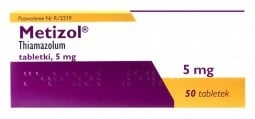
Metizol is a white, round, flat tablet with the inscription "M" on one side and smooth on the other.
The package contains 50 tablets (2 blisters of 25 tablets each).
Marketing authorization holder
Bausch Health Ireland Limited
3013 Lake Drive
Citywest Business Campus
Dublin 24, D24PPT3
Ireland
Manufacturer:
ICN Polfa Rzeszów S.A.
ul. Przemysłowa 2
35-959 Rzeszów, Poland
Date of last revision of the leaflet:
- Country of registration
- Dosage formTablets, 5 mg
- ATC codeH03BB02
- Active substance
- Prescription requiredYes
- Manufacturer
- ImporterICN Polfa Rzeszów S.A.
- This information is for reference only and does not constitute medical advice. Always consult a doctor before taking any medication. Oladoctor is not responsible for medical decisions based on this content.
- Alternatives to MetizolDosage form: Tablets, 5 mgActive substance: thiamazolePrescription requiredDosage form: Tablets, 5 mgActive substance: thiamazolePrescription requiredDosage form: Tablets, 5 mgActive substance: thiamazolePrescription required
Online doctors for Metizol
Discuss questions about Metizol, including use, safety considerations and prescription review, subject to medical assessment and local regulations.


Get Metizol Prescription Online
Fill in a 2-min form
Tell us your symptoms, history, and what medicine you're requesting.
Pick a doctor or let us assign
Choose a specialist or we'll match you with the next available doctor.
Doctor reviews your case
Usually within 30 minutes. They may ask follow-up questions via chat.
Collect from any pharmacy
Electronic prescription sent to your email — valid across Spain.
Frequently Asked Questions
Metizol requires a prescription in Poland. You can check with a doctor online whether this medicine may be appropriate for your situation.
The active ingredient in Metizol is thiamazole. This information helps identify medicines with the same composition but different brand names.
Metizol is manufactured by ICN Polfa Rzeszów S.A.. Pharmacy brands and packaging may differ depending on the distributor.
Doctors such as Family doctors, Psychiatrists, Dermatologists, Cardiologists, Endocrinologists, Gastroenterologists, Pulmonologists, Nephrologists, Rheumatologists, Hematologists, Infectious disease physicians, Allergists, Geriatricians, Paediatricians, Oncologists may assess whether Metizol is appropriate, depending on your situation and local regulations. You can book an online consultation to discuss your symptoms and possible next steps.
Spain has a well-developed healthcare infrastructure across major cities such as Madrid, Barcelona, Valencia, and Seville. Pharmacies are widely available and operate under strict regulations, ensuring access to prescribed medications.
You can buy Metizol in Madrid, Barcelona, Seville, or Valencia at any local pharmacy with a valid prescription.
To obtain a prescription, you can use Oladoctor:
Other medicines with the same active substance (thiamazole) include Metizol, Metizol, Metizol. These may have different brand names or formulations but contain the same therapeutic ingredient. Always consult a doctor before switching or starting a new medicine.
