


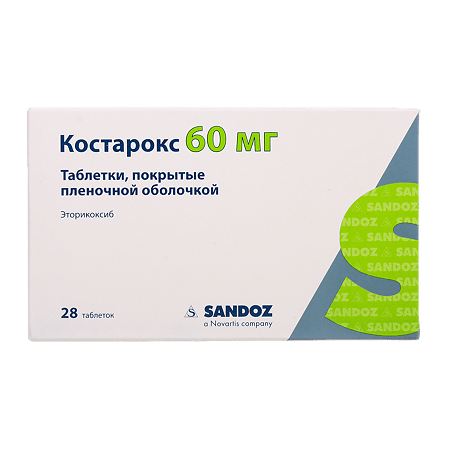
Kostarox
Ask a doctor about a prescription for Kostarox




How to use Kostarox
Package Leaflet: Information for the Patient
Kostarox, 90 mg, Film-Coated Tablets
Etoricoxib
Read all of this leaflet carefully before taking this medicine because it contains important information for you.
- Keep this leaflet. You may need to read it again.
- If you have any further questions, ask your doctor or pharmacist.
- This medicine has been prescribed for you only. Do not pass it on to others. It may harm them, even if their signs of illness are the same as yours.
- If you get any side effects, talk to your doctor or pharmacist. This includes any possible side effects not listed in this leaflet. See section 4.
Contents of the Pack
- 1. What Kostarox is and what it is used for
- 2. Important information before taking Kostarox
- 3. How to take Kostarox
- 4. Possible side effects
- 5. How to store Kostarox
- 6. Contents of the pack and other information
1. What Kostarox is and what it is used for
What is Kostarox?
- Kostarox contains the active substance etoricoxib. Kostarox is a medicine belonging to a group of medicines called selective cyclooxygenase-2 (COX-2) inhibitors. These medicines are a type of non-steroidal anti-inflammatory drug (NSAID).
What is Kostarox used for?
- Kostarox helps to relieve pain and reduce inflammation (swelling) in joints and muscles in people 16 years of age and older with osteoarthritis, rheumatoid arthritis, ankylosing spondylitis, and gout.
- Kostarox is also used for short-term treatment of moderate pain after dental surgery in people 16 years of age and older.
What is osteoarthritis?
Osteoarthritis is a disease of the joints. It happens when the cartilage covering the joints breaks down over time, leading to inflammation, pain, tenderness, stiffness, and limited mobility.
What is rheumatoid arthritis?
Rheumatoid arthritis is a long-term inflammatory disease of the joints. It causes pain, stiffness, swelling, and limited mobility of the affected joints. It can also cause inflammation in other parts of the body.
What is ankylosing spondylitis?
Ankylosing spondylitis is an inflammatory disease of the spine and large joints.
What is gout?
Gout is a disease that causes sudden, recurring attacks of very painful inflammation and redness in the joints. It is caused by deposits of crystals in the joint.
2. Important information before taking Kostarox
When not to take Kostarox
- if you are allergic to etoricoxib or any of the other ingredients of this medicine (listed in section 6);
- if you have had an allergic reaction to a group of medicines called non-steroidal anti-inflammatory drugs (NSAIDs), including aspirin, or to COX-2 inhibitors (see section 4 "Possible side effects");
- if you have or have had recurrent stomach ulcers or bleeding, or if you have bleeding in your brain;
- if you have severe liver disease;
- if you have severe kidney disease;
- if you are pregnant, think you may be pregnant, or are planning to become pregnant (see "Pregnancy, breast-feeding, and fertility");
- if you are under 16 years of age;
- if you have inflammatory bowel disease, such as Crohn's disease or ulcerative colitis;
- if you have high blood pressure that is not controlled by medication (if you are unsure, consult your doctor);
- if you have heart failure, have had a heart attack, or have had bypass surgery (coronary artery bypass graft, CABG);
- if you have peripheral arterial disease (poor circulation in your legs);
- if you have had any kind of stroke (including mini-stroke or transient ischaemic attack, TIA). Etoricoxib may slightly increase the risk of heart attack and stroke, so it should not be used in people who have already had heart or stroke problems.
If you are unsure about any of the above points, do not take this medicine until you have consulted your doctor.
Warnings and precautions
Before taking Kostarox, tell your doctor or pharmacist if:
- you have had stomach ulcers or bleeding, or have bleeding in your brain;
- you are dehydrated, for example, due to prolonged vomiting or diarrhea;
- you have swelling due to fluid retention;
- you have had heart failure or other heart problems;
- you have high blood pressure. Kostarox may increase blood pressure in some people, especially when taken in high doses, so your doctor will check your blood pressure from time to time.
- you have liver or kidney disease;
- you are currently being treated for an infection. Kostarox may mask fever, which is a sign of infection;
- you have diabetes, high cholesterol, or smoke. These conditions increase the risk of heart disease;
- you are planning to become pregnant;
- you are elderly (over 65 years of age).
If you are unsure about any of the above points, consult your doctor before taking Kostarox. The effect of Kostarox is similar in elderly and younger adult patients. In elderly patients, your doctor will monitor you closely.
Children and adolescents
Do not give this medicine to children and adolescents under 16 years of age.
Kostarox and other medicines
Tell your doctor or pharmacist if you are taking, have recently taken, or might take any other medicines, including those obtained without a prescription.
- blood thinners (anticoagulants), such as warfarin;
- rifampicin (an antibiotic);
- methotrexate (a medicine used to suppress the immune system and often used to treat rheumatoid arthritis);
- cyclosporin or tacrolimus (medicines used to suppress the immune system, e.g., after organ transplantation);
- lithium (a medicine used to treat certain types of depression);
- medicines used to treat high blood pressure and heart failure, called ACE inhibitors and angiotensin receptor blockers (e.g., enalapril and ramipril, and losartan and valsartan);
- diuretics;
- digoxin (a medicine used to treat heart failure and irregular heartbeat);
- minoxidil (a medicine used to treat high blood pressure);
- salbutamol tablets or oral solution (a medicine used to treat asthma);
- oral contraceptives (the combination with Kostarox may increase the risk of side effects);
- hormone replacement therapy (the combination with Kostarox may increase the risk of side effects);
- aspirin (the risk of stomach ulcers is higher when Kostarox is taken with aspirin);
- aspirin used to prevent heart attack or stroke: Kostarox can be taken with a low dose of aspirin.
Pregnancy, breast-feeding, and fertility
Pregnancy
Kostarox should not be used during pregnancy. If you are pregnant or think you may be pregnant, or are planning to have a baby, do not take this medicine. If you become pregnant while taking Kostarox, stop taking the medicine and consult your doctor. If you have any further questions, ask your doctor.
Breast-feeding
It is not known whether etoricoxib passes into breast milk. If you are breast-feeding or planning to breast-feed, consult your doctor before taking Kostarox. Do not breast-feed while taking this medicine.
Fertility
Kostarox may affect fertility in women. It is not recommended in women who are trying to become pregnant.
Driving and using machines
Some patients taking Kostarox have reported dizziness and somnolence (sleepiness). If you experience these symptoms, do not drive or operate tools or machines.
Kostarox contains lactose and sodium
If you have been told by your doctor that you have an intolerance to some sugars, contact your doctor before taking this medicine.
This medicine contains less than 1 mmol sodium (23 mg) per film-coated tablet, that is to say essentially 'sodium-free'.
3. How to take Kostarox
Always take this medicine exactly as your doctor or pharmacist has told you. Check with your doctor or pharmacist if you are not sure.
Do not take more than the recommended dose. Your doctor will want to check your progress from time to time. It is important to take the lowest dose that controls your pain and inflammation. Do not take Kostarox for longer than necessary, as this increases the risk of heart attack and stroke.
Osteoarthritis
The recommended dose is 30 mg once daily. If necessary, your doctor may increase the dose to a maximum of 60 mg once daily.
Rheumatoid arthritis
The recommended dose is 60 mg once daily. If necessary, your doctor may increase the dose to a maximum of 90 mg once daily.
Ankylosing spondylitis
The recommended dose is 60 mg once daily. If necessary, your doctor may increase the dose to a maximum of 90 mg once daily.
Acute pain conditions
Kostarox should only be used for the acute painful period.
- GoutThe recommended dose is 120 mg once daily. This dose should only be taken for the acute painful period, limited to a maximum of 8 days.
- Pain after dental surgeryThe recommended dose is 90 mg once daily, limited to a maximum of 3 days.
Elderly patients
No dose adjustment is necessary for elderly patients. As with other medicines, caution should be exercised in elderly patients.
Patients with liver problems
- Patients with mild liver disease should not take more than 60 mg per day.
- Patients with moderateliver disease should not take more than 30 mg per day.
Method of administration
Kostarox is for oral use. Take the tablets once daily. They can be taken with or without food, but onset of effect may be faster when taken without food.
Overdose
Never take more tablets than your doctor has recommended. If you have taken more tablets than you should, contact a doctor or hospital for advice.
Missed dose
It is important to take Kostarox as instructed by your doctor. If you miss a dose, take the next tablet on the following day as scheduled. Do not take a double dose to make up for a forgotten dose. If you have any further questions on the use of this product, ask your doctor or pharmacist.
4. Possible side effects
Like all medicines, this medicine can cause side effects, although not everybody gets them.
If you experience any of the following, stop taking Kostarox and tell your doctor immediately:
- shortness of breath, chest pain, or swelling of your legs or feet
- yellowing of the skin and eyes (jaundice) - these may be signs of liver problems
- severe stomach pain or bleeding, or black tarry stools
- allergic reactions, including skin rashes, itching, or difficulty breathing
The following side effects have been reported with the use of Kostarox:
Very common(may affect more than 1 in 10 people)
- stomach pain
Common(may affect up to 1 in 10 people)
- dry socket (inflammation and pain after tooth extraction)
- swelling of your legs or feet due to fluid retention
- dizziness, headache
- palpitations, irregular heartbeat
- high blood pressure
- wheezing, shortness of breath (bronchospasm)
- constipation, gas, stomach inflammation, heartburn, diarrhea, indigestion, discomfort in the stomach, nausea, vomiting, inflammation of the esophagus, mouth ulcers
- changes in liver function tests
- bruising
- weakness or fatigue, flu-like symptoms
Uncommon(may affect up to 1 in 100 people)
- inflammation of the digestive tract, including stomach and small intestine, and "stomach flu"
- upper respiratory tract infections
- urinary tract infections
- low red blood cell count, which can cause pale skin, weakness, or shortness of breath
- low white blood cell count
- low platelet count, which can increase the risk of bleeding or bruising
- allergic reactions (including hives, which may be severe and require immediate medical attention)
- increased or decreased appetite, weight gain
- anxiety, depression, confusion, loss of mental acuity, seeing, hearing, or feeling things that are not there (hallucinations)
- changes in taste, difficulty sleeping, numbness or tingling, drowsiness
- blurred vision, eye irritation, or redness
- ringing in the ears, feeling of spinning
- abnormal heart rhythm (atrial fibrillation), rapid heartbeat, heart failure, feeling of tightness, pressure, or heaviness in the chest (angina), heart attack
- redness of the skin, stroke, "mini-stroke" (transient ischaemic attack, TIA), significant increase in blood pressure, inflammation of blood vessels, often with skin rash
- cough, shortness of breath, nosebleeds
- bloating, changes in bowel movements, dry mouth, stomach ulcers, stomach inflammation, which can be severe and lead to bleeding, irritable bowel syndrome, pancreatitis
- facial swelling, skin rash, or itching
- muscle spasms or stiffness
- high levels of potassium in the blood, which can cause abnormal heart rhythms, changes in blood or urine tests related to kidney function, severe kidney problems
- chest pain
Rare(may affect up to 1 in 1,000 people)
- severe allergic reactions, including swelling of the face, lips, tongue, or throat, which may cause difficulty breathing or swallowing (angioedema), anaphylactic or anaphylactoid reactions, including shock (severe allergic reactions that require immediate medical attention)
- confusion, restlessness, especially in the elderly
- liver inflammation, liver failure, yellowing of the skin and eyes (jaundice);
- low sodium levels in the blood, which can cause tiredness, confusion, muscle twitching, convulsions, and coma
- severe skin reactions.
Reporting of side effects
If you get any side effects, talk to your doctor, pharmacist, or nurse. This includes any possible side effects not listed in this leaflet. You can also report side effects directly via the national reporting system listed in the "Further information" section.
5. How to store Kostarox
Keep this medicine out of the sight and reach of children.
Do not use this medicine after the expiry date which is stated on the carton after EXP. The expiry date refers to the last day of that month.
There are no special storage conditions for this medicine.
Medicines should not be disposed of via wastewater or household waste. Ask your pharmacist how to dispose of medicines no longer required. These measures will help protect the environment.
6. Contents of the pack and other information
What Kostarox contains
- The active substance is etoricoxib. Each film-coated tablet contains 90 mg of etoricoxib.
- The other ingredients are: Core:calcium phosphate anhydrous, microcrystalline cellulose, povidone K29-32, magnesium stearate, sodium croscarmellose. Coating:hypromellose, lactose monohydrate, titanium dioxide (E171), triacetin.
What Kostarox looks like and contents of the pack
Kostarox film-coated tablets are white, round, and biconvex.
The tablets are packaged in blisters or in a container with a desiccant (silica gel). The desiccant should not be swallowed.
Pack sizes: 10, 14, 15, 20, 28, 30, 49, 50, 56, 60, 84, 90, 98, 100 film-coated tablets.
Not all pack sizes may be marketed.
Marketing Authorisation Holder and Manufacturer
Marketing Authorisation Holder
Sandoz GmbH
Biochemiestrasse 10
6250 Kundl, Austria
Manufacturer/Importer
Salutas Pharma GmbH
Otto-von-Guericke-Allee 1
39179 Barleben, Germany
Delorbis Pharmaceuticals Ltd
17 Athinon Street, Ergates Industrial Area,
2643 Ergates, Lefkosia, Cyprus
For further information on this medicine, contact:
Sandoz Polska Sp. z o.o.
ul. Domaniewska 50 C
02-672 Warszawa
tel. 22 209 70 00
Date of last revision of the leaflet: 06/2023
Sandoz logo
- Country of registration
- Active substance
- Prescription requiredYes
- Manufacturer
- ImporterDelorbis Pharmaceuticals Ltd. Salutas Pharma GmbH
- This information is for reference only and does not constitute medical advice. Always consult a licensed doctor before taking any medication. Oladoctor is not responsible for medical decisions based on this content.
- Alternatives to KostaroxDosage form: Tablets, 60 mgActive substance: etoricoxibManufacturer: Merck Sharp & Dohme B.V. Organon Heist bv Vianex S.A.Prescription requiredDosage form: Tablets, 90 mgActive substance: etoricoxibManufacturer: Merck Sharp & Dohme B.V. Organon Heist bv Vianex S.A.Prescription requiredDosage form: Tablets, 120 mgActive substance: etoricoxibManufacturer: Merck Sharp & Dohme B.V. Organon Heist bv Vianex S.A.Prescription required
Alternatives to Kostarox in other countries
The best alternatives with the same active ingredient and therapeutic effect.
Alternative to Kostarox in Spain
Alternative to Kostarox in Ukraine
Online doctors for Kostarox
Discuss dosage, side effects, interactions, contraindications, and prescription renewal for Kostarox – subject to medical assessment and local rules.

Get updates and exclusive offers
Be the first to know about new services, marketplace updates, and subscriber-only promos.

