



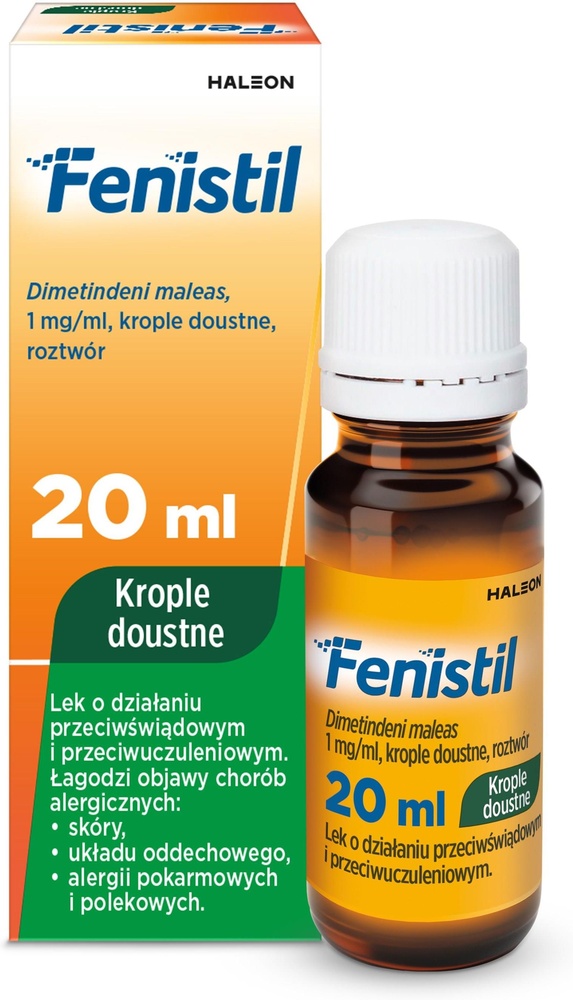
FENISTIL 1 mg /Ml Drops

Prescription review online
A doctor will review your case and decide whether a prescription is medically appropriate.

Talk to a doctor about this medicine
Discuss your symptoms and possible next steps in a quick online consultation.



How to use Fenistil
Contents of the leaflet
- Leaflet attached to the packaging: patient information
- Fenistil, 1 mg/ml, oral drops, solution
- What is Fenistil and what is it used for
- Important information before taking Fenistil
- How to take Fenistil
- Adults and children over 6 years of age:
- Age Maximum daily dose
- Infants from 1 month to 1 year of age and children under 6 years of age:
- The use of Fenistil in infants from 1 month to 1 year of age and in children under 6 years of age should be done on the advice of a doctor.
- Elderly patients
- Overdose of Fenistil
- Missed dose of Fenistil
- Possible side effects
- How to store Fenistil
- Contents of the packaging and other information
Leaflet attached to the packaging: patient information
Fenistil, 1 mg/ml, oral drops, solution
Dimetindene maleate
Read the leaflet carefully before taking the medicine, as it contains important information for the patient.
This medicine should always be taken exactly as described in this patient leaflet or as directed by a doctor or pharmacist.
- Keep this leaflet, you may need to read it again.
- If you need advice or additional information, consult a pharmacist.
- If the patient experiences any side effects, including those not listed in this leaflet, they should inform their doctor or pharmacist. See section 4.
- If there is no improvement after 7 days or the patient feels worse, they should contact their doctor.
Table of contents of the leaflet:
- 1. What is Fenistil and what is it used for
- 2. Important information before taking Fenistil
- 3. How to take Fenistil
- 4. Possible side effects
- 5. How to store Fenistil
- 6. Contents of the packaging and other information

Not sure if this medicine is right for you?
Discuss your symptoms and treatment with a doctor online.
1. What is Fenistil and what is it used for
Fenistil contains dimetindene maleate, which belongs to a group of antihistamine medicines. It inhibits the action of histamine - a substance responsible for allergic reactions. It relieves itching and irritation caused by skin rash, reduces swelling, and also relieves symptoms of allergic rhinitis, such as runny nose (cold), sneezing, nasal itching, and eye itching and tearing.
After oral administration, the effect of the medicine starts within 30-60 minutes and lasts for 8 to 12 hours.
Fenistil is used to treat symptoms of allergic diseases:
- skin: urticaria, itching in atopic dermatitis, allergic contact dermatitis, endogenous eczema,
- respiratory system: seasonal allergic rhinitis (hay fever) and chronic allergic rhinitis (e.g., house dust allergy, pet hair allergy, feather allergy). The medicine is used to treat symptomatic food and drug allergies, as well as itching accompanying infectious diseases (e.g., chickenpox). It can be used to relieve symptoms after insect bites and to prevent allergic reactions during desensitization treatment. If there is no improvement after 7 days or the patient feels worse, they should contact their doctor.
2. Important information before taking Fenistil
When not to take Fenistil in the form of oral drops:
- if the patient is allergic to dimetindene maleate or any of the other ingredients of this medicine (listed in section 6),
- in newborns up to the end of the first month of life, especially premature babies.
Warnings and precautions
Before starting to take Fenistil, the patient should discuss it with their doctor, pharmacist, or nurse.
The patient should consult their doctor before taking this medicine if they have:
- glaucoma,
- urinary retention caused by, for example, prostate enlargement,
- epilepsy,
- are elderly.
Elderly patients should contact their doctor before taking this medicine, as they are more susceptible to the side effects of this medicine, such as excitement and fatigue.
The medicine should not be taken by elderly patients with disorientation.
Children and adolescents
Antihistamines can cause excitement in small children.
The use of Fenistil in infants from 1 month to 1 year of age and in children under 6 years of age should be done on the advice of a doctor.
The recommended dose should not be exceeded.
The medicine should be kept out of sight and reach of children.
Fenistil and other medicines
The patient should tell their doctor about all medicines they are currently taking or have recently taken, including those available without a prescription.
Without a doctor's recommendation, Fenistil should not be taken in case of taking any of the following medicines:
- antidepressants,
- anticholinergic medicines, such as bronchodilators (medicines used to treat asthma and bronchospasm), medicines used to treat spasms in the abdominal cavity (medicines used to prevent stomach and intestinal cramps), mydriatics, urological antispasmodics (medicines used to treat symptoms of urinary incontinence and overactive bladder),
- sedatives,
- anticonvulsants (medicines used to treat epilepsy),
- opioid analgesics,
- antihistamines (medicines used to treat common cold, cough, or other allergies),
- antiemetics,
- procarbazine (a medicine used to treat certain types of cancer),
- scopolamine (a medicine used to prevent motion sickness),
- alcohol.
Taking Fenistil with alcohol
Like other antihistamines, Fenistil may enhance the effect of alcohol.
Pregnancy, breastfeeding, and fertility
If the patient is pregnant or breastfeeding, thinks they may be pregnant, or plans to have a child, they should consult their doctor or pharmacist before taking this medicine.
Fenistil should not be taken during pregnancy, unless the benefits to the mother outweigh the potential risk to the fetus. The medicine should only be used under medical supervision.
Fenistil should not be taken by breastfeeding women.
Driving and using machines
As with other antihistamines, Fenistil may impair psychophysical performance in some patients. Therefore, patients taking Fenistil in the form of oral drops should be cautious when driving vehicles or performing other activities that require concentration (e.g., operating machines).
Fenistil contains benzoesic acid, propylene glycol, and sodium.
The medicine contains 2 mg of benzoesic acid per dose (40 drops), which corresponds to 1 mg/ml.
Benzoesic acid may increase the risk of jaundice (yellowing of the skin and whites of the eyes) in newborns (up to 4 weeks of age).
The medicine contains 200 mg of propylene glycol per dose (40 drops), which corresponds to 100 mg/ml.
Before administering the medicine to a child under 4 weeks of age, the patient should consult their doctor or pharmacist, especially if the child is taking other medicines containing propylene glycol or alcohol.
The medicine contains less than 1 mmol (23 mg) of sodium per dose (40 drops), which means the medicine is considered "sodium-free".

Started taking the medicine and have questions?
Discuss your symptoms and treatment with a doctor online.
3. How to take Fenistil
This medicine should always be taken exactly as described in this patient leaflet or as directed by a doctor, pharmacist, or nurse.
In case of doubt, the patient should consult their doctor, pharmacist, or nurse.
The recommended dose should not be exceeded.
The use of Fenistil in infants from 1 month to 1 year of age and in children under 6 years of age should be done on the advice of a doctor. The medicine should not be taken by children under 1 month of age.
Adults and children over 6 years of age:
The medicine should not be taken for more than 7 days.
If there is no improvement after 7 days or the patient feels worse, they should contact their doctor.
Adults and children over 12 years of age:
The daily dose is 3-6 mg of dimetindene, given in 3 divided doses.
It is recommended to take 20-40 drops 3 times a day.
In patients with a tendency to drowsiness, 40 drops should be taken before bedtime and 20 drops in the morning, during breakfast.
Children under 12 years of age:
The recommended daily dose is 0.1 mg/kg body weight/day, given in 3 divided doses, e.g.,
6 drops 3 times a day in the case of an 8-month-old infant weighing 9 kg.
8 drops 3 times a day in the case of a 2-year-old child weighing 12 kg.
The maximum daily dose should not be exceeded, which is:
Age Maximum daily dose
1 month - 1 year
1.5 mg
30 drops
- 1-3 years 2.25 mg 45 drops
- 3-12 years 3 mg 60 drops
20 drops = 1 ml = 1 mg of dimetindene
Infants from 1 month to 1 year of age and children under 6 years of age:
The use of Fenistil in infants from 1 month to 1 year of age and in children under 6 years of age should be done on the advice of a doctor.
Fenistil should not be exposed to high temperatures. If the infant is bottle-fed, the medicine should be added to the bottle with warm food immediately before feeding. If the infant is spoon-fed, the drops can be given undiluted, on a small teaspoon.
Elderly patients
Elderly patients should contact their doctor before taking this medicine.
Overdose of Fenistil
In case of overdose, the patient should immediately consult their doctor or pharmacist.
Symptoms of overdose are: drowsiness (mainly in adults), central nervous system stimulation (mainly in children and elderly patients), including excitement, coordination disorders, hallucinations, tremors, convulsions, and urinary retention and fever. There may be a decrease in blood pressure, coma, and cardiovascular and respiratory collapse.
Missed dose of Fenistil
In case of a missed dose, the patient should take it as soon as possible, unless there are less than 2 hours left before the next dose. In this case, the patient should take the medicine at the usual time. The patient should not take a double dose to make up for the missed dose.
In case of any further doubts about taking this medicine, the patient should consult their doctor or pharmacist.
4. Possible side effects
Like all medicines, Fenistil can cause side effects, although not everybody gets them.
The patient should STOPtaking the medicine and immediately consult their doctor if they experience any of the following symptoms, which may be signs of an allergic reaction:
- difficulty breathing or swallowing,
- swelling of the face, lips, tongue, or throat,
- severe itching of the skin with red rash or increasing blisters, muscle cramps.
These symptoms occur very rarely(may occur less often than in 1 in 10,000 patients).
Other side effects that may occur are usually mild and temporary. The most common side effects occur especially at the beginning of treatment.
Very common(may occur in more than 1 in 10 people taking the medicine): fatigue.
Common(occur in less than 1 in 10 people taking the medicine): drowsiness, nervousness.
Rare(may occur in less than 1 in 1,000 people taking the medicine): excitement, headache, dizziness, gastrointestinal disorders, nausea, dry mouth, dry throat.
If any of the side effects get worse or if the patient experiences any side effects not listed in this leaflet, they should inform their doctor or pharmacist.
Reporting side effects
If the patient experiences any side effects, including those not listed in this leaflet, they should tell their doctor, pharmacist, or nurse.
Side effects can be reported directly to the Department of Post-Marketing Surveillance of Medicinal Products, Medical Devices, and Biocidal Products: Al. Jerozolimskie 181C, 02-222 Warsaw, tel. +48 22 49 21 301, fax: +48 22 49 21 309.
Side effects can also be reported to the marketing authorization holder.
Reporting side effects will help to gather more information on the safety of the medicine.
5. How to store Fenistil
Fenistil should be stored at a temperature below 25°C.
The bottle should be kept in the packaging.
The medicine should be kept out of sight and reach of children.
The medicine should not be taken after the expiry date stated on the carton and bottle.
The expiry date refers to the last day of the month stated.
Medicines should not be disposed of via wastewater or household waste.
The patient should ask their pharmacist how to dispose of medicines that are no longer needed.
This will help protect the environment.
6. Contents of the packaging and other information
What Fenistil contains
- The active substance of the medicine is dimetindene maleate. One milliliter of Fenistil contains 1 mg of dimetindene maleate.
- Other ingredients of the medicine are propylene glycol, benzoesic acid, disodium edetate, disodium phosphate dodecahydrate, citric acid monohydrate, sodium saccharin, purified water.
What Fenistil looks like and what the packaging contains
Fenistil is a solution, clear, colorless to slightly yellowish-brown, in an orange glass bottle with a polyethylene dropper and a polypropylene cap, or a polypropylene child-resistant cap, placed in a carton box.
Available packaging:20 ml and 100 ml.
Marketing authorization holder:
Haleon Poland Sp. z o.o.
ul. Rzymowskiego 53
02-697 Warsaw
tel. 800 702 849
Importer:
Haleon Germany GmbH
Barthstrasse 4
80339 Munich
Germany
Date of last revision of the leaflet: November 2024
- Country of registration
- Dosage formDrops, 1 mg/ml
- ATC codeR06AB03
- Active substance
- Prescription requiredNo
- ImporterHaleon Germany GmbH
- This information is for reference only and does not constitute medical advice. Always consult a doctor before taking any medication. Oladoctor is not responsible for medical decisions based on this content.
- Alternatives to FenistilDosage form: Drops, 1 mg/mlActive substance: dimetindenePrescription not requiredDosage form: Drops, 1 mg/mlActive substance: dimetindenePrescription not requiredDosage form: Drops, 1 mg/mlActive substance: dimetindenePrescription not required
Online doctors for Fenistil
Discuss questions about Fenistil, including use, safety considerations and prescription review, subject to medical assessment and local regulations.









Get Fenistil Prescription Online
Fill in a 2-min form
Tell us your symptoms, history, and what medicine you're requesting.
Pick a doctor or let us assign
Choose a specialist or we'll match you with the next available doctor.
Doctor reviews your case
Usually within 30 minutes. They may ask follow-up questions via chat.
Collect from any pharmacy
Electronic prescription sent to your email — valid across Spain.
Frequently Asked Questions
Fenistil does not require a prescription in Poland. You can check with a doctor online whether this medicine may be appropriate for your situation.
The active ingredient in Fenistil is dimetindene. This information helps identify medicines with the same composition but different brand names.
Fenistil is manufactured by Haleon Germany GmbH. Pharmacy brands and packaging may differ depending on the distributor.
Doctors such as Family doctors, Psychiatrists, Dermatologists, Cardiologists, Endocrinologists, Gastroenterologists, Pulmonologists, Nephrologists, Rheumatologists, Hematologists, Infectious disease physicians, Allergists, Geriatricians, Paediatricians, Oncologists may assess whether Fenistil is appropriate, depending on your situation and local regulations. You can book an online consultation to discuss your symptoms and possible next steps.
Spain has a well-developed healthcare infrastructure across major cities such as Madrid, Barcelona, Valencia, and Seville. Pharmacies are widely available and operate under strict regulations, ensuring access to prescribed medications.
You can buy Fenistil in Madrid, Barcelona, Seville, or Valencia at any local pharmacy with a valid prescription.
To obtain a prescription, you can use Oladoctor:
Other medicines with the same active substance (dimetindene) include Fenistil, Fenistil, Fenistil. These may have different brand names or formulations but contain the same therapeutic ingredient. Always consult a doctor before switching or starting a new medicine.
