



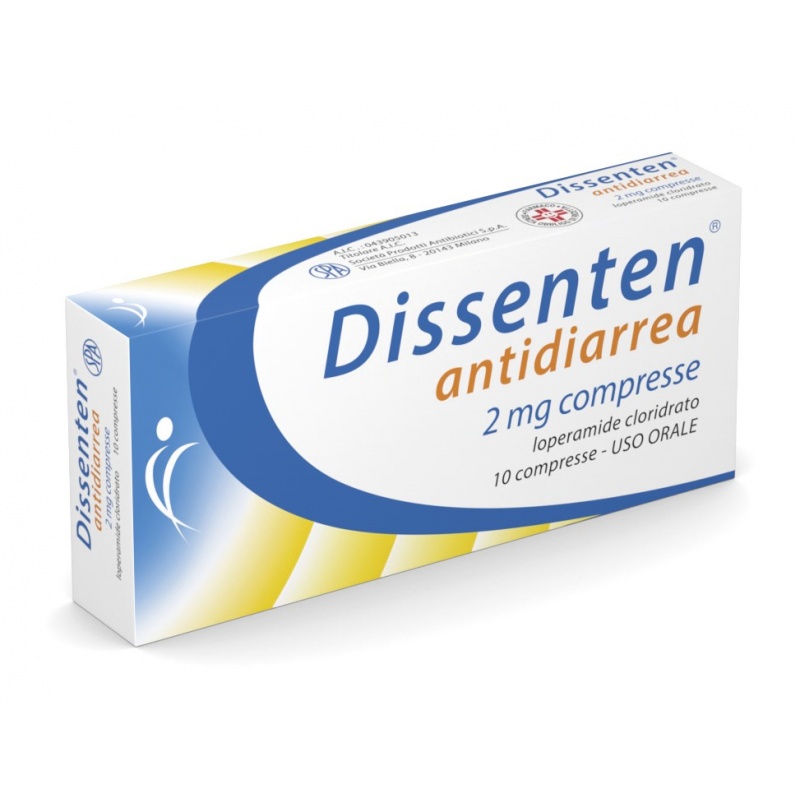
DISSENTEN 2 mg Tablets

Prescription review online
A doctor will review your case and decide whether a prescription is medically appropriate.

Talk to a doctor about this medicine
Discuss your symptoms and possible next steps in a quick online consultation.



How to use Dissenten
Contents of the leaflet
- Package Leaflet: Information for the Patient
- Dissenten, 2 mg, Tablets
- What is Dissenten and what is it used for
- Important information before taking Dissenten
- How to take Dissenten
- Possible side effects
- How to store Dissenten
- Contents of the pack and other information
Package Leaflet: Information for the Patient
Dissenten, 2 mg, Tablets
Loperamide Hydrochloride
Read the package leaflet carefully before taking the medicine, as it contains important information for the patient.
- Keep this leaflet, you may need to read it again.
- If you have any further questions, ask your doctor or pharmacist.
- This medicine has been prescribed for you only. Do not pass it on to others. It may harm them, even if their symptoms are the same as yours.
- If you experience any side effects, including those not listed in this leaflet, tell your doctor or pharmacist. See section 4.
Table of Contents of the Leaflet:

Not sure if this medicine is right for you?
Discuss your symptoms and treatment with a doctor online.
1.
What is Dissenten and what is it used for
2.
Important information before taking Dissenten

Started taking the medicine and have questions?
Discuss your symptoms and treatment with a doctor online.
3.
How to take Dissenten
4.
Possible side effects
5.
How to store Dissenten
6.
Contents of the pack and other information
1. What is Dissenten and what is it used for
The active substance of the medicinal product Dissenten is loperamide, which helps to stop diarrhea by slowing down the movement of the intestines.
Dissenten is used:
- for symptomatic treatment of sporadic or recurrent diarrhea (acute diarrhea or exacerbation of chronic diarrhea).
If there is no improvement after 2 days or if you feel worse, you should consult a doctor.
2. Important information before taking Dissenten
When not to take Dissenten
- If you are allergic to the active substance or any of the other ingredients of this medicine (listed in section 6).
- If taking this medicine may put you at risk of complications that can cause intestinal obstruction (intestinal obstruction, megacolon or acute colonic dilation). If constipation, intestinal obstruction, or abdominal distension occurs during treatment, stop taking this medicine and consult a doctor immediately.
- If you have a bowel disease - acute dysentery, with high fever and bleeding from the anus.
- If you have infectious bowel diseases, such as acute ulcerative colitis (with damage to the intestinal wall), pseudomembranous colitis (severe form of diarrhea associated with the use of broad-spectrum antibiotics or drugs used to treat bacterial infections) or bacterial colitis caused by invasive strains of bacteria from the genus Salmonella, Shigellaand Campylobacter.
- In children under 6 years of age.
Warnings and precautions
Before starting to take Dissenten, discuss it with your doctor or pharmacist.
The medicine can relieve the symptoms of diarrhea (symptomatic treatment), but it does not cure its cause. For this reason, when it is possible to determine the cause of diarrhea, the doctor should use causal treatment.
Do not take the medicine for more than 2 days.
Diarrhea causes significant loss of fluids and minerals, especially in children. Therefore, it is essential to take large amounts of fluids and (or) mineral salts.
Stop taking the medicine and consult a doctor if:
- your condition does not improve within 48 hours of taking Dissenten;
- you have AIDS and during treatment with this medicinal product, bloating occurs; if Dissenten is used to treat bacterial or viral diarrhea (infectious colitis), there is an increased risk of intestinal obstruction (acute colonic dilation).
The medicine should be used with caution and under medical supervision in patients with liver disease (liver dysfunction), as signs of central nervous system toxicity may occur (see "If you take more than the recommended dose of Dissenten").
Dissenten and other medicines
Tell your doctor or pharmacist about all medicines you are taking or have recently taken, as well as any medicines you plan to take.
Be cautious and inform your doctor when taking the following medicines:
- quinidine (a medicine used to treat certain heart diseases),
- ritonavir (a medicine used to treat HIV and AIDS infection),
- itraconazole or ketoconazole (medicines used to treat fungal infections),
- gemfibrozil (a medicine used to reduce blood lipid levels),
- desmopressin (a medicine used to treat diabetes insipidus and nocturnal enuresis),
- medicines with a similar effect to Dissenten,
- medicines that accelerate intestinal motility,
- cytochrome CYP 450 inhibitors.
Pregnancy and breastfeeding
If you are pregnant or breastfeeding, think you may be pregnant or are planning to have a baby, ask your doctor or pharmacist for advice before taking this medicine.
Pregnancy:
If you are pregnant or breastfeeding, think you may be pregnant or are planning to have a baby, ask your doctor or pharmacist for advice before taking this medicine.
Breastfeeding:
Do not take Dissenten during breastfeeding.
Driving and using machines
While taking Dissenten, you may experience drowsiness, dizziness, or sleepiness.
When driving vehicles or operating machinery, be particularly careful.
3. How to take Dissenten
Always take this medicine exactly as described in this leaflet or as directed by your doctor or pharmacist. If you are not sure, ask your doctor or pharmacist.
Oral administration. Swallow the tablets with water.
After improvement of your condition (normalization of stool) during treatment with this medicine, reduce the dose. Stop treatment if constipation occurs (see "Warnings and precautions").
Do not take the medicine for more than 2 days.
Adults:
The recommended initial dose is 2 tablets (4 mg), then 1 tablet (2 mg) after each loose stool.
Do not exceed the maximum dose of 8 tablets (16 mg) per day.
Children and adolescents (from 6 to 17 years of age):
The recommended initial dose is 1 tablet (2 mg). Then, take 1 tablet (2 mg) after each subsequent loose stool. The maximum daily dose is calculated based on body weight (3 tablets/20 kg), but it should not exceed 8 tablets per day.
Children under 6 years of age:
Dissenten should not be taken by children under 6 years of age.
Patients with liver dysfunction:
Use the medicine with caution in patients with liver disease (see "Warnings and precautions").
If you take more than the recommended dose of Dissenten
If you have taken too many tablets of the medicinal product, contact your doctor or go to the nearest hospital emergency department immediately.
In case of overdose, the following symptoms may occur:
- central nervous system depression,
- disorientation (stupor),
- coordination disorders,
- drowsiness,
- pupil constriction (miosis),
- muscle function disorders (increased muscle tone),
- respiratory disorders (respiratory depression),
- decreased urination (urinary retention),
- symptoms indicating intestinal obstruction (obstruction, paralytic ileus, megacolon, acute colonic dilation).
Children are more sensitive to overdose of this medicine than adults. Accidental or excessive ingestion, especially in children under 4 years of age, may cause constipation and central nervous system depression, with drowsiness and slowed breathing rate. In such cases, the patient should be under close medical supervision for at least 48 hours.
Treatment after overdose includes gastric lavage, induction of vomiting, or administration of medicines that accelerate bowel emptying (laxatives). Additionally, in case of overdose symptoms, naloxone can be administered as an antidote. In these cases, the patient should be monitored for at least 48 hours.
If you forget to take Dissenten
Do not take a double dose to make up for a forgotten dose. When it is time for your next dose, take it as usual.
If you have any further questions on the use of this medicine, ask your doctor or pharmacist.
4. Possible side effects
Like all medicines, Dissenten can cause side effects, although not everybody gets them.
Stop taking the medicinal product Dissenten and consult a doctor immediately if you experience any of the following symptoms:
- severe allergic reactions, which may be associated with swelling and difficulty breathing,
- abdominal distension, which may be associated with pain, nausea, vomiting, constipation, signs of intestinal obstruction, or megacolon,
- severe skin reactions, which may be associated with blisters or skin peeling.
The following side effects may occur during treatment with the medicine. They are listed according to their frequency:
Common (may affect up to 1 in 100 people)
- headache, dizziness;
- constipation, nausea, excessive gas production.
Uncommon (may affect up to 1 in 1000 people)
- abdominal pain (especially in the upper part of the abdomen), abdominal discomfort;
- dry mouth;
- vomiting;
- digestive disorders (dyspepsia);
- skin irritation (rash).
Rare (may affect up to 1 in 10,000 people)
- abdominal distension.
Additionally, the following side effects have been reported (after the medicine was placed on the market), the frequency of which cannot be determined based on available data:
- allergic reactions (hypersensitivity), which may be severe (anaphylactic reaction, including shock and anaphylactoid reaction);
- drowsiness, loss of consciousness, mental disorders, including disorientation (stupor), decreased level of consciousness, muscle function disorders (increased muscle tone), and loss of muscle coordination causing difficulty in performing certain actions;
- pupil constriction (miosis);
- symptoms indicating intestinal obstruction (obstruction, paralytic ileus, megacolon, acute colonic dilation);
- burning sensation in the tongue (glossodynia);
- severe skin disorders, which may be associated with blisters (Stevens-Johnson syndrome, toxic epidermal necrolysis, erythema multiforme), skin irritation (hives), itching;
- angioedema (severe allergic reaction causing swelling of the face or throat, which may make breathing and swallowing difficult);
- decreased urination (urinary retention);
- fatigue.
Additional side effects in children and adolescents
In children and adolescents (over 12 years of age), the same side effects may occur as in adults.
Reporting of side effects
If you experience any side effects, including those not listed in this leaflet, tell your doctor or pharmacist. Side effects can be reported directly to: Department of Post-Marketing Surveillance of Adverse Reactions to Medicinal Products, Office for Registration of Medicinal Products, Medical Devices and Biocidal Products, Al. Jerozolimskie 181C, 02-222 Warsaw, tel.: +48 22 49 21 301, fax: +48 22 49 21 309, e-mail: [email protected]
Side effects can also be reported to the marketing authorization holder.
Reporting side effects will help to gather more information on the safety of this medicine.
5. How to store Dissenten
Keep the medicine out of the sight and reach of children.
There are no special precautions for storage.
Do not use this medicine after the expiry date stated on the packaging. The expiry date refers to the last day of the month.
Medicines should not be disposed of via wastewater or household waste. Ask your pharmacist how to dispose of medicines no longer required. This will help protect the environment.
6. Contents of the pack and other information
What Dissenten contains
The active substance of the medicine is loperamide hydrochloride. One tablet contains 2 mg of loperamide hydrochloride.
The other ingredients are: magnesium stearate, microcrystalline cellulose.
What Dissenten looks like and contents of the pack
Dissenten is a round, white, flat tablet with a dividing line.
The packaging of the medicine is a blister pack of polyvinyl chloride and aluminum, in a cardboard box.
The pack contains 15 or 30 tablets.
Marketing authorization holder and manufacturer
Marketing authorization holder:
SPA - Società Prodotti Antibiotici S.p.A.
Via Biella 8, 20143 Milan,
Italy
Manufacturer:
Doppel Farmaceutici S.r.l.,
Via Volturno 48, Quito de Stampi, Rozzano (MI),
Italy
Representative of the marketing authorization holder:
Angelini Pharma Polska Sp. z o.o.
ul. Podleśna 83, 05-552 Łazy
tel.: (22) 702 82 00
e-mail: [email protected]
A leaflet for the blind and partially sighted is available at the representative of the marketing authorization holder.
Date of last revision of the leaflet:
- Country of registration
- Dosage formTablets, 2 mg
- ATC codeA07DA03
- Active substance
- Prescription requiredYes
- Manufacturer
- ImporterDoppel Farmaceutici S.r.l.
- This information is for reference only and does not constitute medical advice. Always consult a doctor before taking any medication. Oladoctor is not responsible for medical decisions based on this content.
- Alternatives to DissentenDosage form: Tablets, 2 mgActive substance: loperamideManufacturer: Tiofarma B.V.Prescription not requiredDosage form: Capsules, 2 mgActive substance: loperamidePrescription requiredDosage form: Tablets, 2 mgActive substance: loperamidePrescription not required
Online doctors for Dissenten
Discuss questions about Dissenten, including use, safety considerations and prescription review, subject to medical assessment and local regulations.









Get Dissenten Prescription Online
Fill in a 2-min form
Tell us your symptoms, history, and what medicine you're requesting.
Pick a doctor or let us assign
Choose a specialist or we'll match you with the next available doctor.
Doctor reviews your case
Usually within 30 minutes. They may ask follow-up questions via chat.
Collect from any pharmacy
Electronic prescription sent to your email — valid across Spain.
Frequently Asked Questions
Dissenten requires a prescription in Poland. You can check with a doctor online whether this medicine may be appropriate for your situation.
The active ingredient in Dissenten is loperamide. This information helps identify medicines with the same composition but different brand names.
Dissenten is manufactured by Doppel Farmaceutici S.r.l.. Pharmacy brands and packaging may differ depending on the distributor.
Doctors such as Family doctors, Psychiatrists, Dermatologists, Cardiologists, Endocrinologists, Gastroenterologists, Pulmonologists, Nephrologists, Rheumatologists, Hematologists, Infectious disease physicians, Allergists, Geriatricians, Paediatricians, Oncologists may assess whether Dissenten is appropriate, depending on your situation and local regulations. You can book an online consultation to discuss your symptoms and possible next steps.
Spain has a well-developed healthcare infrastructure across major cities such as Madrid, Barcelona, Valencia, and Seville. Pharmacies are widely available and operate under strict regulations, ensuring access to prescribed medications.
You can buy Dissenten in Madrid, Barcelona, Seville, or Valencia at any local pharmacy with a valid prescription.
To obtain a prescription, you can use Oladoctor:
Other medicines with the same active substance (loperamide) include Auroblock Fast, Aurostop, Imodium Instant. These may have different brand names or formulations but contain the same therapeutic ingredient. Always consult a doctor before switching or starting a new medicine.
