



DEKRISTOL 50,000 IU Capsules

Prescription review online
A doctor will review your case and decide whether a prescription is medically appropriate.

Talk to a doctor about this medicine
Discuss your symptoms and possible next steps in a quick online consultation.



How to use Dekristol Forte
Contents of the leaflet
- Package Leaflet: Information for the Patient
- Dekristol Forte, 50,000 IU, Hard Capsules
- What is Dekristol Forte and what is it used for
- Important information before taking Dekristol Forte
- How to take Dekristol Forte
- Possible side effects
- How to store Dekristol Forte
- Contents of the pack and other information
Package Leaflet: Information for the Patient
Dekristol Forte, 50,000 IU, Hard Capsules
Cholecalciferol
Read the package leaflet carefully before taking the medicine, as it contains important information for the patient.
- Keep this leaflet, you may need to read it again.
- If you have any further questions, ask your doctor or pharmacist.
- This medicine has been prescribed for you only. Do not pass it on to others. It may harm them, even if their symptoms are the same as yours.
- If you experience any side effects, including those not listed in this leaflet, please inform your doctor or pharmacist. See section 4.
Table of Contents of the Leaflet
- 1. What is Dekristol Forte and what is it used for
- 2. Important information before taking Dekristol Forte
- 3. How to take Dekristol Forte
- 4. Possible side effects
- 5. How to store Dekristol Forte
- 6. Contents of the pack and other information

Not sure if this medicine is right for you?
Discuss your symptoms and treatment with a doctor online.
1. What is Dekristol Forte and what is it used for
Dekristol Forte contains vitamin D (also known as cholecalciferol) used to regulate calcium absorption and metabolism, as well as bone mineralization. Dekristol Forte is used to treat vitamin D deficiency and prevent vitamin D deficiency in adult patients at high risk.
2. Important information before taking Dekristol Forte
When not to take Dekristol Forte:
- if you are allergic to cholecalciferol, orange yellow FCF (E 110), or any of the other ingredients of this medicine (listed in section 6);
- if you have hypercalcemia (high calcium levels in the blood);
- if you have hypercalciuria (high calcium levels in the urine);
- if you have been diagnosed with hypervitaminosis D (high levels of vitamin D in the blood);
- if you have pseudo-hypoparathyroidism (a disorder of parathyroid hormone balance);
- if you have kidney stones or severe kidney failure.
Warnings and precautions
Before starting treatment with Dekristol Forte, discuss it with your doctor or pharmacist:
- if you have a tendency to form kidney stones containing calcium;
- if you have kidney problems and they do not excrete calcium and phosphates properly. Your doctor should monitor the effect of treatment on calcium and phosphate metabolism;
- if you are taking diuretics (thiazide derivatives) or are immobilized, as there is a risk of hypercalcemia (high calcium levels in the blood) and hypercalciuria (high calcium levels in the urine);
- if you have sarcoidosis (a disease that affects connective tissue in the lungs, skin, and joints), as there is a risk of increased conversion of vitamin D to its active form. In such cases, your doctor should monitor calcium levels in the blood and urine;
1/6
- if you have pseudo-hypoparathyroidism (a disorder of parathyroid hormone balance);
- if you are taking other medicines containing vitamin D (e.g., multivitamin preparations) or certain foods containing vitamin D.
If you are taking Dekristol Forte in a dose exceeding 1,000 IU (international units) of vitamin D per day, your doctor should monitor calcium levels in the blood and urine, as well as kidney function. Monitoring is especially important in elderly patients and those taking digitalis glycosides (heart stimulants) or diuretics (urine-stimulating drugs) at the same time. If calcium levels in the blood (hypercalcemia) or urine (hypercalciuria) increase, or other signs of kidney dysfunction occur, the dose should be reduced or the medicine should be discontinued.
Children and adolescents
Dekristol Forte is not recommended for use in children and adolescents under 18 years of age.
Dekristol Forte and other medicines
Tell your doctor or pharmacist about all medicines you are taking, have recently taken, or plan to take.
- The effect of Dekristol Forte may be reduced by concurrent use of:
- phenytoin (a medicine used to treat epilepsy) or barbiturates (medicines used to treat epilepsy, sleep disorders, and for anesthesia);
- glucocorticosteroids (medicines used to treat certain allergic diseases and inflammatory conditions);
- rifampicin and isoniazid (medicines used to treat tuberculosis);
- cholestyramine (a medicine used to lower increased cholesterol levels), laxatives containing liquid paraffin;
- orlistat (a medicine used to treat obesity);
- actinomycin (a medicine used to treat cancer);
- imidazole derivatives (antifungal medicines).
The effect of Dekristol Forte or side effects may be increased by concurrent use of:
- vitamin D metabolites or analogs (e.g., calcitriol): concurrent use with Dekristol Forte should be avoided;
- diuretics (e.g., thiazide diuretics): reduced calcium excretion by the kidneys may lead to increased calcium levels in the blood (hypercalcemia). Therefore, during long-term treatment, calcium levels in the blood and urine should be regularly checked.
Dekristol Forte used at the same time increases the risk of side effects:
- digitalis glycosides (medicines used to stimulate heart function): the risk of cardiac arrhythmias may increase due to increased calcium levels in the blood during vitamin D treatment. In such cases, the attending physician should perform ECG tests, monitor calcium levels in the blood and urine, and the level of the medicine in the blood.
Dekristol Forte with food and drink
Dekristol Forte is best taken with food and drink.
Pregnancy and breastfeeding
If you are pregnant or breastfeeding, think you may be pregnant, or plan to have a child, ask your doctor for advice before taking this medicine.
Pregnancy
2/6
The recommended daily dose of vitamin D during pregnancy is 400 IU, but in the case of women with vitamin D deficiency, a higher dose (up to 2,000 IU/day) may be necessary. During pregnancy, women should follow their doctor's recommendations, as their needs may vary depending on the severity of the disease and response to treatment.
It is not recommended to treat pregnant women with high doses of vitamin D.
During pregnancy, it is necessary to avoid vitamin D overdose, as prolonged hypercalcemia can lead to delayed physical and mental development, as well as heart and eye diseases in the child.
Breastfeeding
Vitamin D and its metabolites pass into breast milk. It is not recommended to treat breastfeeding women with high doses of vitamin D.
Fertility
There are no data on the effect of cholecalciferol on fertility. No adverse effect on fertility is expected at normal, physiological levels of vitamin D.
Driving and using machines
Dekristol Forte has no or negligible influence on the ability to drive and use machines.
Dekristol Forte contains orange yellow FCF (E 110)
The medicine may cause allergic reactions.

Started taking the medicine and have questions?
Discuss your symptoms and treatment with a doctor online.
3. How to take Dekristol Forte
This medicine should always be taken exactly as advised by your doctor or pharmacist. If you are unsure, ask your doctor or pharmacist.
This medicine should be taken orally. The capsules should be swallowed whole, with a sufficient amount of water, preferably with the main meal of the day.
Use in adults
Vitamin D deficiency prevention: 1 capsule (50,000 IU) every 2 months. In the population of patients at high risk (see below), the dose may be increased to 1 capsule every month.
Vitamin D deficiency treatment: 1 capsule (50,000 IU) every week for 6-8 weeks, followed by maintenance treatment (1,400-2,000 IU/day may be required, i.e., 1 capsule every month).
After 3-4 months from the start of maintenance treatment, a test to confirm the desired vitamin D level should be performed.
You can also follow national guidelines for the treatment and prevention of vitamin D deficiency.
Certain populations are at high risk of vitamin D deficiency and may require higher doses and monitoring of vitamin D levels in the blood. These include:
- people living in closed institutions or hospitalized,
- people with dark skin,
- people with limited effective sun exposure due to protective clothing or use of sunscreens,
- obese people,
- patients monitored for osteoporosis,
- people taking certain medicines (e.g., antiepileptics, glucocorticosteroids),
- patients with malabsorption, including non-specific intestinal inflammation and celiac disease,
3/6
- people recently treated for vitamin D deficiency and requiring maintenance treatment.
Use in children and adolescents
Dekristol Forte is not recommended for use in children and adolescents under 18 years of age.
Taking the medicine
The capsules should be swallowed whole, with a sufficient amount of water, preferably with the main meal of the day.
To remove a capsule from the blister:
- press only the end of the capsule to push it through the foil;
- do not press the center of the capsule, as it may cause it to break.

Overdose of Dekristol Forte
If you have taken more than the recommended dose, contact your doctor immediately.
Overdose symptoms are non-specific and may include thirst, nausea, vomiting, initial diarrhea leading to constipation, loss of appetite, fatigue, headache, muscle and joint pain, muscle weakness, persistent drowsiness, impaired consciousness, arrhythmia (irregular heartbeat), azotemia (high nitrogen levels in the blood), increased thirst, increased urine production, and - in the final stage - dehydration.
Your doctor can provide information about other overdose symptoms of vitamin D.
If necessary, your doctor will take the necessary measures.
No specific antidote is known.
Missing a dose of Dekristol Forte
Do not take a double dose to make up for a missed dose.
Stopping treatment with Dekristol Forte
If treatment is stopped prematurely, symptoms may recur or worsen.
If you have any further questions about the use of this medicine, ask your doctor or pharmacist.
4. Possible side effects
Like all medicines, Dekristol Forte can cause side effects, although not everybody gets them.
Stop taking Dekristol Forte and contact your doctor immediately if you experience symptoms of a severe allergic reactionsuch as:
- swelling of the face, lips, tongue, or throat;
- difficulty swallowing;
- hives and difficulty breathing.
The following side effects may occur:
4/6
Uncommon (may affect up to 1 in 100 people):
hypercalcemia (high calcium levels in the blood) and hypercalciuria (high calcium levels in the urine)
Rare (may affect up to 1 in 1,000 people):
itching, rash, or hives.
Frequency not known (cannot be estimated from the available data):
gastrointestinal disorders (constipation, bloating, nausea, abdominal pain, or diarrhea).
Orange yellow FCF (E 110) may cause allergic reactions.
Reporting side effects
If you experience any side effects, including those not listed in this leaflet, please inform your doctor or pharmacist. Side effects can be reported directly to the Department of Drug Safety Monitoring of the Office for Registration of Medicinal Products, Medical Devices, and Biocidal Products:
Al. Jerozolimskie 181C
02-222 Warsaw
Tel.: +48 22 49 21 301
Fax: +48 22 49 21 309
website: https://smz.ezdrowie.gov.pl
Side effects can also be reported to the marketing authorization holder.
By reporting side effects, you can help provide more information on the safety of this medicine.
5. How to store Dekristol Forte
Keep the medicine out of the sight and reach of children.
Store in the original package to protect from light.
No special precautions for storage temperature are necessary.
Do not use this medicine after the expiry date stated on the carton and blister after:
“EXP”. The expiry date refers to the last day of the month stated.
Medicines should not be disposed of via wastewater or household waste. Ask your pharmacist how to dispose of medicines no longer required. This will help protect the environment.
6. Contents of the pack and other information
What Dekristol Forte contains
- The active substance is cholecalciferol. Each hard capsule contains 1.25 mg of cholecalciferol (equivalent to 50,000 IU of vitamin D).
- The other ingredients are: medium-chain triglycerides, gelatin, silicon dioxide, titanium dioxide (E 171), quinoline yellow (E 104), butylhydroxytoluene (E 321), orange yellow FCF (E 110).
5/6
What Dekristol Forte looks like and contents of the pack
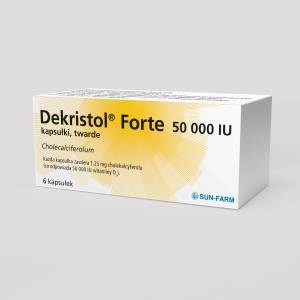
Dekristol Forte is a hard gelatin capsule with an opaque orange body and a yellow cap, filled with a colorless to light yellow oily liquid. The capsules have a colorless band.
Dekristol Forte is available in PVC/PVDC/Aluminum blisters in a carton containing 6, 8, 10, 12, 15, 20, 30, 35, or 40 capsules.
Not all pack sizes may be marketed.
Marketing authorization holder
SUN-FARM Sp. z o.o.
ul. Dolna 21
05-092 Łomianki
tel. +48 22 350 66 69
Manufacturer
mibe GmbH Arzneimittel
Münchener Straße 15
06796 Brehna
Germany
SUN-FARM Sp. z o.o.
ul. Dolna 21
05-092 Łomianki
Date of last revision of the leaflet:01.2024
6/6
- Country of registration
- Dosage formCapsules, 50,000 IU
- ATC codeA11CC05
- Active substance
- Prescription requiredYes
- Manufacturer
- Importermibe GmbH Arzneimittel Sun-Farm Sp. z o.o.
- This information is for reference only and does not constitute medical advice. Always consult a doctor before taking any medication. Oladoctor is not responsible for medical decisions based on this content.
- Alternatives to Dekristol ForteDosage form: Tablets, 1000 IUActive substance: colecalciferolPrescription requiredDosage form: Tablets, 7000 IUActive substance: colecalciferolPrescription requiredDosage form: Tablets, 30,000 IUActive substance: colecalciferolPrescription required
Online doctors for Dekristol Forte
Discuss questions about Dekristol Forte, including use, safety considerations and prescription review, subject to medical assessment and local regulations.









Get Dekristol Forte Prescription Online
Fill in a 2-min form
Tell us your symptoms, history, and what medicine you're requesting.
Pick a doctor or let us assign
Choose a specialist or we'll match you with the next available doctor.
Doctor reviews your case
Usually within 30 minutes. They may ask follow-up questions via chat.
Collect from any pharmacy
Electronic prescription sent to your email — valid across Spain.
Frequently Asked Questions
Dekristol Forte requires a prescription in Poland. You can check with a doctor online whether this medicine may be appropriate for your situation.
The active ingredient in Dekristol Forte is colecalciferol. This information helps identify medicines with the same composition but different brand names.
Dekristol Forte is manufactured by mibe GmbH Arzneimittel. Pharmacy brands and packaging may differ depending on the distributor.
Doctors such as Family doctors, Psychiatrists, Dermatologists, Cardiologists, Endocrinologists, Gastroenterologists, Pulmonologists, Nephrologists, Rheumatologists, Hematologists, Infectious disease physicians, Allergists, Geriatricians, Paediatricians, Oncologists may assess whether Dekristol Forte is appropriate, depending on your situation and local regulations. You can book an online consultation to discuss your symptoms and possible next steps.
Spain has a well-developed healthcare infrastructure across major cities such as Madrid, Barcelona, Valencia, and Seville. Pharmacies are widely available and operate under strict regulations, ensuring access to prescribed medications.
You can buy Dekristol Forte in Madrid, Barcelona, Seville, or Valencia at any local pharmacy with a valid prescription.
To obtain a prescription, you can use Oladoctor:
Other medicines with the same active substance (colecalciferol) include Annexxo, Annexxo, Annexxo. These may have different brand names or formulations but contain the same therapeutic ingredient. Always consult a doctor before switching or starting a new medicine.
