


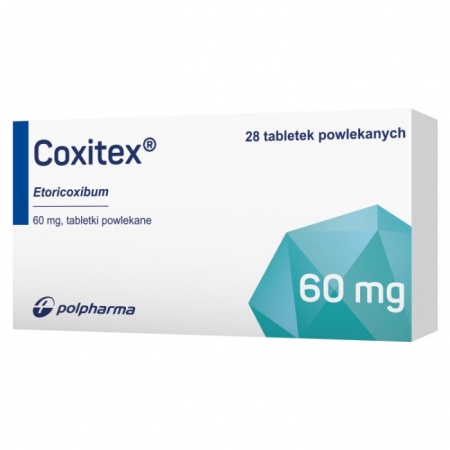
Coxitex
Ask a doctor about a prescription for Coxitex




How to use Coxitex
Package Leaflet: Information for the User
Coxitex, 30 mg, film-coated tablets
Coxitex, 60 mg, film-coated tablets
Coxitex, 90 mg, film-coated tablets
Coxitex, 120 mg, film-coated tablets
Etoricoxib
Read all of this leaflet carefully before you start taking this medicine because it contains important information for you.
- You should keep this leaflet. You may need to read it again.
- If you have any further questions, ask your doctor or pharmacist.
- This medicine has been prescribed for you only. Do not pass it on to others. It may harm them, even if their signs of illness are the same as yours.
- If you get any side effects, talk to your doctor or pharmacist. This includes any possible side effects not listed in this leaflet. See section 4.
Contents of the pack and other information
- 1. What Coxitex is and what it is used for
- 2. Before you take Coxitex
- 3. How to take Coxitex
- 4. Possible side effects
- 5. How to store Coxitex
- 6. Contents of the pack and other information
1. What Coxitex is and what it is used for
What Coxitex is
- Coxitex contains the active substance etoricoxib. Coxitex is a medicine that belongs to a group of medicines called selective cyclooxygenase-2 (COX-2) inhibitors. These medicines are also known as non-steroidal anti-inflammatory drugs (NSAIDs).
What Coxitex is used for
- Coxitex helps to reduce pain and inflammation in the joints and muscles in people 16 years of age and older with osteoarthritis, rheumatoid arthritis, ankylosing spondylitis, and gout.
- Coxitex is also used for short-term treatment of moderate pain associated with dental surgery in people 16 years of age and older.
What is osteoarthritis?
Osteoarthritis is a disease of the joints. It happens when the cartilage that cushions the joints breaks down over time. This can lead to pain, stiffness, and swelling of the joints.
What is rheumatoid arthritis?
Rheumatoid arthritis is a long-term disease that causes inflammation of the joints. It can cause pain, stiffness, swelling, and limited movement of the affected joints. It can also cause inflammation in other parts of the body.
What is gout?
Gout is a disease that causes sudden and recurring attacks of very painful inflammation and redness in the joints. It is caused by the buildup of urate crystals in the joint.
What is ankylosing spondylitis?
Ankylosing spondylitis is an inflammatory disease that affects the spine and large joints.
2. Before you take Coxitex
Do not take Coxitex:
- if you are allergic to etoricoxib or any of the other ingredients of this medicine (listed in section 6);
- if you have had an allergic reaction to a group of medicines called non-steroidal anti-inflammatory drugs (NSAIDs) (such as aspirin, ibuprofen, or diclofenac);
- if you have or have had recurrent stomach ulcers or bleeding;
- if you have severe liver disease;
- if you have severe kidney disease;
- if you are pregnant, think you may be pregnant, or are breast-feeding (see section "Pregnancy, breast-feeding, and fertility");
- if you are under 16 years of age;
- if you have inflammatory bowel disease (such as Crohn's disease or ulcerative colitis);
- if you have high blood pressure that is not controlled;
- if you have heart failure or have had a heart attack;
- if you have had a stroke or have a condition called transient ischaemic attack (TIA or "mini-stroke");
If any of these apply to you, tell your doctor before taking Coxitex.
Warnings and precautions
Before taking Coxitex, tell your doctor:
- if you have had stomach ulcers or bleeding before;
- if you are dehydrated (for example, due to prolonged vomiting or diarrhea);
- if you have swelling due to fluid retention;
- if you have heart failure or any other heart condition;
- if you have high blood pressure;
- if you have liver or kidney disease;
- if you are taking any other medicines (see section "Other medicines and Coxitex");
- if you are over 65 years of age;
Coxitex works just as well in older and younger patients, but older patients are more likely to have age-related conditions, such as high blood pressure, kidney disease, or heart disease. Your doctor will want to check that your medicine is still working and that you are not getting any side effects.
Children and adolescents
Do not give this medicine to children and adolescents under 16 years of age.
Coxitex with other medicines
Tell your doctor or pharmacist if you are taking, have recently taken, or might take any other medicines, including those obtained without a prescription.
- warfarin (a blood thinner);
- rifampicin (an antibiotic);
- methotrexate (a medicine used to treat rheumatoid arthritis);
- cyclosporin or tacrolimus (medicines used to suppress the immune system);
- lithium (a medicine used to treat depression);
- medicines used to treat high blood pressure or heart failure, such as ACE inhibitors (e.g., enalapril, ramipril) or angiotensin receptor blockers (e.g., losartan, valsartan);
- diuretics (water pills);
- digoxin (a medicine used to treat heart failure or irregular heartbeat);
- minoxidil (a medicine used to treat high blood pressure);
- salbutamol (a medicine used to treat asthma);
- oral contraceptives (birth control pills);
- hormone replacement therapy (HRT);
- aspirin (may increase the risk of stomach ulcers);
- aspirin (used for heart protection or stroke prevention): Coxitex can be taken with low-dose aspirin. If you are currently taking low-dose aspirin to prevent a heart attack or stroke, do not stop taking it unless your doctor tells you to.
Coxitex with food and drink
The effect of the medicine may start sooner if Coxitex is taken on an empty stomach.
Pregnancy, breast-feeding, and fertility
Pregnancy
Coxitex must not be used during pregnancy. If you are pregnant, think you may be pregnant, or are planning to become pregnant, do not take Coxitex. If you become pregnant while taking Coxitex, stop taking it and contact your doctor.
Breast-feeding
It is not known if Coxitex passes into breast milk. If you are breast-feeding or planning to breast-feed, consult your doctor before taking Coxitex. Do not breast-feed if you are taking Coxitex.
Fertility
It is not recommended to take Coxitex if you are planning to become pregnant.
Driving and using machines
Some patients have reported dizziness and drowsiness while taking Coxitex. Do not drive or operate machinery if you experience dizziness or drowsiness.
Coxitex contains sodium
This medicine contains less than 1 mmol sodium (23 mg) per tablet, which is essentially "sodium-free".
3. How to take Coxitex
Always take this medicine exactly as your doctor has told you. If you are not sure, ask your doctor or pharmacist.
Do not take more than the recommended dose. Your doctor will want to check your progress regularly and may need to adjust your dose.
Coxitex is available in different strengths. Your doctor will prescribe the strength that is right for you.
Recommended dose
Osteoarthritis
The recommended dose is 30 mg once daily, increased to a maximum of 60 mg once daily if needed.
Rheumatoid arthritis
The recommended dose is 60 mg once daily, increased to a maximum of 90 mg once daily if needed.
Ankylosing spondylitis
The recommended dose is 60 mg once daily, increased to a maximum of 90 mg once daily if needed.
Acute pain
Etoricoxib should only be used for the acute painful period.
Gout
The recommended dose is 120 mg once daily, and it should only be used for the acute painful period, up to a maximum of 8 days.
Pain following dental surgery
The recommended dose is 90 mg once daily, and treatment should not exceed 3 days.
Patients with liver disease
- In patients with mild liver disease, the dose should not exceed 60 mg once daily.
- In patients with moderate liver disease, the dose should not exceed 30 mg once daily.
Use in children and adolescents
Coxitex should not be used in children and adolescents under 16 years of age.
Use in elderly patients
No dose adjustment is necessary for elderly patients. As with other medicines, caution should be exercised in elderly patients.
Coxitex is for oral use. Take one tablet once daily.
Coxitex can be taken with or without food.
If you take more Coxitex than you should
Never take more tablets than your doctor has told you to take. If you have taken too many tablets, contact your doctor or pharmacist immediately.
If you forget to take Coxitex
Take Coxitex as soon as you remember. On the next day, take your normal dose as usual. Do not take a double dose to make up for a forgotten dose.
4. Possible side effects
Like all medicines, Coxitex can cause side effects, although not everybody gets them.
If you experience any of the following symptoms, stop taking Coxitex and contact your doctor immediately (see section 2):
- shortness of breath, chest pain, or swelling of the feet or ankles;
- yellowing of the skin and eyes (jaundice) - a sign of liver problems;
- severe stomach pain or bleeding;
- allergic reactions, including skin problems such as ulcers, blisters, or swelling of the face, lips, tongue, or throat, which may cause difficulty breathing.
The frequency of possible side effects is defined as follows:
Very common: affects more than 1 in 10 people
Common: affects less than 1 in 10 people but more than 1 in 100 people
Uncommon: affects less than 1 in 100 people but more than 1 in 1,000 people
Rare: affects less than 1 in 1,000 people but more than 1 in 10,000 people
Very rare: affects less than 1 in 10,000 people
Very common:
- stomach pain.
Common:
- dry mouth (mouth inflammation and pain after tooth extraction);
- swelling of the feet or ankles due to fluid retention;
- dizziness, headache;
- palpitations (rapid or irregular heartbeat), irregular heartbeat;
- high blood pressure;
- wheezing or shortness of breath (bronchospasm);
- constipation, gas (excess gas in the stomach or intestines), stomach upset (gastritis), heartburn, diarrhea, indigestion (dyspepsia), and discomfort in the stomach, nausea, vomiting, esophagitis, mouth ulcers;
- changes in liver blood tests;
- bruising;
- weakness and fatigue, flu-like symptoms.
Uncommon:
- gastrointestinal upset and infection (gastroenteritis), upper respiratory tract infection, urinary tract infection;
- changes in blood tests (decreased red blood cells, decreased white blood cells, decreased platelets);
- allergic reactions (including hives, which can be severe and require immediate medical attention);
- increased or decreased appetite, weight gain;
- anxiety, depression, decreased mental ability; seeing or hearing things that are not there (hallucinations);
- taste disturbances, insomnia, numbness or tingling, drowsiness;
- blurred vision, eye irritation and redness;
- ringing in the ears, dizziness (feeling of spinning while standing still);
- heart rhythm disturbances (atrial fibrillation), rapid heartbeat, heart failure, feeling of tightness, pressure, or heaviness in the chest (angina pectoris), heart attack;
- hot flushes, stroke, mini-stroke (transient ischaemic attack), severe high blood pressure, blood vessel inflammation;
- cough, shortness of breath, nosebleeds;
- bloating, change in bowel movements, dry mouth, stomach ulcers, gastritis, which can be severe and lead to bleeding, irritable bowel syndrome, pancreatitis;
- face swelling, rash, or itching;
- muscle spasms, muscle pain or stiffness;
- high potassium levels in the blood, changes in kidney blood or urine tests, severe kidney problems;
- chest pain.
Rare:
- angioedema (an allergic reaction that causes swelling of the face, lips, tongue, or throat, which can lead to difficulty breathing or swallowing, and requires immediate medical attention); anaphylactic or anaphylactoid reactions, including shock (a severe allergic reaction that requires immediate medical attention);
- confusion, restlessness;
- liver problems (hepatitis);
- low sodium levels in the blood;
- liver failure, yellowing of the skin and eyes (jaundice);
- severe skin reactions.
Reporting of side effects
If you get any side effects, talk to your doctor or pharmacist. This includes any possible side effects not listed in this leaflet. You can also report side effects directly via the national reporting system listed in the "Contact details for the reporting of side effects" section.
5. How to store Coxitex
Keep this medicine out of the sight and reach of children.
Do not use this medicine after the expiry date which is stated on the carton after EXP. The expiry date refers to the last day of that month.
Store in the original package to protect from moisture.
Do not throw away any medicines via wastewater or household waste. Ask your pharmacist how to throw away medicines you no longer use. These measures will help protect the environment.
6. Contents of the pack and other information
What Coxitex contains
- The active substance is etoricoxib. Each film-coated tablet contains 30 mg, 60 mg, 90 mg, or 120 mg of etoricoxib.
- The other ingredients are:
- Core: microcrystalline cellulose, calcium hydrogen phosphate, sodium croscarmellose, magnesium stearate.
- Coating: Coxitex 30 mg, 60 mg, 120 mg:polyvinyl alcohol, titanium dioxide (E 171), glycerol monostearate, aluminum lake of indigo carmine (E 132), yellow iron oxide (E 172), talc, sodium lauryl sulfate. Coxitex 90 mg:polyvinyl alcohol, titanium dioxide (E 171), glycerol monostearate, talc, sodium lauryl sulfate.
What Coxitex looks like and contents of the pack
Coxitex is available in four strengths:
30 mg: blue-green film-coated tablets, apple-shaped, biconvex, with "30" engraved on one side and plain on the other, 5.8 x 5.9 mm in size.
60 mg: dark green film-coated tablets, apple-shaped, biconvex, with "60" engraved on one side and plain on the other, 7.1 x 7.3 mm in size.
90 mg: white film-coated tablets, apple-shaped, biconvex, with "90" engraved on one side and plain on the other, 8.1 x 8.3 mm in size.
120 mg: light green film-coated tablets, apple-shaped, biconvex, with "120" engraved on one side and plain on the other, 8.9 x 9.2 mm in size.
Aluminum-Aluminum blister packs in a cardboard box.
The pack contains 7 or 28 film-coated tablets.
Not all pack sizes may be marketed.
Marketing Authorisation Holder and Manufacturer
Marketing Authorisation Holder
Zakłady Farmaceutyczne POLPHARMA S.A.
ul. Pelplińska 19, 83-200 Starogard Gdański
tel. + 48 22 364 61 01
Manufacturer
Rontis Hellas S.A., Medical and Pharmaceutical Products
P.O. Box 3012 Larisa Industrial Area
Larisa, 41004
Greece
Date of last revision of the leaflet:
- Country of registration
- Active substance
- Prescription requiredYes
- ImporterRontis Hellas Medical and Pharmaceutical Products S.A.
- This information is for reference only and does not constitute medical advice. Always consult a licensed doctor before taking any medication. Oladoctor is not responsible for medical decisions based on this content.
- Alternatives to CoxitexDosage form: Tablets, 60 mgActive substance: etoricoxibManufacturer: Merck Sharp & Dohme B.V. Organon Heist bv Vianex S.A.Prescription requiredDosage form: Tablets, 90 mgActive substance: etoricoxibManufacturer: Merck Sharp & Dohme B.V. Organon Heist bv Vianex S.A.Prescription requiredDosage form: Tablets, 120 mgActive substance: etoricoxibManufacturer: Merck Sharp & Dohme B.V. Organon Heist bv Vianex S.A.Prescription required
Alternatives to Coxitex in other countries
The best alternatives with the same active ingredient and therapeutic effect.
Alternative to Coxitex in Hiszpania
Alternative to Coxitex in Ukraina
Online doctors for Coxitex
Discuss dosage, side effects, interactions, contraindications, and prescription renewal for Coxitex – subject to medical assessment and local rules.

Get updates and exclusive offers
Be the first to know about new services, marketplace updates, and subscriber-only promos.

