



CORSODYL 0.2% w/v Liquid

Prescription review online
A doctor will review your case and decide whether a prescription is medically appropriate.

Talk to a doctor about this medicine
Discuss your symptoms and possible next steps in a quick online consultation.



How to use Corsodil
Contents of the leaflet
- Leaflet attached to the packaging: patient information
- CORSODYL
- What is Corsodyl and what is it used for
- Important information before using Corsodyl
- How to use Corsodyl
- Possible side effects
- How to store Corsodyl
- Package contents and other information
Leaflet attached to the packaging: patient information
CORSODYL
0.2% w/v ,liquid for oral use
Chlorhexidine gluconate
Read the leaflet carefully before using the medicine, as it contains important information for the patient.
This medicine should always be used exactly as described in this patient leaflet or according to the doctor's, pharmacist's, or nurse's instructions.
- Keep this leaflet, you may need to read it again.
- If you need advice or additional information, consult a pharmacist.
- If the patient experiences any side effects, including any possible side effects not listed in this leaflet, they should inform their doctor, pharmacist, or nurse. See section 4.
- If after 4 weeks there is no improvement or the patient feels worse, they should contact their doctor.
Table of contents of the leaflet
- 1. What is Corsodyl and what is it used for
- 2. Important information before using Corsodyl
- 3. How to use Corsodyl
- 4. Possible side effects
- 5. How to store Corsodyl
- 6. Package contents and other information

Not sure if this medicine is right for you?
Discuss your symptoms and treatment with a doctor online.
1. What is Corsodyl and what is it used for
Corsodyl oral liquid contains chlorhexidine gluconate with antibacterial action.
Indications for using Corsodyl liquid:
Inhibition of dental plaque formation.
Assistance in the treatment and prevention of gingivitis and maintenance of oral hygiene, especially in situations where proper toothbrushing is not possible (e.g., after oral surgery and in physically or mentally handicapped patients).
For use after surgical procedures on the periodontal tissues to accelerate healing of the gums.
Supporting the treatment of aphthous ulcers and fungal infections of the mouth (e.g., denture stomatitis and thrush).
2. Important information before using Corsodyl
When not to use Corsodyl
If the patient is allergic to chlorhexidine or any of the other ingredients of this medicine (listed in section 6).
Warnings and precautions
Before starting to use Corsodyl, discuss it with your doctor, pharmacist, or nurse.
For oral use only (external use). Protect your eyes and ears from contact with the medicine.
If the liquid gets into your eyes, rinse them immediately and thoroughly with water.
Do not swallow the liquid.
If you experience pain, swelling, or irritation of the mouth, stop using the medicine and contact your doctor.
Stop using Corsodyl and consult your doctor if you experience a rash, swelling of the lips, tongue, throat, face, or difficulty breathing.
A superficial discoloration of the tongue may occur, which disappears after stopping the use of the medicine. Discoloration of teeth and fillings may also occur. This discoloration is not permanent and can be largely prevented by limiting the consumption of coffee, tea, and red wine and brushing your teeth with toothpaste before using the liquid, and in the case of dentures, cleaning them with a denture cleaning agent.
However, in some cases, professional polishing of the teeth may be necessary to completely remove the stains. Inadequately cleaned discolored fillings with uneven edges or rough surfaces may need to be replaced. In situations where toothbrushing is not possible, such as in facial injuries treated with intermaxillary traction or orthodontic appliances, removal of dental tartar and polishing of the teeth may also be required.
Corsodyl is incompatible with anionic agents, which are usually found in toothpastes. Therefore, before using Corsodyl after brushing your teeth, rinse your mouth thoroughly with water and wait 5 minutes. You can also use Corsodyl at a different time of day.
In the initial period of using the oral liquid, transient disturbances of taste and sensations of burning, tingling, or numbness of the tongue may occur. This effect usually subsides with continued use of the liquid.
If the above symptoms persist, consult your doctor.
In case of desquamation of the oral mucosa, dilute the liquid with an equal amount of water and mix, which often allows for continued use.
Corsodyl and other medicines
Chlorhexidine is incompatible with anionic substances, including toothpaste ingredients.
Pregnancy, breastfeeding, and fertility
For external use only. No special precautions are recommended.
Driving and using machines
For external use only. No effect on the ability to drive and use machines is known.
Corsodyl contains glycerol, sorbitol, and a flavoring agent
Glycerol
The medicine contains 500 mg of glycerol in each dose (10 ml). The medicine may cause headache, stomach upset, and diarrhea.
Sorbitol
The medicine contains 1.05 mg of sorbitol in each dose (10 ml).
Flavoring agent
The medicine contains a flavoring agent with benzyl alcohol, citral, geraniol, limonene, linalool, eugenol, and citronellol. They may cause allergic reactions.

Started taking the medicine and have questions?
Discuss your symptoms and treatment with a doctor online.
3. How to use Corsodyl
This medicine should always be used exactly as described in this patient leaflet or according to the doctor's, pharmacist's, or nurse's instructions. If you are unsure, consult your doctor, pharmacist, or nurse.
Use in adults
Method of use: twice a day, for about one minute, thoroughly rinse the mouth with 10 ml of the liquid.
Before dental surgery: rinse the mouth with 10 ml of the liquid for one minute.
In the treatment of gingivitis, a course of treatment lasting about one month is recommended.
In the case of aphthous ulcers and fungal infections of the mouth, treatment should be continued for 48 hours after clinical signs of healing have been obtained. In the treatment of denture stomatitis, after cleaning the dentures, soak them in Corsodyl liquid twice a day for 15 minutes.
The liquid should not be used for more than 4 weeks, unless otherwise advised by a doctor.
Do not exceed the recommended dose of the medicine.
Use in elderly patients and children over 12 years of age
There are no special dosage recommendations for elderly patients and children over 12 years of age. The usual adult dose is appropriate, unless otherwise advised by a dentist.
Use in children
The medicine should not be used in children under 12 years of age without a doctor's recommendation.
Using more than the recommended dose of Corsodyl
No cases of overdose have been reported.
Accidental ingestion
Chlorhexidine is poorly absorbed after oral administration. Even in the case of ingestion of large amounts, the occurrence of systemic symptoms is unlikely.
4. Possible side effects
Like all medicines, this medicine can cause side effects, although not everybody gets them.
Side effects are listed below by frequency of occurrence.
The following side effects may occur:
Very common( occurring in more than 1 in 10 patients):
- coated tongue.
Common( occurring in less than 1 in 10 patients, but more than 1 in 100 patients):
- dryness and burning sensation in the mouth,
- loss of taste/taste disturbance,
- tongue pain,
- disorders of sensation (paresthesia)/hypoesthesia in the mouth.
Isolated reports:
- discoloration of teeth and tongue,
- irritation of the mouth,
- desquamation and/or swelling of the oral mucosa,
- swelling of the parotid glands,
- breathing difficulties,
- rash,
- hypersensitivity and anaphylactic reactions (swelling of the lips, tongue, throat, face).
In some patients, other side effects may occur during the use of Corsodyl. If other side effects occur, not listed in this leaflet, inform your doctor.
Reporting side effects
If you experience any side effects, including any possible side effects not listed in this leaflet, inform your doctor, pharmacist, or nurse. Side effects can be reported directly to the Department of Monitoring of Adverse Reactions to Medicinal Products, Urząd Rejestracji Produktów Leczniczych, Wyrobów Medycznych i Produktów Biobójczych, Al. Jerozolimskie 181C, 02-222 Warsaw, tel.: +48 22 49 21 301, fax: +48 22 49 21 309, website: https://smz.ezdrowie.gov.pl.
Reporting side effects will help to gather more information on the safety of the medicine.
Side effects can also be reported to the marketing authorization holder.
5. How to store Corsodyl
Store in a temperature below 25°C.
Keep the medicine out of the sight and reach of children.
Do not use this medicine after the expiry date stated on the packaging.
The expiry date refers to the last day of the month stated.
Medicines should not be disposed of via wastewater or household waste. Ask your pharmacist how to dispose of medicines no longer required. This will help protect the environment.
6. Package contents and other information
What Corsodyl contains
- The active substance is chlorhexidine gluconate.
- The other ingredients are: glycerol, macrogol glycerol hydroxystearate, non-crystallizing liquid sorbitol, Optamint 291616 flavor (with benzyl alcohol, citral, geraniol, limonene, linalool, eugenol, and citronellol), purified water.
What Corsodyl looks like and contents of the pack
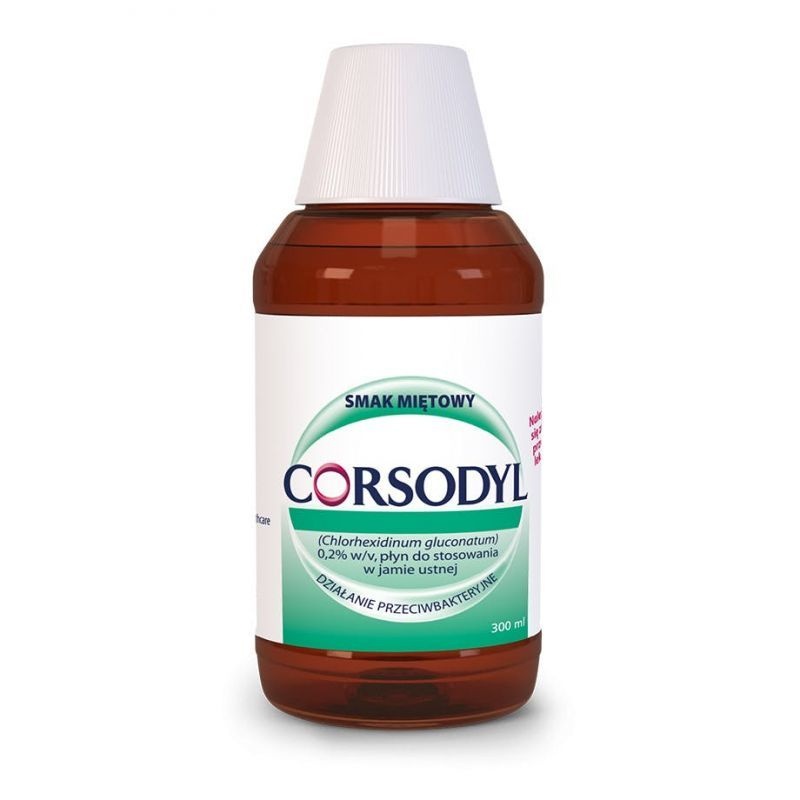
Bottle of 300 ml
Marketing authorization holder
Haleon Poland Sp. z o.o.
ul. Rzymowskiego 53
02-697 Warsaw
tel. 800 702 849
Manufacturer
Omega Pharma Manufacturing GmbH & Co. KG, Benzstrasse 25, D-71083 Herrenberg, Germany
Date of last revision of the leaflet: November 2023
Detailed information on this medicine is available on the website of Urząd Rejestracji Produktów Leczniczych, Wyrobów Medycznych i Produktów Biobójczych.
- Country of registration
- Dosage formLiquid, 0.2% w/v
- ATC codeA01AB03
- Active substance
- Prescription requiredNo
- Manufacturer
- ImporterOmega Pharma Manufacturing GmbH&Co.KG
- This information is for reference only and does not constitute medical advice. Always consult a doctor before taking any medication. Oladoctor is not responsible for medical decisions based on this content.
- Alternatives to CorsodilDosage form: Liquid, 1.2 mg/mlActive substance: chlorhexidineManufacturer: Laboratoires Chemineau Lichtenheldt GmbHPrescription not requiredDosage form: Gel, 20 mg/gActive substance: miconazolePrescription not requiredDosage form: Gel, 140 mg/gActive substance: doxycyclineManufacturer: Artesan Pharma GmbH & Co. KGPrescription required
Online doctors for Corsodil
Discuss questions about Corsodil, including use, safety considerations and prescription review, subject to medical assessment and local regulations.









Get Corsodil Prescription Online
Fill in a 2-min form
Tell us your symptoms, history, and what medicine you're requesting.
Pick a doctor or let us assign
Choose a specialist or we'll match you with the next available doctor.
Doctor reviews your case
Usually within 30 minutes. They may ask follow-up questions via chat.
Collect from any pharmacy
Electronic prescription sent to your email — valid across Spain.
Frequently Asked Questions
Corsodil does not require a prescription in Poland. You can check with a doctor online whether this medicine may be appropriate for your situation.
The active ingredient in Corsodil is chlorhexidine. This information helps identify medicines with the same composition but different brand names.
Corsodil is manufactured by Omega Pharma Manufacturing GmbH&Co.KG. Pharmacy brands and packaging may differ depending on the distributor.
Doctors such as Family doctors, Psychiatrists, Dermatologists, Cardiologists, Endocrinologists, Gastroenterologists, Pulmonologists, Nephrologists, Rheumatologists, Hematologists, Infectious disease physicians, Allergists, Geriatricians, Paediatricians, Oncologists may assess whether Corsodil is appropriate, depending on your situation and local regulations. You can book an online consultation to discuss your symptoms and possible next steps.
Spain has a well-developed healthcare infrastructure across major cities such as Madrid, Barcelona, Valencia, and Seville. Pharmacies are widely available and operate under strict regulations, ensuring access to prescribed medications.
You can buy Corsodil in Madrid, Barcelona, Seville, or Valencia at any local pharmacy with a valid prescription.
To obtain a prescription, you can use Oladoctor:
Other medicines with the same active substance (chlorhexidine) include Paroex, Daktarin-oral, Ligosan. These may have different brand names or formulations but contain the same therapeutic ingredient. Always consult a doctor before switching or starting a new medicine.
