



CEFEPIME 1 g Powder

Prescription review online
A doctor will review your case and decide whether a prescription is medically appropriate.

Talk to a doctor about this medicine
Discuss your symptoms and possible next steps in a quick online consultation.



How to use Cefepime Kabi
Contents of the leaflet
- Leaflet attached to the packaging: information for the user
- Cefepime Kabi, 1 g, powder for solution for injection or infusion
- Cefepime Kabi, 2 g, powder for solution for injection or infusion
- What is Cefepime Kabi and what is it used for
- Important information before using Cefepime Kabi
- How to use Cefepime Kabi
- Possible side effects
- The following side effects have also been observed during treatment with Cefepime Kabi.
- Very common side effects (more than 1 in 10 patients):
- Common side effects (less than 1 in 10 patients):
- Uncommon side effects (less than 1 in 100 patients):
- Rare side effects (less than 1 in 1,000 patients):
- Frequency not known (cannot be estimated from the available data):
- Reporting side effects
- How to store Cefepime Kabi
- Contents of the packaging and other information
- What Cefepime Kabi contains
- What Cefepime Kabi looks like and contents of the packaging
- Marketing authorization holder and manufacturer
- Marketing authorization holder
- Manufacturer
- This medicinal product is authorized in the Member States of the European Economic Area under the following names:
- Belgium
- Bulgaria
- Cyprus
- Greece
- Netherlands
- Spain
- Poland
- Portugal
- Romania
- Slovenia
- Date of last revision of the leaflet:
Leaflet attached to the packaging: information for the user
Cefepime Kabi, 1 g, powder for solution for injection or infusion

Not sure if this medicine is right for you?
Discuss your symptoms and treatment with a doctor online.
Cefepime Kabi, 2 g, powder for solution for injection or infusion
Cefepime
Read the leaflet carefully before using the medicine, as it contains important information for the patient.
Keep this leaflet, you may need to read it again.
In case of any doubts, consult a doctor.
If the patient experiences any side effects, including any side effects not listed in this leaflet, tell the doctor. See section 4.
Table of contents of the leaflet
- 1. What is Cefepime Kabi and what is it used for
- 2. Important information before using Cefepime Kabi
- 3. How to use Cefepime Kabi
- 4. Possible side effects
- 5. How to store Cefepime Kabi
- 6. Contents of the packaging and other information
1. What is Cefepime Kabi and what is it used for
Cefepime Kabi is an antibiotic used to treat infections of various parts of the body, caused by bacteria. It belongs to a group of antibiotics called "fourth-generation cephalosporins".
Cefepime only works on certain types of bacteria. This means it is only suitable for treating certain types of infections.
Cefepime Kabi is used to treat various infections:
- in adult patients and children over 12 years of age:
- complicated (severe) urinary tract and kidney infections (urinary tract infections);
- lung infections (pneumonia);
- complicated (severe) abdominal infections;
- peritonitis (inflammation of the peritoneum) associated with dialysis in patients undergoing continuous ambulatory peritoneal dialysis;
in children from 2 months to 12 years of age and weighing ≤40 kg:
- complicated (severe) urinary tract and kidney infections (urinary tract infections);
- lung infections (pneumonia).
Cefepime may be used in adult patients and children over 2 months of age to treat bacterial blood infections (bacteremia) that are or may be associated with the infections listed above.
Cefepime may be used in adult patients and children over 2 months of age with neutropenia (patients with reduced immunity) and fever, if it is suspected that it has been caused by a bacterial infection.

Started taking the medicine and have questions?
Discuss your symptoms and treatment with a doctor online.
2. Important information before using Cefepime Kabi
When not to use Cefepime Kabi
- If the patient is allergic (hypersensitive) to:
- cefepime or any of the other ingredients of this medicine (listed in section 6);
- any other antibiotic from the cephalosporin group.
- If the patient has ever had a severe allergic reaction to any other antibiotic from the beta-lactam group (such as penicillins, so-called monobactams, and carbapenems).
In case of any doubts, consult a doctor.
Warnings and precautions
Before starting treatment with Cefepime Kabi, consult a doctor:
- if the patient has ever had an allergic reaction to cefepime or any other antibiotic from the beta-lactam group, or to any other medicine; if an allergic reaction occurs during cefepime treatment, the doctor should be informed immediately, as the reaction may be severe and the doctor will immediately stop the treatment;
- if the patient has ever been diagnosed with asthma or has a tendency to allergies;
- if the patient has kidney function disorders; the dose of Cefepime Kabi may need to be adjusted;
- if severe and persistent diarrhea occurs during treatment; this may be a sign of colitis and prompt medical attention may be necessary;
- if the patient suspects that a new infection has developed during treatment with Cefepime Kabi; this may be an infection caused by microorganisms that are not sensitive to cefepime and it may be necessary to discontinue the treatment;
- if the doctor orders blood or urine tests, tell the doctor that you are using Cefepime Kabi, as this medicine may affect the results of some tests.
Cefepime Kabi and other medicines
Tell the doctor about all medicines that you are currently taking or have recently taken, as well as any medicines that you plan to take. This is important because some medicines should not be taken at the same time as cefepime.
In particular, tell the doctor if you are taking:
- any other antibiotics, especially aminoglycosides (such as gentamicin) or "diuretic" medicines (such as furosemide); in such cases, kidney function should be monitored;
- medicines that prevent blood clots (anticoagulant coumarin derivatives, such as warfarin); their effect may be enhanced;
- certain types of antibiotics (bacteriostatic antibiotics), as they may affect the action of cefepime.
Pregnancy and breastfeeding
If you are pregnant or think you may be pregnant, inform your doctor. There is no data on the use of cefepime in pregnant women. It is recommended to avoid using cefepime in pregnant women.
Small amounts of the medicine may pass into breast milk. Cefepime can be used during breastfeeding, but the baby should be closely monitored for any side effects.
If you are pregnant or breastfeeding, think you may be pregnant, or plan to have a child, consult your doctor before using this medicine.
Driving and using machines
During treatment, headaches or seizures, dizziness, confusion, or altered state of consciousness may occur. If such symptoms occur, do not drive or operate machinery.
3. How to use Cefepime Kabi
Cefepime Kabi is usually administered by a doctor or nurse. It is administered:
- by slow injection into a vein (intravenous injection) or
- by infusion (drip) into a vein (intravenous infusion). The dose depends on the type and severity of the infection, as well as the patient's age, weight, and kidney function. The doctor will provide explanations in this regard.
Cefepime Kabi is usually administered 2-3 times a day.
Typically recommended dosing:
- in adult patients and adolescents (over 12 years of age): 4 to 6 g per day;
- in infants and children (from 2 months to 12 years of age): 100 to 150 mg/kg body weight per day;
- the duration of treatment is usuallyfrom 7 to 10 days;
- the maximum dose in children over 2 months of age and adult patients is 6 g per day.
Using a higher dose of Cefepime Kabi than recommended
If you think you have received too much of the medicine, tell your doctor as soon as possible.
Missing a dose of Cefepime Kabi
If you think you have missed a dose of the medicine, tell your doctor.
Stopping treatment with Cefepime Kabi
This medicine should be used for the entire prescribed treatment period, even if you feel better after the first few doses. If you stop treatment too early, the infection may not be fully cured.
In case of any further doubts related to the use of this medicine, consult a doctor.
4. Possible side effects
Like all medicines, this medicine can cause side effects, although not everybody gets them.
In case of the following side effects, immediate action should be taken. If you experience any of the following side effects, stopusingthe medicine and immediatelyconsult a doctor.
- Pseudomembranous colitis (or post-antibiotic colitis), causing severe, prolonged, watery diarrhea with abdominal cramps and fever (occurs in less than 1 in 100 patients).
- Severe allergic reaction (anaphylaxis) with sudden wheezing or shortness of breath, facial or body swelling, rash, fainting (loss of consciousness) (occurs in less than 1 in 1,000 patients).
- Mild or moderate skin rash with blisters and peeling (erythema multiforme) (frequency cannot be estimated from the available data).
- Sudden onset of severe rash and swelling with blisters or peeling of the skin, associated with high fever and joint pain (Stevens-Johnson syndrome) (frequency cannot be estimated from the available data).
The following side effects have also been observed during treatment with Cefepime Kabi.
Very common side effects (more than 1 in 10 patients):
- false-positive test result for antibodies causing the death (destruction) of red blood cells.
Common side effects (less than 1 in 10 patients):
- allergic reactions, such as skin rash;
- diarrhea;
- pain, swelling, and inflammation at the injection or infusion site (phlebitis) and thrombophlebitis;
- changes in blood cell count, including low red blood cell count (anemia) and changes in the count of certain types of white blood cells;
- changes in laboratory test results, indicating liver function disorders.
Uncommon side effects (less than 1 in 100 patients):
- vaginitis;
- itching, hives;
- headache, fever;
- nausea (nausea) and vomiting;
- thrush (in the mouth);
- increased values of certain blood test results (urea and creatinine), indicating kidney function;
- changes in blood cell count (changes in the count of certain types of white blood cells and platelets);
- inflammation at the infusion site.
Rare side effects (less than 1 in 1,000 patients):
- disorders of sensation (paresthesia), confusion, dizziness, seizures, appetite disorders;
- breathing difficulties;
- thrush;
- abdominal pain, constipation;
- vasodilation;
- chills.
Frequency not known (cannot be estimated from the available data):
- life-threatening allergic reactions (anaphylactic shock);
- changes in blood cell count, significant reduction in red blood cell count (anemia) or white blood cell count (agranulocytosis);
- brain function disorders, including altered state of consciousness (stupor, coma), confusion, hallucinations, muscle movements (myoclonic seizures);
- kidney function disorders (kidney failure, toxic nephropathy);
- gastrointestinal disorders;
- bleeding from damaged vessels (hemorrhage);
- false-positive glucose test results in urine.
Reporting side effects
If you experience any side effects, including any side effects not listed in the leaflet, tell your doctor, pharmacist, or nurse. Side effects can be reported directly to the Department of Monitoring of Adverse Reactions to Medicinal Products of the Office for Registration of Medicinal Products, Medical Devices, and Biocidal Products
Al. Jerozolimskie 181C
02-222 Warsaw
tel.: + 48 22 49 21 301
fax: + 48 22 49 21 309
e-mail: [email protected].
Side effects can also be reported to the marketing authorization holder.
Reporting side effects will help to gather more information on the safety of the medicine.
5. How to store Cefepime Kabi
Keep the medicine out of the sight and reach of children.
Do not use this medicine after the expiry date stated on the packaging after EXP.
The expiry date refers to the last day of the month.
Do not store above 25°C.
Store the vials in a carton to protect from light.
The solution of Cefepime Kabi should be administered immediately after preparation. Do not administer Cefepime Kabi if the solution is cloudy and has changed color; the solution should be completely clear, colorless to amber-yellow. Unused solution should be discarded.
Medicines should not be disposed of via wastewater or household waste. Ask your pharmacist how to dispose of medicines that are no longer needed. This will help protect the environment.
6. Contents of the packaging and other information
What Cefepime Kabi contains
- The active substance of the medicine is cefepime in the form of cefepime hydrochloride monohydrate.
Cefepime Kabi, 1 g
Each vial contains 1 g of cefepime in the form of cefepime hydrochloride monohydrate (1189.2 mg).
Cefepime Kabi, 2 g
Each vial contains 2 g of cefepime in the form of cefepime hydrochloride monohydrate (2378.5 mg).
- The other ingredient is L-arginine.
What Cefepime Kabi looks like and contents of the packaging
Cefepime Kabi, powder for solution for injection or infusion, is usually mixed with water for injections or other suitable fluids to obtain a clear solution for intravenous injection (intravenous injection) or intravenous infusion (drip infusion).
The prepared solution of cefepime can be mixed by the doctor with other suitable infusion fluids.
The packaging contains: 1 vial, 10 vials, or 50 vials.
Marketing authorization holder and manufacturer
Marketing authorization holder
Fresenius Kabi Polska Sp. z o.o.
Al. Jerozolimskie 134
02-305 Warsaw
Manufacturer
Labesfal-Laboratórios Almiro S.A. (Fresenius Kabi Group)
Lagedo
3465-157 Santiago de Besteiros
Portugal
To obtain more detailed information, contact the representative of the marketing authorization holder:
Fresenius Kabi Polska Sp. z o.o.
Al. Jerozolimskie 134
02-305 Warsaw
tel.: + 48 22 345 67 89
This medicinal product is authorized in the Member States of the European Economic Area under the following names:
Belgium
Cefepim Fresenius Kabi 1 g, poeder voor oplossing voor injectie of infusie
Cefepim Fresenius Kabi 2 g, poeder voor oplossing voor injectie of infusie
Bulgaria
Cefepime Kabi 1 g powder for solution for injection or infusion
Cyprus
Cefepime Kabi 1 g, κόνις για διάλυμα προς ένεση ή έγχυση
Cefepime Kabi 2 g, κόνις για διάλυμα προς ένεση ή έγχυση
Greece
Cefepime Kabi 1 g, κόνις για διάλυμα προς ένεση ή έγχυση
Cefepime Kabi 2 g, κόνις για διάλυμα προς ένεση ή έγχυση
Netherlands
Cefepim Fresenius Kabi 1 g, poeder voor oplossing voor injectie of infusie
Cefepim Fresenius Kabi 2 g, poeder voor oplossing voor injectie of infusie
Spain
Cefepima Kabi 1g polvo para solución inyectable o para perfusión EFG
Cefepima Kabi 2 g polvo para solución inyectable o para perfusión EFG
Poland
Cefepime Kabi
Portugal
Cefepima Kabi
Romania
CEFEPIME KABI 1 g, pulbere pentru soluţie injectabilă sau perfuzabilă
Slovenia
Cefepim Kabi 1 g prašek za raztopino za injiciranje ali infundiranje
Cefepim Kabi 2 g prašek za raztopino za injiciranje ali infundiranje
Date of last revision of the leaflet:
---------------------------------------------------------------------------------------------------------------------------
Information intended for healthcare professionals only:
Before administration, it is recommended to check if the solution for parenteral administration does not contain visible solid particles.
During storage, the solution may change color (from colorless to amber-yellow), which does not affect the efficacy of the medicine.
Storage conditions
Before opening the vial
Do not store above 25°C.
Store the vials in a carton to protect from light.
After reconstitution/dilution
The solution of cefepime should be used immediately after reconstitution.
The prepared solution shows chemical and physical stability for 2 hours at 25°C.
From a microbiological point of view, the medicine should be used immediately. If not used immediately, the user is responsible for the storage conditions before use. The storage time should not exceed 24 hours at 2°C - 8°C, unless the solution was prepared in controlled and validated aseptic conditions.
Compatibility
Cefepime is compatible with the following solvents and solutions: 0.9% sodium chloride solution (with 5% glucose solution or without), 10% glucose solution, Ringer's solution (with 5% glucose solution or without), M/6 sodium lactate.
Instructions for reconstitution, dilution, and administration
To administer by directintravenous injection, Cefepime Kabi should be reconstituted in sterile water for injections, 5% glucose solution for injections, or 0.9% sodium chloride solution, using the volumes listed in the table "Preparation of cefepime solutions".
The prepared solution should be administered by direct intravenous injection over 3 to 5 minutes or to an infusion set, when the patient is receiving a compatible intravenous fluid.
To administer by infusion, prepare the solution of cefepime 1 g or 2 g as for direct intravenous injection and add the appropriate volume of the solution to a container with a compatible intravenous fluid. The intravenous infusion time should be 30 minutes.
Preparation of cefepime solutions
| Dose and route of administration | Volume of solvent added (ml) | Approximate volume in the vial (ml) | Approximate concentration of cefepime (mg/ml) | |
| iv. | ||||
| vial 1 g | 10 | 11.4 | 90 | |
| vial 2 g | 10 | 12.8 | 160 | |
| Disposal | ||||
Any unused medicine or waste material should be disposed of in accordance with local regulations.
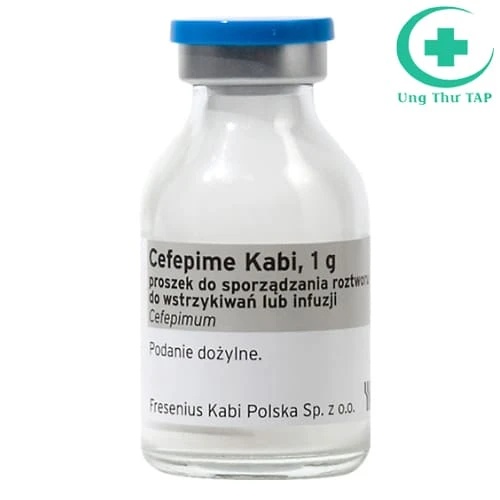
- Country of registration
- Dosage formPowder, 1 g
- ATC codeJ01DE01
- Active substance
- Prescription requiredYes
- Manufacturer
- ImporterLabesfal - Laboratorios Almiro S.A. (Fresenius Kabi Group)
- This information is for reference only and does not constitute medical advice. Always consult a doctor before taking any medication. Oladoctor is not responsible for medical decisions based on this content.
- Alternatives to Cefepime KabiDosage form: Powder, 1 gActive substance: cefepimeManufacturer: MIP Pharma GmbHPrescription requiredDosage form: Powder, 2 gActive substance: cefepimeManufacturer: MIP Pharma GmbHPrescription requiredDosage form: Powder, 1 gActive substance: cefepimeManufacturer: Laboratorio Farmaceutico C.T.s.r.l.Prescription required
Online doctors for Cefepime Kabi
Discuss questions about Cefepime Kabi, including use, safety considerations and prescription review, subject to medical assessment and local regulations.









Get Cefepime Kabi Prescription Online
Fill in a 2-min form
Tell us your symptoms, history, and what medicine you're requesting.
Pick a doctor or let us assign
Choose a specialist or we'll match you with the next available doctor.
Doctor reviews your case
Usually within 30 minutes. They may ask follow-up questions via chat.
Collect from any pharmacy
Electronic prescription sent to your email — valid across Spain.
Frequently Asked Questions
Cefepime Kabi requires a prescription in Poland. You can check with a doctor online whether this medicine may be appropriate for your situation.
The active ingredient in Cefepime Kabi is cefepime. This information helps identify medicines with the same composition but different brand names.
Cefepime Kabi is manufactured by Labesfal - Laboratorios Almiro S.A. (Fresenius Kabi Group). Pharmacy brands and packaging may differ depending on the distributor.
Doctors such as Family doctors, Psychiatrists, Dermatologists, Cardiologists, Endocrinologists, Gastroenterologists, Pulmonologists, Nephrologists, Rheumatologists, Hematologists, Infectious disease physicians, Allergists, Geriatricians, Paediatricians, Oncologists may assess whether Cefepime Kabi is appropriate, depending on your situation and local regulations. You can book an online consultation to discuss your symptoms and possible next steps.
Spain has a well-developed healthcare infrastructure across major cities such as Madrid, Barcelona, Valencia, and Seville. Pharmacies are widely available and operate under strict regulations, ensuring access to prescribed medications.
You can buy Cefepime Kabi in Madrid, Barcelona, Seville, or Valencia at any local pharmacy with a valid prescription.
To obtain a prescription, you can use Oladoctor:
Other medicines with the same active substance (cefepime) include Cefepim Mip Pharma, Cefepim Mip Pharma, Cefepime Accord. These may have different brand names or formulations but contain the same therapeutic ingredient. Always consult a doctor before switching or starting a new medicine.
