


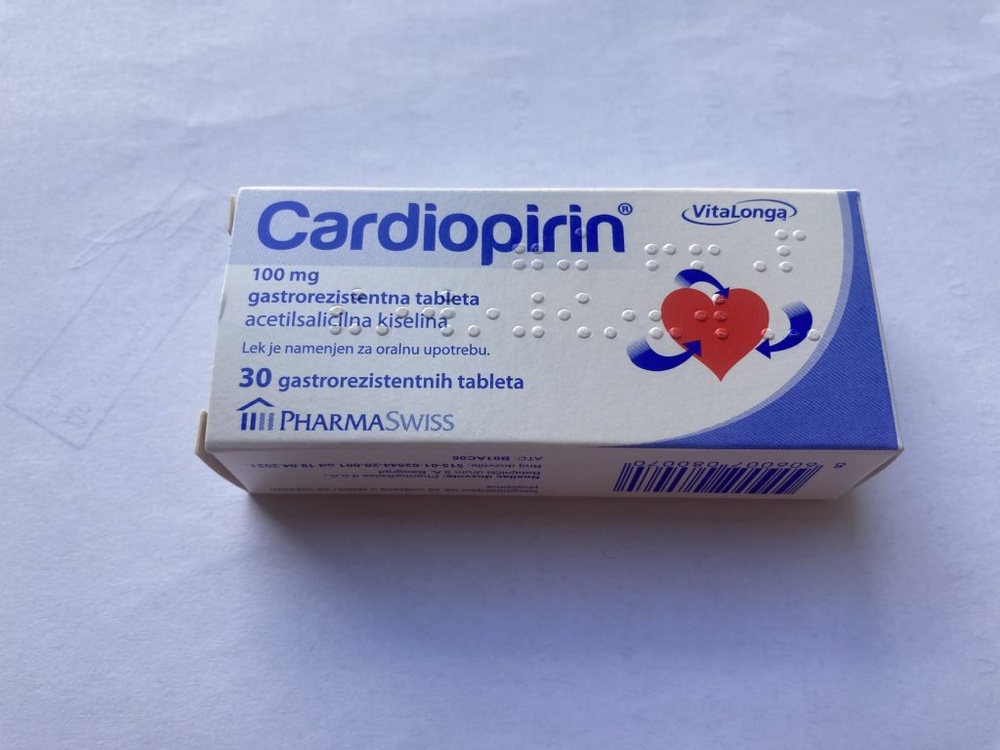
Cardiopirin
Ask a doctor about a prescription for Cardiopirin




How to use Cardiopirin
Leaflet accompanying the packaging: patient information
Cardiopirin, 75 mg, enteric-coated tablets
Cardiopirin, 100 mg, enteric-coated tablets
Acetylsalicylic acid
Read the leaflet carefully before taking the medicine, as it contains important information for the patient.
This medicine should always be taken according to the description in the patient leaflet or as directed by a doctor or pharmacist.
The leaflet should be kept in case it needs to be read again.
- The pharmacist should be consulted if advice or additional information is needed.
- If any side effects occur, including any possible side effects not listed in the leaflet, the doctor or pharmacist should be informed. See section 4.
- If there is no improvement or the patient feels worse, the doctor should be contacted.
Table of contents of the leaflet:
- 1. What is Cardiopirin and what is it used for
- 2. Important information before taking Cardiopirin
- 3. How to take Cardiopirin
- 4. Possible side effects
- 5. How to store Cardiopirin
- 6. Contents of the packaging and other information
1. What is Cardiopirin and what is it used for
Cardiopirin contains acetylsalicylic acid, which in small doses belongs to a group of medicines called antiplatelet agents. Platelets are small blood cells that cause blood clots and are involved in thrombosis. When a clot forms in an artery, it stops blood flow and reduces tissue oxygen supply. If this happens in the heart vessels, it can lead to a heart attack or angina pectoris, and in the brain, it can cause a stroke. Cardiopirin is used to reduce the risk of blood clots and prevent:
- heart attacks;
- strokes;
- cardiovascular problems in patients with stable or unstable angina pectoris (chest pain).
Cardiopirin is also used to prevent blood clots after certain heart surgeries to widen or unblock blood vessels. This medicine is not recommended for emergency cases. It can only be used as preventive treatment.
2. Important information before taking Cardiopirin
When not to take Cardiopirin:
- if the patient is allergic to acetylsalicylic acid or any of the other ingredients of this medicine (listed in section 6);
- if the patient has or has ever had stomach or duodenal ulcers, or other types of bleeding, such as stroke;
- if the patient has ever had a blood clotting problem;
- if the patient has severe kidney or liver disease;
- if the patient is in the last three months of pregnancy, doses greater than 100 mg per day should not be taken (see section "Pregnancy and breastfeeding");
- if the patient is taking a medicine called methotrexate (e.g., used to treat cancer or rheumatoid arthritis) in doses greater than 15 mg per week.
Warnings and precautions
Before starting to take Cardiopirin, the doctor or pharmacist should be consulted if:
- there are kidney, liver, or heart diseases;
- there are or have been stomach or small intestine diseases;
- the patient has high blood pressure;
- the patient has asthma, allergy to other medicines, especially other salicylates or non-steroidal anti-inflammatory drugs (NSAIDs), hay fever, nasal polyps, or other chronic respiratory diseases; acetylsalicylic acid may cause an asthma attack;
- the patient has ever had gout;
- the patient has heavy menstrual bleeding.
The patient must immediately consult a doctor if symptoms worsen or if the patient experiences severe or unexpected side effects, such as unusual bleeding, severe skin reactions, or other symptoms of a strong allergy (see section "Possible side effects"). The doctor should be informed about planned surgeries (even minor ones, such as tooth extraction), as acetylsalicylic acid "thins" the blood and the risk of bleeding may be increased.
Children and adolescents
Acetylsalicylic acid may cause Reye's syndrome in children. Reye's syndrome is a very rare disease affecting the brain and liver that can be life-threatening. Therefore, Cardiopirin should not be given to children under 16 years of age, unless a doctor recommends it. The patient should ensure not to become dehydrated (symptoms include thirst and dryness in the mouth), as concurrent use of acetylsalicylic acid may worsen kidney function. This medicine is not suitable for use as a pain reliever or antipyretic. If any of the above warnings apply to the patient or if the patient has doubts, they should consult a doctor or pharmacist.
Cardiopirin and other medicines
The doctor or pharmacist should be told about all medicines currently being taken or recently taken, as well as any medicines the patient plans to take. The use of acetylsalicylic acid with other medicines may affect treatment:
- "blood thinners" or medicines that prevent blood clots (e.g., warfarin, heparin, clopidogrel);
- medicines that prevent the rejection of transplanted organs (cyclosporine, tacrolimus);
- medicines for high blood pressure (e.g., diuretics and ACE inhibitors);
- medicines that regulate heart function (digoxin);
- medicines used to treat bipolar affective disorder (lithium salts);
- pain relievers and anti-inflammatory medicines (e.g., non-steroidal anti-inflammatory drugs), such as ibuprofen or steroids or metamizole; Metamizole (a substance with analgesic and antipyretic effects) may reduce the effect of acetylsalicylic acid on platelet aggregation (clumping of blood cells and clot formation), if these medicines are taken at the same time. Therefore, caution should be exercised when using metamizole in patients receiving acetylsalicylic acid.
- medicines for gout (e.g., probenecid);
- medicines for epilepsy (valproate, phenytoin);
- medicines for glaucoma (acetazolamide);
- medicines for cancer or rheumatoid arthritis (methotrexate in doses <15 mg week);< li>
- medicines for diabetes (e.g., glibenclamide);
- medicines for depression (selective serotonin reuptake inhibitors (SSRIs), such as sertraline or paroxetine);
- hormone replacement therapy, when the adrenal glands or pituitary gland have been destroyed or removed, or used to treat inflammatory conditions, including rheumatic diseases and colitis (corticosteroids).
Cardiopirin with food, drink, and alcohol
Enteric-coated tablets can be taken with or without food. Drinking alcohol may increase the risk of gastrointestinal bleeding and prolong bleeding time.
Pregnancy, breastfeeding, and fertility
In pregnancy, breastfeeding, or if pregnancy is suspected, or if the woman is planning to become pregnant, the doctor or pharmacist should be consulted before taking this medicine. Acetylsalicylic acid should not be taken during pregnancy, unless a doctor recommends it. During the last three months of pregnancy, the patient should not take Cardiopirin, unless a doctor recommends it, in which case the daily dose should not exceed 100 mg (see section "When not to take Cardiopirin"). Regular or high-dose use of this medicine in late pregnancy may cause serious complications in the mother or child. Breastfeeding women should not take acetylsalicylic acid, unless a doctor recommends it.
Driving and using machines
Cardiopirin should not affect the ability to drive or operate machines.
3. How to take Cardiopirin
This medicine should always be taken according to the description in the patient leaflet or as directed by a doctor or pharmacist. If in doubt, the doctor or pharmacist should be consulted. Adults
Prevention of heart attack:
The recommended dose is 75-150 mg once a day.
Prevention of stroke:
The recommended dose is 75-300 mg once a day.
Prevention of cardiovascular diseases in patients with stable or unstable angina pectoris (chest pain):
The recommended dose is 75-150 mg once a day.
Prevention of blood clots after certain heart surgeries:
The recommended dose is 75-150 mg once a day.
Elderly patients
As for adult patients. In general, acetylsalicylic acid should be used with caution in elderly patients who are more prone to side effects. Treatment should be regularly monitored.
Use in children and adolescents
Acetylsalicylic acid should not be used in children and adolescents under 16 years of age, unless a doctor recommends it (see section "Warnings and precautions").
Method of administration
For oral use.
Tablets should be swallowed whole, washed down with a sufficient amount of liquid (1/2 glass of water). The tablets have an enteric coating that prevents irritating the intestines, so they should not be crushed, broken, or chewed.
Overdose of Cardiopirin
If the patient (or anyone else) accidentally takes too many tablets, the doctor or the nearest hospital emergency department should be informed immediately. The doctor should be shown the unused medicine or the empty packaging. Symptoms of overdose may include ringing in the ears, hearing problems, headache, dizziness, disorientation, nausea, vomiting, and abdominal pain. Severe overdose may be characterized by rapid breathing (hyperventilation), fever, excessive sweating, convulsions, hallucinations, low blood sugar, coma, and shock.
Missed dose of Cardiopirin
If the patient forgets to take a dose, they should wait until the next dose is due and then continue treatment according to the established dosing schedule. A double dose should not be taken to make up for a missed dose of Cardiopirin. If the patient has any further doubts about taking this medicine, they should consult a doctor or pharmacist.
4. Possible side effects
Like all medicines, this medicine can cause side effects, although not everybody gets them.
If the patient notices any of the following serious side effects, they should stop taking Cardiopirin and contact a doctor immediately:
- sudden wheezing, swelling of the face, lips, tongue, or body, rash, fatigue, or difficulty swallowing (severe allergic reactions) (rare);
- redness of the skin with blisters or peeling, which may be associated with high fever and joint pain. These may be symptoms of erythema multiforme, Stevens-Johnson syndrome, or Lyell's syndrome (rare);
- unusual bleeding, such as coughing up blood, bloody vomiting, or blood in the urine, or black stools (frequency not known);
- mouth ulcers, fever, and infections (agranulocytosis - significantly reduced white blood cell count) (rare).
The following possible side effects are classified according to their frequency of occurrence as follows:
Common side effects (occurring in 1 to 10 in 100 patients):
- indigestion;
- increased tendency to bleeding.
Uncommon side effects (occurring in 1 to 10 in 1000 patients):
- hives;
- runny nose;
- breathing difficulties.
Rare side effects (occurring in 1 to 10 in 10,000 patients):
- severe bleeding from the stomach or intestines, bleeding in the brain, changes in blood cell count;
- nausea and vomiting;
- bronchospasm, asthma attack;
- vasculitis;
- bruises with purple spots (bleeding into the skin);
- severe allergic reactions, such as: rash in the form of erythema multiforme and its life-threatening form: Stevens-Johnson syndrome and Lyell's syndrome;
- hypersensitivity reactions, such as swelling, e.g., of the lips, face, or body, or anaphylactic shock;
- abnormal, heavy, or prolonged menstrual bleeding.
Frequency not known side effects (frequency cannot be estimated from the available data):
- ringing in the ears (tinnitus) or hearing loss;
- headache;
- dizziness;
- stomach or duodenal ulcers and perforation;
- prolonged bleeding time;
- kidney function disorders;
- liver function disorders;
- high uric acid levels in the blood.
Reporting side effects
If any side effects occur, including any side effects not listed in the leaflet, the doctor or pharmacist should be informed. Side effects can be reported directly to the Department of Monitoring of Adverse Reactions to Medicinal Products of the Office for Registration of Medicinal Products, Medical Devices, and Biocidal Products: Al. Jerozolimskie 181C, 02-222 Warsaw, tel.: 22 49-21-301, fax: 22 49-21-309, e-mail: https://smz.ezdrowie.gov.pl. Side effects can also be reported to the marketing authorization holder. By reporting side effects, more information can be collected on the safety of the medicine.
5. How to store Cardiopirin
The medicine should be stored out of sight and reach of children. Store in a temperature below 25°C. Store in the original packaging to protect from moisture. Do not use this medicine after the expiry date stated on the carton or blister pack after the EXP symbol. The expiry date refers to the last day of the month. Medicines should not be disposed of via wastewater or household waste. The pharmacist should be asked how to dispose of medicines that are no longer used. This will help protect the environment.
6. Contents of the packaging and other information
What Cardiopirin contains
- The active substance of the medicine is acetylsalicylic acid. Each enteric-coated tablet contains 75 mg or 100 mg of acetylsalicylic acid.
- The other ingredients are: tablet core:microcrystalline cellulose, corn starch, colloidal anhydrous silica, stearic acid; tablet coating:methacrylic acid and ethyl acrylate copolymer (1:1) dispersion 30%, polysorbate 80, sodium lauryl sulfate, triethyl citrate, talc.
What Cardiopirin looks like and contents of the pack
Cardiopirin, 75 mg, enteric-coated tablets: oval, white, biconvex tablets with dimensions 9.2 x 5.2 mm.
Cardiopirin, 100 mg, enteric-coated tablets: round, white, biconvex tablets with a diameter of 7.2 mm.
Pack sizes:
10, 20, 28, 30, 50, 56, 60, 90, 100 enteric-coated tablets.
Not all pack sizes may be marketed.
Marketing authorization holder
Bausch Health Ireland Limited
3013 Lake Drive
Citywest Business Campus
Dublin 24, D24PPT3
Ireland
Manufacturer
ICN Polfa Rzeszów S.A.
ul. Przemysłowa 2
35-959 Rzeszów
Poland
This medicinal product is authorized in the Member States of the European Economic Area under the following names:
Sweden
Esteprin
Bulgaria
Cardiopirin 100 mg гастрорезистентна таблетка
Czech Republic
Vasopirin 100 mg
Poland
Cardiopirin
Slovakia
Vasopirin 100 mg
Slovenia
Provapirin 100 mg gastroresistentne tablete
Date of last revision of the leaflet:
- Country of registration
- Active substance
- Prescription requiredNo
- Manufacturer
- ImporterICN Polfa Rzeszów S.A.
- This information is for reference only and does not constitute medical advice. Always consult a licensed doctor before taking any medication. Oladoctor is not responsible for medical decisions based on this content.
- Alternatives to CardiopirinDosage form: Tablets, 75 mgActive substance: acetylsalicylic acidManufacturer: G.L. Pharma GmbH Krka, d.d., Novo mesto TAD Pharma GmbHPrescription not requiredDosage form: Tablets, 100 mgActive substance: acetylsalicylic acidManufacturer: G.L. Pharma GmbH Krka, d.d., Novo mesto TAD Pharma GmbHPrescription not requiredDosage form: Tablets, 160 mgActive substance: acetylsalicylic acidManufacturer: G.L. Pharma GmbH Krka, d.d., Novo mesto TAD Pharma GmbHPrescription not required
Alternatives to Cardiopirin in other countries
The best alternatives with the same active ingredient and therapeutic effect.
Alternative to Cardiopirin in Испания
Alternative to Cardiopirin in Украина
Online doctors for Cardiopirin
Discuss dosage, side effects, interactions, contraindications, and prescription renewal for Cardiopirin – subject to medical assessment and local rules.


Get updates and exclusive offers
Be the first to know about new services, marketplace updates, and subscriber-only promos.

