


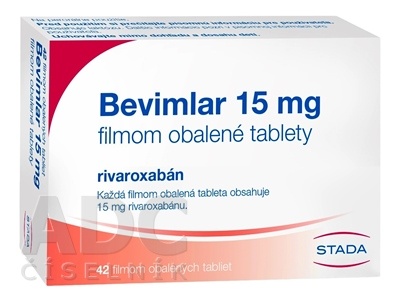
Bevimlar
Ask a doctor about a prescription for Bevimlar




How to use Bevimlar
Package Leaflet: Information for the User
Bevimlar, 15 mg, film-coated tablets
Bevimlar, 20 mg, film-coated tablets
Rivaroxaban
Read all of this leaflet carefully before taking this medicine because it contains important information for you.
- You should keep this leaflet. You may need to read it again.
- If you have any further questions, ask your doctor, pharmacist, or nurse.
- This medicine has been prescribed for you only. Do not pass it on to others. It may harm them, even if their signs of illness are the same as yours.
- If you get any side effects, talk to your doctor, pharmacist, or nurse. This includes any possible side effects not listed in this leaflet. See section 4.
Contents of the pack and other information
- 1. What Bevimlar is and what it is used for
- 2. What you need to know before you take Bevimlar
- 3. How to take Bevimlar
- 4. Possible side effects
- 5. How to store Bevimlar
- 6. Contents of the pack and other information
1. What Bevimlar is and what it is used for
Bevimlar contains the active substance rivaroxaban.
Bevimlar is used in adults to
- prevent blood clots in the brain (stroke) and other blood vessels in the body, if you have a form of irregular heart rhythm called atrial fibrillation not caused by heart valve problems
- treat blood clots in the legs (deep vein thrombosis) and in the blood vessels of the lungs (pulmonary embolism) and prevent new blood clots from forming in the blood vessels of the legs and/or lungs.
Bevimlar is used in children and adolescents aged below 18 years and weighing 30 kg or more, to
- treat and prevent blood clots in the veins or lungs after at least 5 days of initial treatment with injectable medicines used to treat blood clots.
Bevimlar belongs to a group of medicines called anticoagulants. Its action is to block factor Xa, a substance in the blood that helps to form clots, and so reduces the tendency of the blood to form clots.
2. What you need to know before you take Bevimlar
Do not take Bevimlar
- if you are allergic to rivaroxaban or any of the other ingredients of this medicine (listed in section 6)
- if you have bleeding that is not under control
- if you have a disease or condition that increases the risk of serious bleeding, such as a stomach ulcer, bleeding in the brain, recent surgery of the brain or eyes, or recent spinal injury or after a spinal tap
- if you are taking other medicines to prevent blood clots, such as warfarin, dabigatran, apixaban, or heparin, except when switching to Bevimlar or when heparin is given to maintain a line in a vein or artery
- if you have liver disease that leads to an increased risk of bleeding
- if you are pregnant or breast-feeding.
Do not take Bevimlar and inform your doctorif you think any of the above applies to you.
Warnings and precautions
Before taking Bevimlar, talk to your doctor or pharmacist.
When to be extra careful while taking Bevimlar
- if you have an increased risk of bleeding, such as severe kidney disease in adults and moderate or severe kidney disease in children and adolescents, as kidney function may affect the amount of medicine that works in the body, or if you are taking other medicines that prevent blood clotting (such as warfarin, dabigatran, apixaban, or heparin) when switching to Bevimlar or when heparin is given to maintain a line in a vein or artery (see section "Bevimlar with other medicines"), or if you have bleeding disorders, or if you have very high blood pressure that does not come down with treatment, or if you have stomach or intestinal problems that may cause bleeding, such as inflammation of the stomach or intestines, or inflammation of the esophagus (gullet), or tumors in the stomach, intestines, genital, or urinary tract
- if you have artificial heart valves
- if you have a condition called antiphospholipid syndrome (a disorder of the immune system that increases the risk of blood clots), you should inform your doctor, who will decide whether to change your treatment
- if you have abnormal blood pressure or if you are scheduled for surgery to remove a blood clot from the lungs.
If you think any of the above applies to you, tell your doctor
before taking Bevimlar. Your doctor will decide whether to prescribe Bevimlar and whether you should be kept under close observation.
If you need to have an operation:
- you must follow your doctor's instructions about taking Bevimlar in the days before and after the operation
- if you need to have a procedure to open up blocked blood vessels in the heart (called percutaneous coronary intervention, PCI, with stent placement), it is very important to take Bevimlar before and after the procedure at the times recommended by your doctor, and to inform your doctor immediately if you experience symptoms such as numbness or weakness in your legs, problems with bowel or bladder function, after the procedure, as you may need urgent treatment
Children and adolescents
Bevimlar tablets are not recommended for children under 30 kg.
There is not enough information on the use of Bevimlar in children and adolescents for the same conditions as in adults.
Bevimlar with other medicines
Tell your doctor or pharmacist about all the medicines you are taking, have recently taken, or might take, including those obtained without a prescription.
- If you are taking: certain medicines used to treat fungal infections (such as fluconazole, itraconazole, voriconazole, posaconazole), unless they are used only on the skin, ketoconazole tablets (used to treat Cushing's syndrome, a condition where the body produces too much cortisol), certain medicines used to treat bacterial infections (such as clarithromycin, erythromycin), certain antiviral medicines used to treat HIV or AIDS (such as ritonavir), other medicines used to reduce blood clotting (such as enoxaparin, clopidogrel, or vitamin K antagonists, such as warfarin or acenocoumarol), anti-inflammatory and pain-relieving medicines (such as naproxen or acetylsalicylic acid), dronedarone, a medicine used to treat irregular heart rhythm, certain medicines used to treat depression (selective serotonin reuptake inhibitors (SSRIs) or serotonin and noradrenaline reuptake inhibitors (SNRIs))
If you think any of the above applies to you, tell your doctor
before taking Bevimlar, as the effect of Bevimlar may be increased. Your doctor will decide whether to prescribe Bevimlar and whether you should be kept under close observation.
If your doctor thinks that you are at increased risk of stomach or intestinal ulcers, he or she may prescribe a medicine to prevent this.
- If you are taking: certain medicines used to treat epilepsy (phenytoin, carbamazepine, phenobarbital), St. John's Wort (Hypericum perforatum), a herbal medicine used to treat depression, rifampicin, an antibiotic
If you think any of the above applies to you, tell your doctor
before taking Bevimlar, as the effect of Bevimlar may be reduced. Your doctor will decide whether to prescribe Bevimlar and whether you should be kept under close observation.
Pregnancy and breast-feeding
Do not take Bevimlar if you are pregnant or breast-feeding. If there is a risk that you may become pregnant, you should use a reliable method of contraception while taking Bevimlar. If you become pregnant while taking Bevimlar, you should inform your doctor immediately, who will decide on the continuation of the treatment.
Driving and using machines
Bevimlar may cause dizziness (common side effect) and fainting (uncommon side effect) (see section 4, "Possible side effects"). Patients who experience these side effects should not drive, ride a bicycle, or use machines.
Bevimlar contains lactose
If you have been told by your doctor that you have an intolerance to some sugars, contact your doctor before taking this medicine.
Bevimlar contains sodium
This medicine contains less than 1 mmol sodium (23 mg) per tablet, which is essentially "sodium-free".
3. How to take Bevimlar
Always take this medicine exactly as your doctor has told you. If you are not sure, check with your doctor or pharmacist.
Bevimlar should be taken with food.
Swallow the tablet(s) whole, with water.
If you have difficulty swallowing whole tablets, talk to your doctor about other ways to take Bevimlar. The tablet can be crushed and mixed with water or soft food such as apple puree, just before taking. After taking the mixture, you should eat straight away. If necessary, your doctor may also give you the crushed tablet through a stomach tube.
How much to take
Adults
o to prevent blood clots in the brain (stroke) and other blood vessels in the body
The recommended dose is one 20 mg tablet of Bevimlar once daily.
If you have kidney problems, your doctor may reduce your dose to one 15 mg tablet of Bevimlar once daily.
If you need a procedure to open up blocked blood vessels in the heart (called percutaneous coronary intervention, PCI, with stent placement), there is limited evidence to support the use of a reduced dose of one 15 mg tablet of Bevimlar once daily (or one 10 mg tablet of Bevimlar once daily in case of kidney problems) in combination with an anti-platelet medicine such as clopidogrel.
o to treat blood clots in the legs, blood clots in the lungs, and to prevent new blood clots from forming
The recommended dose is one 15 mg tablet of Bevimlar twice daily for the first 3 weeks.
After 3 weeks, the recommended dose is one 20 mg tablet of Bevimlar once daily.
After at least 6 months of treatment for blood clots, your doctor may decide to continue treatment with one 10 mg tablet of Bevimlar once daily or one 20 mg tablet of Bevimlar once daily.
If you have kidney problems and are taking one 20 mg tablet of Bevimlar once daily, your doctor may decide to reduce your dose to one 15 mg tablet of Bevimlar once daily after 3 weeks of treatment, if the risk of bleeding is greater than the risk of new blood clots.
Children and adolescents
The dose of Bevimlar depends on body weight and will be calculated by your doctor.
o The recommended dose for children and adolescents with body weight from 30 kg to less than 50 kgis one 15 mgtablet of Bevimlar once daily.
o The recommended dose for children and adolescents with body weight of 50 kg or moreis one 20 mgtablet of Bevimlar once daily.
Each dose of Bevimlar should be taken with food, with a drink (such as water or juice). The tablets should be taken once daily, at approximately the same time each day. It is helpful to set an alarm reminder.
For parents or caregivers: you should check that the child has taken the whole dose.
The dose of Bevimlar is based on body weight, so it is important to come to scheduled doctor's appointments, as the dose may need to be adjusted if the child's weight changes.
Never adjust the dose yourself. If necessary, your doctor will adjust the dose.
Do not divide the tablet to achieve a partial dose. If a smaller dose is needed, a different form of rivaroxaban, such as a granule for oral suspension, should be used.
For children and adolescents who are unable to swallow whole tablets, rivaroxaban should be used, for example, in the form of a granule for oral suspension.
If an oral suspension is not available, the Bevimlar tablet can be crushed and mixed with water or apple puree just before taking. After taking the mixture, you should eat straight away. If necessary, your doctor may also give you the crushed tablet through a stomach tube.
If a dose is spat out or vomited
- less than 30 minutes after taking Bevimlar, you should take a new dose.
- more than 30 minutes after taking Bevimlar, do not take a new dose. In this case, take the next dose of Bevimlar at the usual time.
Contact your doctor if you spit out or vomit a dose of Bevimlar more than once.
When to take Bevimlar
Take the tablet(s) every day until your doctor tells you to stop.
It is best to take the tablet(s) at the same time each day, as this will help you to remember to take them.
Your doctor will decide how long you should take Bevimlar.
To prevent blood clots in the brain (stroke) and other blood vessels in the body:
If your heart rhythm needs to be restored to normal using a procedure called cardioversion, you should take Bevimlar as recommended by your doctor.
Missed dose of Bevimlar
- Adults, children, and adolescents: If you take one 20 mg or one 15 mg tablet oncedaily and miss a dose, take it as soon as possible. Do not take more than one tablet in a 24-hour period to make up for a missed dose. Take the next tablet at the usual time and then continue taking one tablet once daily.
- Adults: If you take one 15 mg tablet twicedaily and miss a dose, take it as soon as possible. Do not take more than two 15 mg tablets in a 24-hour period. If you miss a dose, you may take two 15 mg tablets at the same time to get a total daily dose of 30 mg. The next day, continue taking one 15 mg tablet twice daily.
Take too much Bevimlar
If you take more Bevimlar than you should, contact a doctor or hospital immediately. Taking more Bevimlar than recommended may increase the risk of bleeding.
Stopping Bevimlar
Do not stop taking Bevimlar without talking to your doctor first, as Bevimlar prevents serious health problems.
If you have any further questions on the use of this medicine, ask your doctor or pharmacist.
4. Possible side effects
Like all medicines, this medicine can cause side effects, although not everybody gets them.
As with other medicines that prevent blood clotting, Bevimlar may cause bleeding, which can be life-threatening. Excessive bleeding may lead to a sudden drop in blood pressure (shock). Not all bleeding may be obvious or external.
Seek immediate medical attention if you experience any of the following side effects:
Signs of bleeding
o bleeding into the brain or inside the skull (symptoms may include headache, one-sided weakness, vomiting, seizures, decreased consciousness, and stiff neck.
Emergency medical attention is required!),
o prolonged or excessive bleeding,
o unusual weakness, tiredness, paleness, dizziness, headache, unexplained swelling, shortness of breath, chest pain or angina,
Signs of bleeding may include:
Signs of severe skin reactions
o widespread, severe skin rash, blistering, or skin peeling (such as Stevens-Johnson syndrome, toxic epidermal necrolysis),
o drug reaction that causes rash, fever, inflammation of internal organs, blood cell abnormalities, and systemic involvement (DRESS syndrome).
The frequency of these side effects is very rare (up to 1 in 10,000 people).
Signs of severe allergic reactions
o swelling of the face, lips, mouth, tongue, or throat; hives and difficulty breathing; sudden drop in blood pressure.
The frequency of severe allergic reactions is very rare (anaphylactic reactions, including anaphylactic shock, may occur in up to 1 in 10,000 people) and uncommon (angioedema and allergic oedema may occur in 1 in 100 people).
General list of possible side effects in adults, children, and adolescents:
Common(may affect up to 1 in 10 people)
- reduced red blood cell count, which may cause pale skin and be the cause of weakness or shortness of breath
- bleeding from the stomach or intestine, bleeding from the urinary tract (including blood in the urine and heavy menstrual bleeding), nosebleeds, bleeding from the gums
- bleeding into the eye (including bleeding from the conjunctiva),
- bleeding into tissues or body cavities (haematoma, bruising),
- coughing up blood (haemoptysis),
- bleeding from the skin or bleeding under the skin
- bleeding after surgery
- oozing of blood or fluid from the wound after surgery
- swelling of the limbs
- limb pain
- kidney problems (which may be seen in blood tests),
- fever
- stomach pain, nausea (feeling sick) or vomiting, constipation, diarrhoea
- low blood pressure (symptoms may include dizziness or fainting when standing up)
- general weakness and lack of energy (fatigue), headache, dizziness
- rash, itching
- increased activity of some liver enzymes, which may be seen in blood tests
Uncommon(may affect up to 1 in 100 people)
- bleeding into the brain or inside the skull (see above signs of bleeding),
- bleeding into a joint, causing pain and swelling
- thrombocytopenia (low platelet count, which can increase the risk of bleeding)
- allergic reactions, including skin allergic reactions
- liver problems (which may be seen in blood tests)
- blood tests may show increased levels of bilirubin, liver enzymes, or platelet count
- fainting
- feeling unwell
- rapid heartbeat
- dry mouth
- hives
Rare(may affect up to 1 in 1,000 people)
- bleeding into muscles
- cholestasis (bile flow obstruction), liver inflammation, including liver cell damage
- jaundice (yellowing of the skin and eyes)
- localised swelling
- collection of blood (haematoma) in the groin as a complication of a procedure to open up blocked blood vessels in the heart, when a catheter is inserted into an artery in the leg (pseudoaneurysm)
Very rare(may affect up to 1 in 10,000 people)
- accumulation of eosinophils, a type of white blood cell that causes inflammation in the lungs (eosinophilic pneumonia)
Frequency not known(frequency cannot be estimated from the available data)
- kidney failure after severe bleeding
- kidney bleeding, sometimes with blood in the urine, leading to kidney failure (nephropathy associated with anticoagulants)
- increased pressure in the muscles of the arms and legs after bleeding, which can cause pain, swelling, changes in sensation, numbness, or paralysis (compartment syndrome after bleeding)
Side effects in children and adolescents
Overall, the side effects seen in children and adolescents treated with rivaroxaban were similar in type to those seen in adults and were mostly mild to moderate.
Side effects seen more frequently in children and adolescents:
- Very common(may affect more than 1 in 10 people)
- headache
- fever
- nosebleeds
- vomiting
Common(may affect up to 1 in 10 people)
- rapid heartbeat
- blood tests may show increased levels of bilirubin
- low platelet count (thrombocytopenia)
- heavy menstrual bleeding
Uncommon(may affect up to 1 in 100 people)
- blood tests may show increased levels of a subtype of bilirubin (direct bilirubin)
Reporting of side effects
If you get any side effects, talk to your doctor, pharmacist, or nurse. This includes any possible side effects not listed in this leaflet. You can also report side effects directly via the national reporting system listed in the "Contact details for reporting side effects" section below.
By reporting side effects, you can help provide more information on the safety of this medicine.
5. How to store Bevimlar
Keep this medicine out of the sight and reach of children.
Do not use this medicine after the expiry date which is stated on the blister and carton after EXP. The expiry date refers to the last day of that month.
There are no special storage conditions for this medicine.
Crushed tabletsThe crushed tablets are stable in water or apple puree for up to 4 hours.
Medicines should not be disposed of via wastewater or household waste. Ask your pharmacist how to dispose of medicines no longer required. These measures will help protect the environment.
6. Contents of the pack and other information
What Bevimlar contains
The active substance is rivaroxaban.
One film-coated tablet contains 15 mg or 20 mg of rivaroxaban.
The other ingredients are:
- Tablet core: microcrystalline cellulose, lactose monohydrate, povidone K-30, corn starch, crospovidone type B, sodium lauryl sulfate, magnesium stearate. See section 2 "Bevimlar contains lactose".
- Coating: hypromellose 2910, titanium dioxide (E171), macrogol 4000, iron oxide red (E172).
What Bevimlar looks like and contents of the pack
The 15 mg film-coated tablets are red, round, biconvex, approximately 6 mm in diameter. They are available in blisters containing 14, 28, 42, or 100 tablets in a carton.
The 20 mg film-coated tablets are brown-red, round, biconvex, approximately 7 mm in diameter. They are available in blisters containing 14, 28, 42, or 100 tablets in a carton.
Not all pack sizes may be marketed.
Marketing Authorisation Holder and Manufacturer
Marketing Authorisation Holder:
STADA Arzneimittel AG
Stadastrasse 2-18
61118 Bad Vilbel
Germany
For further information on this medicine, please contact the Marketing Authorisation Holder:
Stada Pharm Sp. z o.o.
ul. Krakowiaków 44
02-255 Warsaw
Phone: +48 22 737 79 20
Manufacturer/Importer:
STADA Arzneimittel AG
Stadastrasse 2-18,
61118 Bad Vilbel,
Germany
Laboratorios Liconsa S.A.
Avenida Miralcampo 7
Polígono Industrial Miralcampo
ES- 19200 Guadalajara
Spain
This medicine is authorised in the Member States of the European Economic Area under the following names:
Sweden:
Bevimlar
Czech Republic:
Bevimlar
Hungary:
Poland:
Bevimlar
Bevimlar
Slovakia:
Bevimlar
Date of last revision of the leaflet:
- Country of registration
- Active substance
- Prescription requiredNo
- ImporterLaboratorios Liconsa S.A. STADA Arzneimittel AG
- This information is for reference only and does not constitute medical advice. Always consult a licensed doctor before taking any medication. Oladoctor is not responsible for medical decisions based on this content.
- Alternatives to BevimlarDosage form: Tablets, 2.5 mgActive substance: rivaroxabanManufacturer: Genericon Pharma Gesellschaft m.b.H. PharOS Mt Ltd Rontis Hellas Medical and Pharmaceutical Products S.A.Prescription not requiredDosage form: Tablets, 10 mgActive substance: rivaroxabanManufacturer: Genericon Pharma Gesellschaft m.b.H. PharOS Mt Ltd Rontis Hellas Medical and Pharmaceutical Products S.A.Prescription not requiredDosage form: Tablets, 15 mgActive substance: rivaroxabanManufacturer: Genericon Pharma Gesellschaft m.b.H. PharOS Mt Ltd Rontis Hellas Medical and Pharmaceutical Products S.A.Prescription not required
Alternatives to Bevimlar in other countries
The best alternatives with the same active ingredient and therapeutic effect.
Alternative to Bevimlar in Spain
Alternative to Bevimlar in Ukraine
Online doctors for Bevimlar
Discuss dosage, side effects, interactions, contraindications, and prescription renewal for Bevimlar – subject to medical assessment and local rules.


Get updates and exclusive offers
Be the first to know about new services, marketplace updates, and subscriber-only promos.

