



ATAZANAVIR 200 mg Capsules

Prescription review online
A doctor will review your case and decide whether a prescription is medically appropriate.

Talk to a doctor about this medicine
Discuss your symptoms and possible next steps in a quick online consultation.



How to use Atazanavir Accord
Contents of the leaflet
- Package Leaflet: Information for the Patient
- Atazanavir Accord, 150 mg, hard capsules
- Atazanavir Accord, 200 mg, hard capsules
- Atazanavir Accord, 300 mg, hard capsules
- What is Atazanavir Accord and what is it used for
- Important information before taking Atazanavir Accord
- How to take Atazanavir Accord
- Possible side effects
- How to store Atazanavir Accord
- Contents of the pack and other information
- What Atazanavir Accord contains
- What Atazanavir Accord looks like and contents of the pack
- Marketing authorization holder
- Manufacturer/Importer
- This medicinal product is authorized in the Member States of the European Economic Area and in the United Kingdom (Northern Ireland) under the following names:
- Member State
- Marketing authorization holder
- Date of last revision of the package leaflet: September 2023
Package Leaflet: Information for the Patient
Atazanavir Accord, 150 mg, hard capsules

Not sure if this medicine is right for you?
Discuss your symptoms and treatment with a doctor online.
Atazanavir Accord, 200 mg, hard capsules
Atazanavir Accord, 300 mg, hard capsules
atazanavir
Read the package leaflet carefully before taking the medicine, as it contains important information for the patient.
- Keep this package leaflet, you may need to read it again.
- If you have any further questions, ask your doctor or pharmacist.
- This medicine has been prescribed for you only. Do not pass it on to others. It may harm them, even if their symptoms are the same as yours.
- If you experience any side effects, including those not listed in this package leaflet, tell your doctor or pharmacist. See section 4.
Contents of the Package Leaflet
- 1. What is Atazanavir Accord and what is it used for
- 2. Important information before taking Atazanavir Accord
- 3. How to take Atazanavir Accord
- 4. Possible side effects
- 5. How to store Atazanavir Accord
- 6. Contents of the pack and other information

Started taking the medicine and have questions?
Discuss your symptoms and treatment with a doctor online.
1. What is Atazanavir Accord and what is it used for
Atazanavir Accord is an antiviral medicine (antiretroviral).It belongs to a group of medicines called protease inhibitors. These medicines control HIV infection by inhibiting a protein that the HIV virus needs to replicate. They work by reducing the amount of HIV in the body, which helps to strengthen the immune system. In this way, Atazanavir Accord reduces the risk of developing diseases related to HIV infection.
Atazanavir Accord capsules can be used in adults and children from 6 years of age. Your doctor has prescribed Atazanavir Accord because you have HIV and are at risk of developing acquired immunodeficiency syndrome (AIDS). Atazanavir Accord is usually used in combination with other HIV medicines. Your doctor will discuss with you which of these medicines to use in combination with Atazanavir Accord.
2. Important information before taking Atazanavir Accord
When not to take Atazanavir Accord:
- if you are allergicto atazanavir or any of the other ingredients of this medicine (listed in section 6)
- if you have moderate or severe liver problems. Before taking Atazanavir Accord, your doctor will assess the severity of your liver disease.
- if you are taking any of the following medicines(see also "Atazanavir Accord and other medicines"):
- rifampicin (an antibiotic used to treat tuberculosis)
- astemizole or terfenadine (medicines often used to treat allergy symptoms, which may also be available without a prescription); cisapride (a medicine used to treat gastroesophageal reflux disease, whose symptoms are sometimes called heartburn); pimozide (a medicine used to treat schizophrenia); quinidine or bepridil (medicines used to regulate heart rhythm);
ergotamine, dihydroergotamine, ergometrine, methylergometrine (medicines used to treat headache) and alfuzosin (a medicine used to treat enlarged prostate)
- quetiapine (a medicine used to treat schizophrenia, bipolar disorder, and severe depression); lurasidone (a medicine used to treat schizophrenia)
- herbal medicines containing St. John's Wort (Hypericum perforatum)
- triazolam and oral midazolam (medicines used to help you sleep or relieve anxiety)
- lomitapide, simvastatin, and lovastatin (medicines used to lower cholesterol levels in the blood)
- medicines containing grazoprevir, including combination products containing elbasvir and grazoprevir in a fixed dose, and glecaprevir and pibrentasvir in a fixed dose (used to treat chronic hepatitis C virus infection)
Do not take Atazanavir Accord with sildenafil used to treat pulmonary arterial hypertension. Sildenafil is also used to treat erectile dysfunction. If you are taking sildenafil to treat erectile dysfunction, tell your doctor. If any of the above applies to you, tell your doctor immediately.
Warnings and precautions
Atazanavir Accord does not cure HIV infection. There is still a risk of developing infections or other diseases related to HIV.
Some people require special care before taking and while taking Atazanavir Accord. Before starting treatment with Atazanavir Accord, discuss this with your doctor and pharmacist.
Tell your doctor if you:
- have viral hepatitis B or C;
- have symptoms of gallstones (pain on the right side of the abdomen);
- have hemophilia A or B;
- require hemodialysis.
Atazanavir Accord may affect kidney function.
Patients taking atazanavir have reported kidney stones. If you experience symptoms of kidney stones (pain in the side, blood in the urine, pain while urinating), tell your doctor immediately.
In some patients with advanced HIV infection (with AIDS) and a history of opportunistic infections, signs of inflammation from previous infections may occur soon after starting antiviral treatment. It is believed that these symptoms are due to the improvement of the immune system, which allows the body to fight infections that may have been hidden. If you notice any symptoms of infection, tell your doctor immediately. In addition to opportunistic infections, autoimmune diseases (diseases in which the immune system attacks healthy tissues) may also occur after starting HIV treatment. Autoimmune diseases can occur months after starting treatment. If you notice any symptoms of infection or other symptoms such as muscle weakness, weakness starting from the hands and feet and moving towards the trunk, heart palpitations, tremors, or hyperactivity, tell your doctor immediately so that they can provide the necessary treatment.
In some patients taking combination antiretroviral therapy, a condition called osteonecrosis (death of bone tissue due to insufficient blood supply) may develop. Risk factors for developing this condition include long-term use of combination antiretroviral therapy, use of corticosteroids, alcohol consumption, significant immune system suppression, increased body mass index, and others. Symptoms of osteonecrosis are stiffness and pain in the joints (especially hips, knees, and shoulders) and difficulty moving. If you experience any of these symptoms, tell your doctor.
Patients taking atazanavir have reported hyperbilirubinemia (increased bilirubin levels in the blood). A symptom may be a slight yellowing of the skin or eyes. If you experience any of these symptoms, tell your doctor.
Patients taking atazanavir have reported severe skin rashes, including Stevens-Johnson syndrome. If a rash appears, contact your doctor immediately.
If you experience heart rhythm disturbances (changes in heart rhythm), tell your doctor. In children taking Atazanavir Accord, heart function may need to be monitored. Your doctor will decide whether such monitoring is necessary.
Children
Do not give this medicine to childrenunder 3 months of age and weighing less than 5 kg. Atazanavir has not been studied in children under 3 months of age and weighing less than 5 kg due to the risk of serious complications.
Atazanavir Accord and other medicines
Tell your doctor about all medicines you are currently taking, or have recently taken, and about any medicines you plan to take.
Some medicines must not be taken with Atazanavir Accord. These are listed at the beginning of section 2 in "When not to take Atazanavir Accord".
There are also other medicines that must not be taken with Atazanavir Accord. Tell your doctor about all medicines you are currently taking, or have recently taken, and about any medicines you plan to take. It is especially important to tell your doctor if you are taking:
- other medicines used to treat HIV (e.g., indinavir, nevirapine, and efavirenz)
- sofosbuvir with velpatasvir and voxilaprevir (medicines used to treat hepatitis C virus infection)
- sildenafil, vardenafil, or tadalafil (medicines used to treat erectile dysfunction)
- oral contraceptives ("the pill"): if you are taking oral contraceptives while taking Atazanavir Accord, you should strictly follow your doctor's instructions and not miss any doses
- any medicines used to treat diseases related to stomach acid production (e.g., antacids [which should be taken 1 hour before or 2 hours after Atazanavir Accord], H2 receptor antagonists [such as famotidine], and proton pump inhibitors [such as omeprazole])
- medicines used to lower blood pressure, slow heart rate, or regulate heart rhythm (amiodarone, diltiazem, lidocaine given systemically, verapamil)
- atorvastatin, pravastatin, and fluvastatin (medicines used to lower cholesterol levels in the blood)
- salmeterol (a medicine used to treat asthma)
- cyclosporine, tacrolimus, and sirolimus (medicines used to reduce the effects of the immune system)
- certain antibiotics (rifabutin, clarithromycin)
- ketoconazole, itraconazole, and voriconazole (antifungal medicines)
- apixaban, dabigatran, edoxaban, rivaroxaban, and warfarin (anticoagulant medicines used to prevent blood clots)
- carbamazepine, phenytoin, phenobarbital, lamotrigine (antiepileptic medicines)
- irinotecan (a medicine used to treat cancer)
- sedatives (e.g., midazolam given by injection)
- buprenorphine (a medicine used to treat opioid dependence and pain)
Some medicines may interact with ritonavir used with Atazanavir Accord. It is important to tell your doctor if you are taking fluticasone or beclomethasone (medicines given nasally or by inhalation to treat allergy symptoms or asthma).
Atazanavir Accord with food and drink
It is important to take Atazanavir Accord with food (a full meal or a substantial snack), as this helps the body absorb the medicine.
Pregnancy and breastfeeding
If you are pregnant or breastfeeding, think you may be pregnant, or are planning to have a baby, ask your doctor for advice before taking this medicine.
Atazanavir, the active substance in Atazanavir Accord, passes into breast milk. Women taking this medicine must not breastfeed.
It is not recommended that HIV-infected women breastfeed their babies, as there is a risk of transmitting the virus through breast milk to the child.
If you are breastfeeding or planning to breastfeed, discuss this with your doctor as soon as possible.
Driving and using machines
If you experience dizziness or drowsiness after taking Atazanavir Accord, do not drive or operate machinery, but consult your doctor immediately.
Atazanavir Accord contains lactose
If you have been told that you have an intolerance to some sugars, contact your doctor before taking this medicine.
Atazanavir Accord, 200 mg, hard capsules, and Atazanavir Accord, 300 mg, hard capsules, contain orange yellow S (E110). May cause allergic reactions.
3. How to take Atazanavir Accord
Always take this medicine exactly as your doctor has told you. If you are not sure, ask your doctor. This will help to ensure that the medicine is fully effective and reduce the risk of developing resistance to treatment.
The recommended dose of Atazanavir Accord for adults is 300 mg once daily with
ritonavir 100 mg once daily, taken with foodand in combination with other HIV medicines. Your doctor may adjust the dose of Atazanavir Accord according to the treatment regimen used.
The dose of Atazanavir Accord for children and adolescents (from 6 to less than 18 years of age) will be
calculated by your doctor based on the child's weight. The dose calculated based on body weight should be taken once daily with food, with ritonavir 100 mg once daily, as shown in the following table:
| Body weight (kg) | Dose of Atazanavir Accord to be taken once daily (mg) | Dose of ritonavir* to be taken once daily (mg) |
| 15 to less than 35 | 200 mg | 100 mg |
| 35 or more | 300 mg | 100 mg |
| *Ritonavir capsules, tablets, or oral solution can be used. | ||
Check the availability of other pharmaceutical forms suitable for use in children from 3 months of age and weighing at least 5 kg. It is recommended to switch to Atazanavir Accord capsules when the patient is able to swallow capsules consistently. Changing the formulation from oral powder to capsules may require a dose adjustment. Your doctor will determine the appropriate dose based on the child's weight.
Atazanavir Accord should be taken with food(a full meal or a substantial snack). The capsules should be swallowed whole. The capsules should not be opened.
Overdose of Atazanavir Accord
Taking more than the prescribed dose of Atazanavir Accord may cause yellowing of the skin and/or eyes (jaundice) and irregular heart rhythm (prolonged QTc interval).
If you have taken more Atazanavir Accord capsules than your doctor prescribed, contact your doctor or the nearest hospital immediately.
Missing a dose of Atazanavir Accord
If you miss a dose, take it as soon as you remember, with food. Take the next dose at the usual time. However, if it is almost time for the next dose, skip the missed dose. Do not take a double dose to make up for a missed dose.
Stopping treatment with Atazanavir Accord
Do not stop taking Atazanavir Accord without consulting your doctor.
If you have any further questions on the use of this medicine, ask your doctor or pharmacist.
4. Possible side effects
Like all medicines, Atazanavir Accord can cause side effects, although not everybody gets them.
During HIV treatment, it is not always easy to determine whether a side effect is caused by Atazanavir Accord or other medicines you are taking, or by the disease related to HIV. Tell your doctor about any changes in your health.
During HIV treatment, you may experience an increase in weight and levels of lipids and glucose in the blood. This is partly due to the improvement in your health and lifestyle, and in the case of lipids, sometimes due to the HIV medicines themselves. Your doctor will perform tests to monitor these changes.
If you experience any of the following serious side effects, tell your doctor immediately.
- It is possible to experience skin rash, itching, which can be severe. The rash usually disappears within 2 weeks without changing the treatment with Atazanavir Accord. Severe rash can occur with other symptoms, which can be severe. If you experience a severe rash or rash with symptoms resembling flu, formation of blisters, fever, mouth sores, muscle or joint pain, swelling of the face, eye inflammation causing redness (conjunctivitis), formation of painful, warm, or red bumps, stop taking Atazanavir Accord and contact your doctor immediately.
- Frequent yellowing of the skin or eyes due to high bilirubin levels in the blood has been reported. This side effect is usually not serious in adults and children over 3 months of age, but it can be a sign of serious liver problems. If your skin or eyes turn yellow, contact your doctor immediately.
- Rarely, changes in heart rhythm have been reported. If you experience dizziness, drowsiness, or sudden fainting, contact your doctor immediately. These may be symptoms of serious heart problems.
- Uncommonly, liver problems have been reported. Your doctor should perform blood tests before starting treatment with Atazanavir Accord and during treatment. In patients with liver problems, including hepatitis B and C, liver disease may worsen. If you experience dark urine (tea-colored), itching, yellowing of the skin or eyes, stomach pain, pale stools, or nausea, contact your doctor immediately.
- During treatment with atazanavir, uncommonly, gallbladder problems have been reported. Symptoms may include: pain in the right or middle upper abdomen, nausea, vomiting, fever, or yellowing of the skin or eyes.
- Atazanavir Accord may affect kidney function.
- Patients taking atazanavir have uncommonly reported kidney stones. If you experience symptoms of kidney stones, such as pain in the lower back or abdomen, blood in the urine, or pain while urinating, contact your doctor immediately.
Other side effects reported in patients taking atazanavir:
Common (may affect up to 1 in 10 people):
- headache
- vomiting, diarrhea, abdominal pain (stomach pain and discomfort), nausea, indigestion
- extreme fatigue
Uncommon (may affect up to 1 in 100 people):
- peripheral neuropathy (numbness, weakness, tingling, or pain in the arms and legs)
- hypersensitivity (allergic reaction)
- asthenia (feeling unusual tiredness or weakness)
- weight loss or gain, loss of appetite, increased appetite
- depression, anxiety, sleep disorders
- disorientation, memory loss, dizziness, drowsiness, unusual dreams
- fainting, high blood pressure
- shortness of breath
- pancreatitis, stomach inflammation, mouth sores, taste disorders, gas, dry mouth, abdominal bloating
- angioedema (severe swelling of the skin and other tissues, most commonly in the lips or eyes)
- hair loss (unusual hair loss or thinning), itching
- muscle atrophy (reduction in muscle mass), joint pain, muscle pain
- interstitial nephritis, hematuria (blood in the urine), proteinuria (protein in the urine), frequent urination
- gynecomastia (breast enlargement in men)
- chest pain, malaise, fever
- insomnia (difficulty sleeping)
Rare (may affect up to 1 in 1000 people):
- gait disturbances (abnormal gait)
- edema
- liver and spleen enlargement
- myopathy (muscle pain, tenderness, and weakness not caused by physical exertion)
- kidney pain
Reporting side effects
If you experience any side effects, including those not listed in this package leaflet, tell your doctor or nurse. Side effects can be reported directly to the Department of Drug Safety Monitoring, Office for Registration of Medicinal Products, Medical Devices, and Biocidal Products:
Al. Jerozolimskie 181C, 02-222 Warsaw
tel.: +48 22 49 21 301, fax: +48 22 49 21 309 website: https://smz.ezdrowie.gov.pl
Side effects can also be reported to the marketing authorization holder.
By reporting side effects, you can help provide more information on the safety of this medicine.
5. How to store Atazanavir Accord
Keep this medicine out of the sight and reach of children.
There are no special storage instructions for this medicinal product.
Do not use this medicine after the expiry date stated on the carton, bottle, and blister after EXP. The expiry date refers to the last day of that month.
Medicines should not be disposed of via wastewater or household waste. Ask your pharmacist how to dispose of medicines no longer required. This will help protect the environment.
6. Contents of the pack and other information
What Atazanavir Accord contains
Atazanavir Accord, 150 mg, hard capsules
- The active substance is atazanavir. One hard capsule contains 150 mg of atazanavir (as atazanavir sulfate).
- The other ingredients are:
- capsule content:lactose monohydrate, crospovidone type B, magnesium stearate
- capsule shell:gelatin, brilliant blue FCF (E 133), iron oxide black (E 172), iron oxide yellow (E 172), titanium dioxide (E 171)
- black ink:shellac, iron oxide black (E 172), potassium hydroxide
Atazanavir Accord, 200 mg, hard capsules
- The active substance is atazanavir. One hard capsule contains 200 mg of atazanavir (as atazanavir sulfate).
- The other ingredients are:
- capsule content:lactose monohydrate, crospovidone type B, magnesium stearate
- capsule shell:gelatin, brilliant blue FCF (E 133), iron oxide yellow (E 172), titanium dioxide (E 171), orange yellow S (E 110)
- black ink:shellac, iron oxide black (E 172), potassium hydroxide
Atazanavir Accord, 300 mg, hard capsules
- The active substance is atazanavir. One hard capsule contains 300 mg of atazanavir (as atazanavir sulfate).
- The other ingredients are:
- capsule content:lactose monohydrate, crospovidone type B, magnesium stearate
- capsule shell:gelatin, brilliant blue FCF (E 133), iron oxide yellow (E 172), titanium dioxide (E 171), erythrosine (E 127), orange yellow S (E 110)
- black ink:shellac, iron oxide black (E 172), potassium hydroxide
What Atazanavir Accord looks like and contents of the pack
Atazanavir Accord, 150 mg, hard capsules are a granular powder with a white to light yellow color in hard gelatin capsules, approximately 19.3 mm in length, with a green opaque cap with a black print "H" and a light green opaque body with a black print "A6".
Available in OPA/Aluminum/PVC/Aluminum blisters containing 30, 60, and 90 hard capsules, in a cardboard box. Also available in a high-density polyethylene (HDPE) bottle with a child-resistant polypropylene (PP) cap, containing 60 hard capsules, in a cardboard box.
Atazanavir Accord, 200 mg, hard capsules are a granular powder with a white to light yellow color in hard gelatin capsules, approximately 21.4 mm in length, with a green opaque cap with a black print "H" and a light green opaque body with a black print "A7".
Available in OPA/Aluminum/PVC/Aluminum blisters containing 30, 60, and 90 hard capsules, in a cardboard box. Also available in a high-density polyethylene (HDPE) bottle with a child-resistant polypropylene (PP) cap, containing 60 hard capsules, in a cardboard box.
Atazanavir Accord, 300 mg, hard capsules are a granular powder with a white to light yellow color in hard gelatin capsules, approximately 23.5 mm in length, with an orange opaque cap with a black print "H" and a green opaque body with a black print "A8".
Available in OPA/Aluminum/PVC-Aluminum blisters containing 30, 60, and 90 hard capsules, in a cardboard box. Also available in a high-density polyethylene (HDPE) bottle with a child-resistant polypropylene (PP) cap, containing 30 hard capsules, in a cardboard box.
Marketing authorization holder
Accord Healthcare Polska Sp. z o.o.
Taśmowa 7
02-677 Warsaw
Poland
Tel: +48 22 577 28 00
Manufacturer/Importer
Pharmadox Healthcare Ltd.
KW20A Kordin Industrial Park
Paola, PLA 3000
Malta
Accord Healthcare Polska Sp. z o.o.
Lutomierska 50
96-200 Pabianice
This medicinal product is authorized in the Member States of the European Economic Area and in the United Kingdom (Northern Ireland) under the following names:
Member State
Marketing authorization holder
Bulgaria
Atazanavir Accord 150 mg hard capsules
Croatia
Atazanavir Accord
Cyprus
Atazanavir Accord 150 mg/300 mg σκληρά καψάκια
Czech Republic
Atazanavir Accord
Denmark
Atazanavir Accord
Spain
Atazanavir Accord 150 mg/200 mg/300 mg capsulas duras
Netherlands
Atazanavir Accord 150 mg/200 mg/300 mg harde capsule
Ireland
Atazanavir Accord 200 mg/300 mg hard capsules
Finland
Atazanavir Accord 200 mg/300 mg kapselit, kovat
Germany
Atazanavir Accord 150 mg/200 mg/300 mg Hartkapseln
Norway
Atazanavir Accord
Poland
Atazanavir Accord
Portugal
Atazanavir Accord
Romania
Atazanavir Accord 150 mg/200 mg/300 mg hard capsules
Slovenia
Atazanavir Accord 150 mg/200 mg/300 mg trde kapsule
Sweden
Atazanavir Accord 200 mg/300 mg hårda kapslar
Hungary
Atazanavir Accord Accord 150 mg/200 mg/300 mg tvrde kapsule
United Kingdom (Northern Ireland)
Atazanavir Accord 150 mg/200 mg/300 mg hard capsules
Italy
Atazanavir Accord
Date of last revision of the package leaflet: September 2023
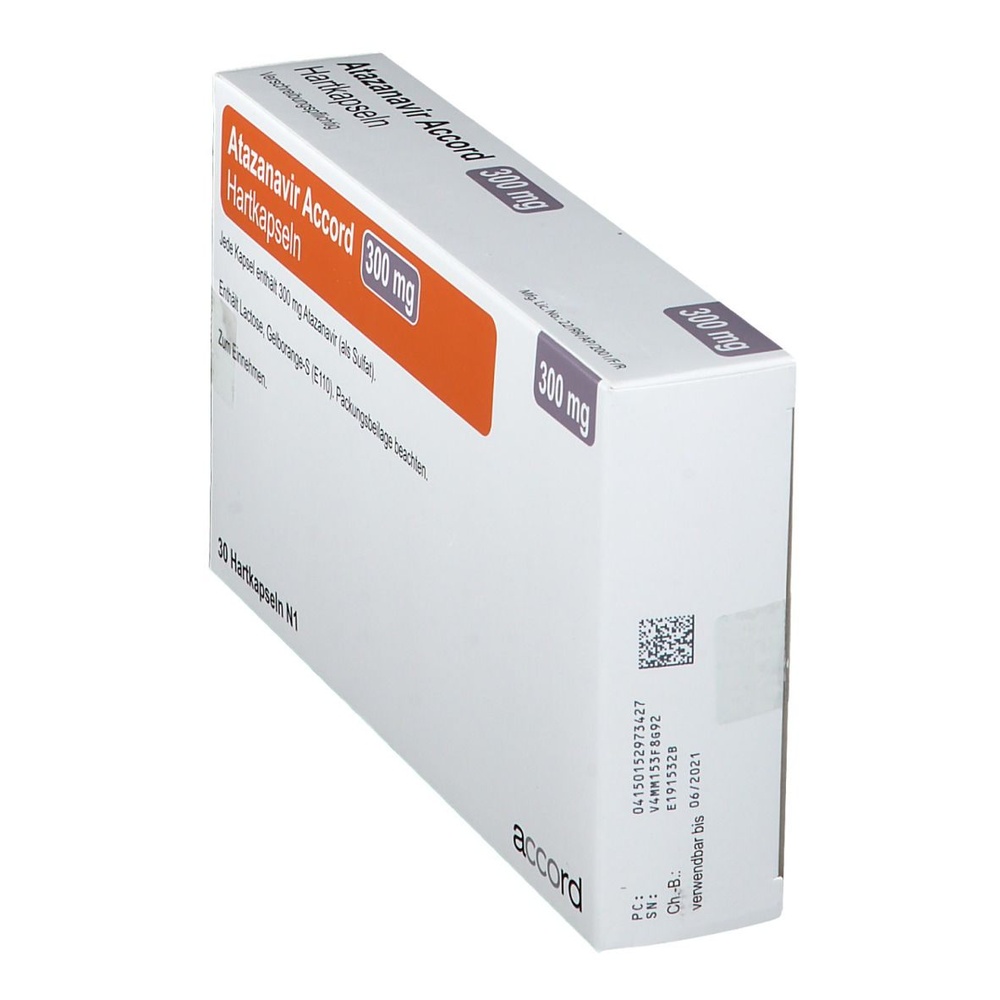
- Country of registration
- Dosage formCapsules, 200 mg
- ATC codeJ05AE08
- Active substance
- Prescription requiredYes
- Manufacturer
- ImporterAccord Healthcare Polska Sp. z o.o. Pharmadox Healthcare Ltd.
- This information is for reference only and does not constitute medical advice. Always consult a doctor before taking any medication. Oladoctor is not responsible for medical decisions based on this content.
- Alternatives to Atazanavir AccordDosage form: Capsules, 150 mgActive substance: atazanavirManufacturer: Pharmadox Healthcare Ltd.Prescription requiredDosage form: Capsules, 300 mgActive substance: atazanavirManufacturer: Pharmadox Healthcare Ltd.Prescription requiredDosage form: Capsules, 300 mgActive substance: atazanavirManufacturer: Zentiva, k.s.Prescription required
Online doctors for Atazanavir Accord
Discuss questions about Atazanavir Accord, including use, safety considerations and prescription review, subject to medical assessment and local regulations.









Get Atazanavir Accord Prescription Online
Fill in a 2-min form
Tell us your symptoms, history, and what medicine you're requesting.
Pick a doctor or let us assign
Choose a specialist or we'll match you with the next available doctor.
Doctor reviews your case
Usually within 30 minutes. They may ask follow-up questions via chat.
Collect from any pharmacy
Electronic prescription sent to your email — valid across Spain.
Frequently Asked Questions
Atazanavir Accord requires a prescription in Poland. You can check with a doctor online whether this medicine may be appropriate for your situation.
The active ingredient in Atazanavir Accord is atazanavir. This information helps identify medicines with the same composition but different brand names.
Atazanavir Accord is manufactured by Pharmadox Healthcare Ltd.. Pharmacy brands and packaging may differ depending on the distributor.
Doctors such as Family doctors, Psychiatrists, Dermatologists, Cardiologists, Endocrinologists, Gastroenterologists, Pulmonologists, Nephrologists, Rheumatologists, Hematologists, Infectious disease physicians, Allergists, Geriatricians, Paediatricians, Oncologists may assess whether Atazanavir Accord is appropriate, depending on your situation and local regulations. You can book an online consultation to discuss your symptoms and possible next steps.
Spain has a well-developed healthcare infrastructure across major cities such as Madrid, Barcelona, Valencia, and Seville. Pharmacies are widely available and operate under strict regulations, ensuring access to prescribed medications.
You can buy Atazanavir Accord in Madrid, Barcelona, Seville, or Valencia at any local pharmacy with a valid prescription.
To obtain a prescription, you can use Oladoctor:
Other medicines with the same active substance (atazanavir) include Atazanavir Accord, Atazanavir Accord, Atazanavir Zentiva. These may have different brand names or formulations but contain the same therapeutic ingredient. Always consult a doctor before switching or starting a new medicine.
