


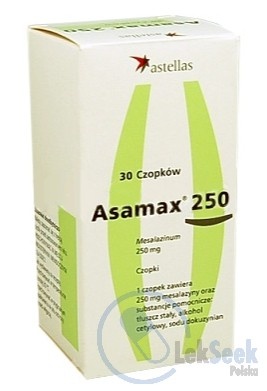
Asamax 250
Ask a doctor about a prescription for Asamax 250




How to use Asamax 250
Package Leaflet: Information for the Patient
Asamax 250, 250 mg, enteric-coated tablets
Asamax 500, 500 mg, enteric-coated tablets
Mesalazine
Read the package leaflet carefully before taking the medicine, as it contains important information for the patient.
Keep this package leaflet, you may need to read it again.
In case of any doubts, consult a doctor or pharmacist.
This medicine has been prescribed specifically for you. Do not pass it on to others. The medicine may harm another person, even if their symptoms are the same.
If the patient experiences any side effects, including any not listed in this leaflet, they should tell their doctor or pharmacist. See section 4.
Table of Contents of the Package Leaflet:
- 1. What is Asamax 250 and Asamax 500 and what is it used for
- 2. Important information before taking Asamax 250 and Asamax 500
- 3. How to take Asamax 250 and Asamax 500
- 4. Possible side effects
- 5. How to store Asamax 250 and Asamax 500
- 6. Contents of the pack and other information
1. What is Asamax 250 and Asamax 500 and what is it used for
Asamax 250 and Asamax 500 enteric-coated tablets contain the active substance mesalazine.
Mesalazine has a direct anti-inflammatory effect. Asamax 250 and Asamax 500 enteric-coated tablets inhibit the development of the disease process in the intestines.
Indications for use of Asamax 250 and Asamax 500
Mild to moderate ulcerative colitis, both in the acute phase and in remission.
Crohn's disease in the colon, both in the acute phase and in remission.
2. Important information before taking Asamax 250 and Asamax 500
When not to take Asamax 250 and Asamax 500
Warnings and precautions
Before starting mesalazine treatment, the patient should inform their doctor:
- if they have a history of myocarditis or pericarditis.
- if they have a history of liver or kidney disease.
- if they have a history of sulfa allergy.
- if they are taking any other medicines, including those not prescribed by a doctor.
the patient should stop taking mesalazine and seek medical attention immediately if they experience any of the following symptoms: severe skin rash, peeling of the skin, blisters in the mouth, throat, nose, genitals, or eyes, widespread rash, fever, and swollen lymph nodes.
- the doctor will monitor the patient's blood counts and liver and kidney function during treatment.
- the doctor will be cautious when prescribing mesalazine to patients with liver disease.
- mesalazine should not be taken by patients with kidney disease. In patients who develop kidney failure during treatment, the possibility of mesalazine toxicity should be considered.
- the doctor will closely monitor patients with lung disease, especially those with asthma.
- the doctor will closely monitor patients who have experienced side effects after taking sulfasalazine.
- if the patient experiences a hypersensitivity reaction, the doctor will stop treatment.
- mesalazine may cause kidney stones. Symptoms may include pain in the sides of the abdomen and blood in the urine. During mesalazine treatment, the patient should drink plenty of fluids.
- mesalazine may cause a reddish-brown discoloration of the urine after contact with sodium hypochlorite bleach in the toilet water. This is a harmless chemical reaction between mesalazine and bleach.
Children and adolescents
There is limited data on the use of mesalazine in children and adolescents (aged 6-18 years).
Asamax 250 and Asamax 500 and other medicines:
The patient should tell their doctor about all medicines they are currently taking or have recently taken, as well as any medicines they plan to take.
In patients who are also taking azathioprine, 6-mercaptopurine, or thioguanine, there is a possibility of increased bone marrow suppression.
There is limited evidence that mesalazine may reduce the anticoagulant effect of warfarin.
Asamax 250 and Asamax 500 with food and drink:
Asamax 250 and Asamax 500 enteric-coated tablets should be taken after a meal, with a drink. Do not chew.
Pregnancy, breastfeeding, and fertility:
If the patient is pregnant or breastfeeding, thinks they may be pregnant, or plans to have a baby, they should consult their doctor before taking this medicine.
Asamax 250 and Asamax 500 should only be used during pregnancy if the potential benefits outweigh the expected risks.
There is limited data on the use of mesalazine in pregnant women. Data from a limited number of women exposed to mesalazine during pregnancy did not show any adverse effects on the pregnancy, the fetus, or the newborn. Other epidemiological data are not available at present.
In a single case, after taking high doses of mesalazine (2-4 g orally) during pregnancy, kidney failure was reported in the newborn.
Animal studies with mesalazine did not show any direct or indirect harmful effects on pregnancy, embryonic or fetal development, or postnatal development.
Asamax 250 and Asamax 500 should only be used during breastfeeding if the potential benefits outweigh the expected risks.
N-acetyl-5-aminosalicylic acid and, to a lesser extent, mesalazine pass into breast milk in small amounts. To date, only limited data are available from breastfeeding women. In breastfed infants, it is not possible to exclude an allergic reaction, such as diarrhea. If diarrhea occurs in the breastfed infant, breastfeeding should be discontinued.
The use of mesalazine during pregnancy and breastfeeding is always decided by the doctor.
Very rarely, a temporary decrease in sperm count in semen has been reported in association with mesalazine. There is no data on the effect of mesalazine on fertility in women.
Driving and using machines:
No effects of mesalazine on the ability to drive or use machines have been observed.
3. How to take Asamax 250 and Asamax 500
Asamax 250 and Asamax 500 should always be taken exactly as prescribed by the doctor. In case of doubts, the patient should consult their doctor.
The dosage and duration of treatment are always determined by the doctor, depending on the severity of the symptoms. The desired therapeutic effect of mesalazine treatment can only be achieved if the dosage recommendations are consistently and accurately followed.
Recommended dose:
Adults
Ulcerative colitis:
In the acute phase: 2 to 4.5 g per day in three or four divided doses. In the remission phase, to prevent relapse: at least 2 g per day, in divided doses.
Crohn's disease:
In the acute phase: up to 4.5 g per day in three or four divided doses. In the remission phase, to prevent relapse: up to 3 g per day in three or four divided doses.
Use in children and adolescents:
There is limited data on the use of mesalazine in children (aged 6-18 years)
Children aged 6 years and older:
In the acute phase: The dosage should be determined individually, starting with doses of 30-50 mg/kg body weight per day in divided doses. Maximum dose: 75 mg/kg body weight per day in divided doses. The total dose should not exceed 4 g per day.
In the remission phase: The dosage should be determined individually, starting with doses of 15-30 mg/kg body weight per day in divided doses. Maximum dose: 75 mg/kg body weight per day in divided doses. The total dose should not exceed 2 g per day.
Children with a body weight of up to 40 kg should be given half the dose recommended for adults, and children with a body weight over 40 kg should be given the same dose as adults.
Duration of treatment:
The duration of treatment is always determined by the doctor, depending on the severity of the symptoms.
Method of administration:
The tablets should be swallowed whole, without chewing, with a drink. Take after a meal.
Overdose of Asamax 250 or Asamax 500:
There are limited data on overdose (e.g., attempted suicide after oral ingestion of large doses of the medicine), which do not indicate toxic effects of mesalazine on the liver and kidneys. There is no specific antidote, and treatment of overdose is symptomatic and supportive.
In case of overdose, the patient should contact their doctor immediately.
Missed dose of Asamax 250 or Asamax 500:
If the patient forgets to take a dose, they should take it as soon as possible, unless the time to the next dose is less than 2-3 hours. In this case, they should only take the next dose.
The patient should not take a double dose to make up for the missed dose.
In case of any further doubts about the use of this medicine, the patient should consult their doctor or pharmacist.
4. Possible side effects
Like all medicines, Asamax 250 and Asamax 500 can cause side effects, although not everybody gets them.
The patient should stop taking mesalazine and seek medical attention immediately if they experience any of the following symptoms:
- red, flat, target-like, or circular patches on the torso, often with blisters in the center, peeling of the skin, ulcers in the mouth, throat, nose, genitals, or eyes, widespread rash, fever, and swollen lymph nodes. The occurrence of such severe skin rashes may be preceded by local inflammatory conditions, skin eruptions, fever, and flu-like symptoms (see also section 2).
- such severe skin rashes may also be associated with elevated liver enzymes and increased white blood cell count (eosinophilia) shown in blood tests, if necessary, prescribed by the doctor.
Other possible side effects:
Uncommon side effects (may affect up to 1 in 100 people) include:
- headache
- dizziness
- myocarditis, pericarditis
- abdominal pain, diarrhea, bloating, nausea, vomiting
- increased sensitivity of the skin to sunlight and ultraviolet radiation (photosensitivity)
Rare side effects (may affect up to 1 in 1,000 people) include:
- changed blood cell count (aplastic anemia, agranulocytosis, pancytopenia, neutropenia, leukopenia, thrombocytopenia); eosinophilia in the course of an allergic reaction.
- allergic reactions, such as allergic rash, drug fever, lupus-like syndrome, ulcerative colitis.
- peripheral neuropathy (a disease of the peripheral nerves characterized by numbness, tingling, or weakness of the limbs).
- allergic and fibrotic reactions of the lungs (including, among others: shortness of breath, cough, bronchospasm, pneumonia, eosinophilic pneumonia, lung infiltrates, lung fibrosis).
- acute pancreatitis.
- changes in liver function parameters (increased transaminase activity, cholestasis), hepatitis, cholestatic hepatitis.
- muscle pain, joint pain.
- hair loss.
- kidney dysfunction, including acute and chronic interstitial nephritis and kidney failure.
- temporary decrease in sperm count in semen.
Frequency not known (frequency cannot be estimated from the available data):
- kidney stones and associated kidney pain (see also section 2).
Reporting side effects
If the patient experiences any side effects, including any not listed in the package leaflet, they should tell their doctor or pharmacist. Side effects can be reported directly to the Department of Drug Safety Monitoring of the Office for Registration of Medicinal Products, Medical Devices, and Biocidal Products, Al. Jerozolimskie 181C, 02-222 Warsaw, Tel.: +48 22 49 21 301, Fax: +48 22 49 21 309, website: https://smz.ezdrowie.gov.pl. Side effects can also be reported to the marketing authorization holder. By reporting side effects, more information can be gathered on the safety of the medicine.
5. How to store Asamax 250 and Asamax 500
The medicine should be stored out of sight and reach of children.
Store in a temperature below 30°C. Store in the original package.
Do not use Asamax 250 and Asamax 500 after the expiry date stated on the carton and blister after: "Expiry date (EXP):" / "EXP:".
Medicines should not be disposed of via wastewater or household waste. The patient should ask their pharmacist how to dispose of medicines no longer required. This will help protect the environment.
6. Contents of the pack and other information
What Asamax 250 and Asamax 500 contain.
The active substance of Asamax 250 and Asamax 500 is mesalazine.
One enteric-coated tablet of Asamax 250 contains 250 mg of mesalazine.
One enteric-coated tablet of Asamax 500 contains 500 mg of mesalazine.
The other ingredients are: microcrystalline cellulose, povidone K25 and K90, colloidal silicon dioxide, crospovidone, magnesium stearate, hypromellose, macrogol 6000, methacrylic acid copolymer - Type A, methacrylic acid copolymer - Type B, triethyl citrate, talc, titanium dioxide (E171), yellow iron oxide (E172).
What Asamax 250 and Asamax 500 look like and contents of the pack
Asamax 250 and Asamax 500 enteric-coated tablets are packaged in blisters (Al/PVC/PVDC) in a cardboard box. One pack contains 100 tablets.
Marketing authorization holder and manufacturer
Marketing authorization holder:
Astellas Pharma Sp. z o.o.
ul. Żwirki i Wigury 16C
02-092 Warsaw
tel. (22) 545 11 11
Manufacturer:
Sever Pharma Solutions AB
Agneslundsvägen 27
212 15 Malmö
Sweden
To obtain more detailed information, the patient should contact the representative of the marketing authorization holder.
Date of last revision of the package leaflet:09/2023
- Country of registration
- Active substance
- Prescription requiredYes
- ImporterSever Pharma Solutions AB
- This information is for reference only and does not constitute medical advice. Always consult a licensed doctor before taking any medication. Oladoctor is not responsible for medical decisions based on this content.
- Alternatives to Asamax 250Dosage form: Suppositories, 250 mgActive substance: mesalazineManufacturer: Temmler Italia S.R.L.Prescription requiredDosage form: Tablets, 500 mgActive substance: mesalazinePrescription requiredDosage form: Suppositories, 500 mgActive substance: mesalazineManufacturer: Temmler Italia S.R.L.Prescription required
Alternatives to Asamax 250 in other countries
The best alternatives with the same active ingredient and therapeutic effect.
Alternative to Asamax 250 in Hiszpania
Alternative to Asamax 250 in Ukraina
Online doctors for Asamax 250
Discuss dosage, side effects, interactions, contraindications, and prescription renewal for Asamax 250 – subject to medical assessment and local rules.


Get updates and exclusive offers
Be the first to know about new services, marketplace updates, and subscriber-only promos.

