



ARICEPT 10 mg Tablets

Prescription review online
A doctor will review your case and decide whether a prescription is medically appropriate.

Talk to a doctor about this medicine
Discuss your symptoms and possible next steps in a quick online consultation.



How to use Aricept
Contents of the leaflet
- Leaflet attached to the packaging: patient information
- What is Aricept and what is it used for
- Important information before taking Aricept
- How to take Aricept
- Possible side effects
- How to store Aricept
- Contents of the pack and other information
Leaflet attached to the packaging: patient information
Aricept, 5 mg, film-coated tablets
Aricept, 10 mg, film-coated tablets
Donepezil hydrochloride
Read the leaflet carefully before taking the medicine, as it contains important information for the patient.
- Keep this leaflet, so you can read it again if you need to.
- If you have any doubts, consult your doctor or pharmacist.
- This medicine has been prescribed specifically for you. Do not pass it on to others. The medicine may harm another person, even if their symptoms are the same.
- If the patient experiences any side effects, including any side effects not listed in this leaflet, they should tell their doctor or pharmacist. See section 4.
Table of contents of the leaflet
- 1. What is Aricept and what is it used for
- 2. Important information before taking Aricept
- 3. How to take Aricept
- 4. Possible side effects
- 5. How to store Aricept
- 6. Contents of the pack and other information
1. What is Aricept and what is it used for
Aricept contains the active substance donepezil hydrochloride, which belongs to a group of medicines called acetylcholinesterase inhibitors.
Donepezil, by slowing down the breakdown of acetylcholine, increases its concentration in the brain.
Acetylcholine is important for memory function.
Aricept is indicated for the symptomatic treatment of mild to moderate Alzheimer's disease. The symptoms of the disease may include increasing memory loss, feeling disoriented, and changes in behavior.
Aricept can be used by adult patients.

Not sure if this medicine is right for you?
Discuss your symptoms and treatment with a doctor online.
2. Important information before taking Aricept
When not to take Aricept
If the patient is allergic to donepezil hydrochloride or to piperidine derivatives, or to any of the other ingredients of this medicine (listed in section 6).
Warnings and precautions
Before starting to take Aricept, the patient should discuss with their doctor or pharmacist if any of the following situations apply to them:
stomach or duodenal ulcer;
seizures;
heart disorders (such as irregular or very slow heart rate, heart failure, myocardial infarction, sick sinus syndrome, or atrioventricular conduction disorders);
a heart condition called "prolonged QT interval" or previously diagnosed certain heart rhythm disorders called torsades de pointes or a history of "QT interval prolongation";
low magnesium or potassium levels in the blood;
asthma or other chronic lung diseases;
liver disease or hepatitis in the medical history;
urinary tract disorders (with difficulty urinating);
taking antipsychotic medicines.
The patient should also inform their doctor if they are pregnant or think they may be pregnant.
Children and adolescents
Aricept is not indicated for use in children and adolescents (under 18 years of age).
Aricept and other medicines
The patient should tell their doctor or pharmacist about all medicines they are taking, have recently taken, or plan to take.
The patient should inform their doctor if they are taking any of the following medicines:
- medicines used to treat heart rhythm disorders, such as amiodarone, sotalol
- medicines used to treat depression, such as citalopram, escitalopram, amitriptyline, fluoxetine
- antipsychotic medicines, such as pimozide, sertindole, ziprasidone
- medicines used to treat bacterial infections, such as clarithromycin, erythromycin, levofloxacin, moxifloxacin, rifampicin
- antifungal medicines, such as ketoconazole, itraconazole
- other medicines used to treat Alzheimer's disease, such as galantamine
- painkillers or medicines used to treat arthritis, such as acetylsalicylic acid, non-steroidal anti-inflammatory medicines, such as ibuprofen, diclofenac
- anticholinergic medicines, such as tolterodine
- antiepileptic medicines, such as phenytoin, carbamazepine
- medicines used to treat heart conditions, such as quinidine, beta-blockers (propranolol and atenolol)
- muscle relaxants, such as tetrazepam, diazepam, suxamethonium
- general anesthetics
- over-the-counter medicines, such as herbal medicines.
A patient who is to undergo surgery requiring general anesthesia should tell their doctor that they are taking Aricept. Aricept may affect the amount of anesthetic needed.
Aricept can be used in patients with kidney disease and mild to moderate liver impairment. The patient should inform their doctor about kidney or liver disease. Patients with severe liver impairment should not take Aricept.
Taking Aricept with food, drink, and alcohol
Food does not affect the action of the medicine.
While taking Aricept, the patient should not drink alcohol, as alcohol may change the action of the medicine.
Pregnancy, breastfeeding, and fertility
If the patient is pregnant or breastfeeding, thinks they may be pregnant, or plans to have a child, they should consult their doctor or pharmacist before taking this medicine.
Taking Aricept during pregnancy is contraindicated. Women taking Aricept should not breastfeed.
Driving and using machines
Alzheimer's disease may impair the ability to drive or operate machines, so the patient should not perform these activities until their doctor has assessed that it is safe for them to do so.
Additionally, Aricept may cause fatigue, dizziness, and muscle cramps. If any of these side effects occur, the patient should not drive or operate machines.
Aricept contains lactose monohydrate.Patients with intolerance to some sugars should consult their doctor before taking Aricept.
3. How to take Aricept
This medicine should always be taken exactly as prescribed by the doctor. If the patient has any doubts, they should consult their doctor or pharmacist.
The recommended initial dose is 5 mg, one white tablet, taken in the evening. After one month, the doctor may increase the dose to 10 mg, one yellow tablet, taken in the evening.
The tablet should be taken with a glass of water, in the evening before going to bed.
If the patient experiences unusual dreams, nightmares, or difficulty falling asleep (see section 4), the doctor may recommend taking Aricept in the morning.
The dose of Aricept used may change depending on the duration of treatment and the doctor's recommendations.
The maximum recommended daily dose is 10 mg. The patient should not change the dose without consulting their doctor.
Taking Aricept in children and adolescents
Aricept is not recommended for use in children and adolescents under 18 years of age.
Taking Aricept in patients with kidney and liver disorders
Patients with impaired kidney function may use a similar dosing schedule as patients with normal kidney function.
In patients with mild and moderate liver impairment, the dose should be increased according to individual patient tolerance. There are no data on the use of Aricept in patients with severe liver impairment.
Taking more than the recommended dose of Aricept
If the patient takes more than the recommended dose of Aricept, they should immediately inform their doctor or go to the nearest hospital. They should take this leaflet and the packaging of the medicine with them.
Symptoms of overdose may include: severe nausea, vomiting, salivation, excessive sweating, bradycardia (slow heart rate), hypotension, respiratory depression, collapse, and seizures. It is also possible to experience progressive muscle weakness, which can lead to death in the case of respiratory muscle weakness. Depending on the symptoms, the doctor will provide appropriate treatment.
Missing a dose of Aricept
In such a case, the patient should take the next dose at the scheduled time. They should not take a double dose to make up for the missed dose.
If the patient misses taking Aricept for more than one week, they should consult their doctor before taking the medicine again.
Stopping Aricept treatment
The patient should not stop taking Aricept unless their doctor recommends it. After stopping treatment, the benefits of the treatment will gradually disappear.
If the patient has any further doubts about taking this medicine, they should consult their doctor or pharmacist.

Started taking the medicine and have questions?
Discuss your symptoms and treatment with a doctor online.
4. Possible side effects
Like all medicines, Aricept can cause side effects, although not everybody gets them.
The following side effects have been reported in patients taking Aricept.
If any of the following side effects occur while taking Aricept, the patient should contact their doctor.
Aricept.
Severe side effects:
If any of the following severe side effects occur, the patient should immediately consult their doctor, as they may need urgent medical attention.
- liver disorders, including hepatitis. Symptoms of hepatitis include nausea or vomiting, loss of appetite, general malaise, fever, itching, yellowing of the skin and eyes, dark urine (Frequency: rare, may occur less frequently than 1 in 1,000 patients).
- stomach or duodenal ulcers. Symptoms of ulcers include stomach pain and discomfort in the upper abdomen (Frequency: uncommon, may occur less frequently than 1 in 100 patients).
- gastrointestinal bleeding. This can cause black, tarry stools or the appearance of blood in the rectum (Frequency: uncommon, may occur less frequently than 1 in 100 patients).
- seizures or convulsions (Frequency: uncommon, may occur less frequently than 1 in 100 patients).
- fever with muscle stiffness, sweating, or decreased level of consciousness (a condition called neuroleptic malignant syndrome) (Frequency: very rare, may occur less frequently than 1 in 10,000 patients).
- weakness, tenderness, or muscle pain, especially if accompanied by malaise, high fever, or dark urine. These symptoms may be caused by abnormal muscle cell breakdown, which can be life-threatening and lead to kidney disorders (a condition called rhabdomyolysis) (Frequency: very rare, may occur less frequently than 1 in 10,000 patients).
- rapid, irregular heartbeat, fainting, which can be symptoms of a life-threatening condition called torsades de pointes (Frequency: unknown, cannot be estimated from the available data).
Other side effects include:
Very common side effects (may occur more frequently than 1 in 10 patients):
- diarrhea,
- nausea
- headache
Common side effects (may occur less frequently than 1 in 10 patients):
- muscle cramps
- fatigue
- sleep disturbances (insomnia)
- cold
- loss of appetite
- hallucinations (delusions)
- unusual dreams, including nightmares
- agitation
- aggressive behavior
- fainting
- dizziness
- gastrointestinal disorders, vomiting
- rash
- itching
- urinary incontinence
- pain
- accidents (patients may be more prone to falls and accidental injuries)
Uncommon side effects (may occur less frequently than 1 in 100 patients):
- bradycardia (slow heart rate)
- mild increase in creatine kinase levels in the blood
- increased salivation
Rarely reported side effects (may occur less frequently than 1 in 1,000 patients):
- extrapyramidal symptoms (movement disorders affecting the nervous system, such as: muscle stiffness, reduced facial expressions, slow movement, restlessness, involuntary muscle contractions and involuntary movements, especially of the face and tongue, but also of the hands and feet)
- atrioventricular block (heart disorders)
Frequency unknown (cannot be estimated from the available data):
- changes in heart function visible on the ECG, known as "QT interval prolongation"
- increased libido, hypersexuality
- a condition called "Pisa tower phenomenon" (involving involuntary muscle contraction with abnormal twisting of the body and head to one side)
Reporting side effects
If the patient experiences any side effects, including any side effects not listed in the leaflet, they should tell their doctor or pharmacist. Side effects can be reported directly to the Department of Drug Safety Monitoring, Office for Registration of Medicinal Products, Medical Devices, and Biocidal Products, Al. Jerozolimskie 181C, 02-222 Warsaw, Tel.: +48 22 49 21 301, Fax: +48 22 49 21 309, website: https://smz.ezdrowie.gov.pl. Side effects can also be reported to the marketing authorization holder or its representative.
Reporting side effects will help to gather more information on the safety of the medicine.
5. How to store Aricept
The medicine should be stored out of sight and reach of children.
Do not use this medicine after the expiry date stated on the carton and blister after EXP.
The expiry date refers to the last day of the month stated.
Store in a temperature below 30°C.
Medicines should not be disposed of via wastewater or household waste. The patient should ask their pharmacist how to dispose of medicines that are no longer needed. This will help protect the environment.
6. Contents of the pack and other information
What Aricept contains
- The active substance of Aricept is donepezil hydrochloride. Two tablet strengths are available. One film-coated tablet of Aricept contains either 5 mg or 10 mg of donepezil hydrochloride.
- The other ingredients are: lactose monohydrate, corn starch, microcrystalline cellulose, magnesium stearate, hydroxypropyl cellulose, purified water. The coating of the 5 mg tablet contains: hydroxypropyl methylcellulose, talc, macrogol 8000, titanium dioxide. The coating of the 10 mg tablet contains: hydroxypropyl methylcellulose, talc, macrogol 8000, titanium dioxide, yellow iron oxide.
What Aricept looks like and contents of the pack
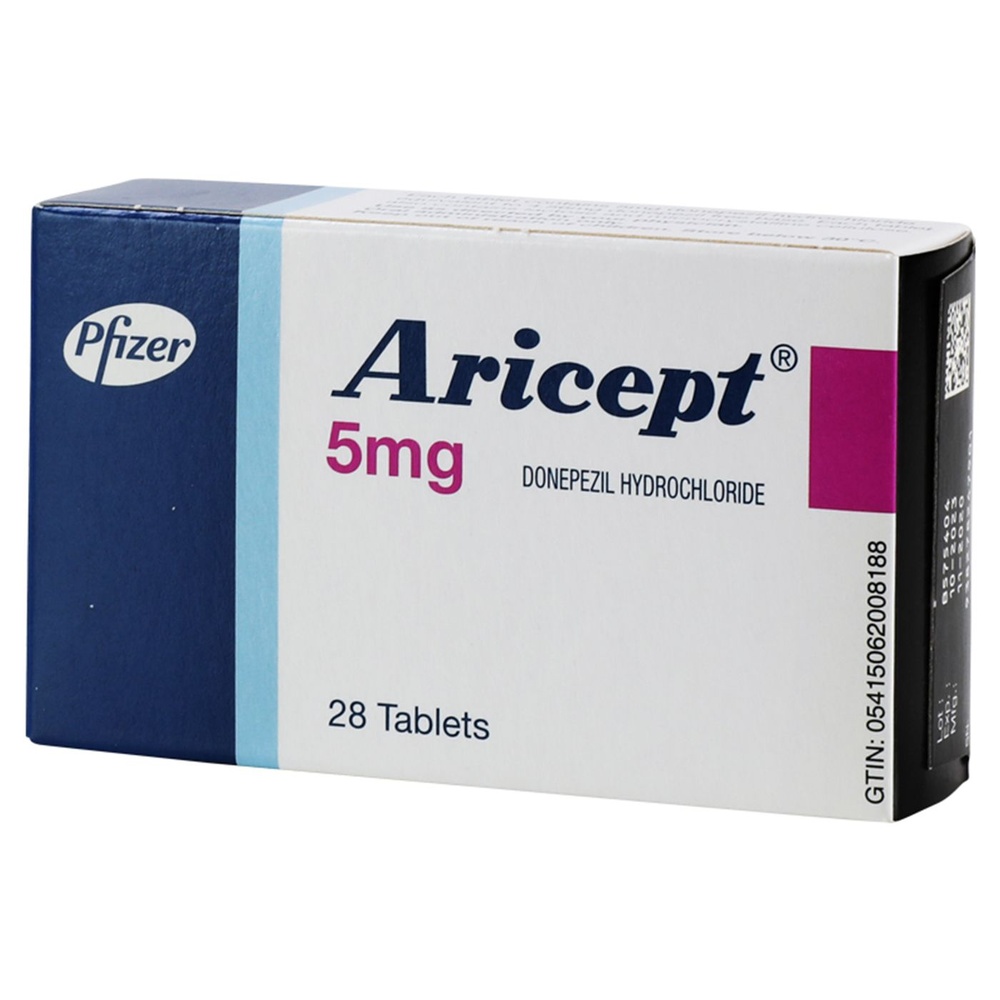
Aricept, 5 mg is a white, round, biconvex film-coated tablet with "Aricept" engraved on one side and "5" on the other.
Aricept, 10 mg is a yellow, round, biconvex film-coated tablet with "Aricept" engraved on one side and "10" on the other.
The pack contains 28 film-coated tablets in aluminum/PVC blisters in a cardboard box.
Marketing authorization holder and manufacturer
Marketing authorization holder:
Pfizer Europe MA EEIG, Boulevard de la Plaine 17, 1050 Bruxelles, Belgium
Manufacturer:
Fareva Amboise, Zone Industrielle, 29 route des Industries, 37530 Pocé-sur-Cisse, France
To obtain more detailed information, the patient should contact the representative of the marketing authorization holder:
Pfizer Polska Sp. z o.o.
tel. 22 335 61 00
Date of last revision of the leaflet: 10/2022
Detailed and up-to-date information about this product can be obtained by scanning the QR code on the outer packaging using a mobile device. The same information is also available at the website: https://www.pfizer.pl/ulotka-aricept and on the website of the Office for Registration of Medicinal Products, Medical Devices, and Biocidal Products http://www.urpl.gov.pl.
- Country of registration
- Dosage formTablets, 10 mg
- ATC codeN06DA02
- Active substance
- Prescription requiredYes
- Manufacturer
- ImporterFareva Amboise
- This information is for reference only and does not constitute medical advice. Always consult a doctor before taking any medication. Oladoctor is not responsible for medical decisions based on this content.
- Alternatives to AriceptDosage form: Tablets, 5 mgActive substance: donepezilManufacturer: Apotex Nederland B.V. SPECIAL PRODUCTS LINE S.p.A.Prescription requiredDosage form: Tablets, 10 mgActive substance: donepezilManufacturer: Apotex Nederland B.V. SPECIAL PRODUCTS LINE S.p.A.Prescription requiredDosage form: Tablets, 5 mgActive substance: donepezilManufacturer: Fareva AmboisePrescription required
Online doctors for Aricept
Discuss questions about Aricept, including use, safety considerations and prescription review, subject to medical assessment and local regulations.









Get Aricept Prescription Online
Fill in a 2-min form
Tell us your symptoms, history, and what medicine you're requesting.
Pick a doctor or let us assign
Choose a specialist or we'll match you with the next available doctor.
Doctor reviews your case
Usually within 30 minutes. They may ask follow-up questions via chat.
Collect from any pharmacy
Electronic prescription sent to your email — valid across Spain.
Frequently Asked Questions
Aricept requires a prescription in Poland. You can check with a doctor online whether this medicine may be appropriate for your situation.
The active ingredient in Aricept is donepezil. This information helps identify medicines with the same composition but different brand names.
Aricept is manufactured by Fareva Amboise. Pharmacy brands and packaging may differ depending on the distributor.
Doctors such as Family doctors, Psychiatrists, Dermatologists, Cardiologists, Endocrinologists, Gastroenterologists, Pulmonologists, Nephrologists, Rheumatologists, Hematologists, Infectious disease physicians, Allergists, Geriatricians, Paediatricians, Oncologists may assess whether Aricept is appropriate, depending on your situation and local regulations. You can book an online consultation to discuss your symptoms and possible next steps.
Spain has a well-developed healthcare infrastructure across major cities such as Madrid, Barcelona, Valencia, and Seville. Pharmacies are widely available and operate under strict regulations, ensuring access to prescribed medications.
You can buy Aricept in Madrid, Barcelona, Seville, or Valencia at any local pharmacy with a valid prescription.
To obtain a prescription, you can use Oladoctor:
Other medicines with the same active substance (donepezil) include Apo-doperil, Apo-doperil, Aricept. These may have different brand names or formulations but contain the same therapeutic ingredient. Always consult a doctor before switching or starting a new medicine.
