


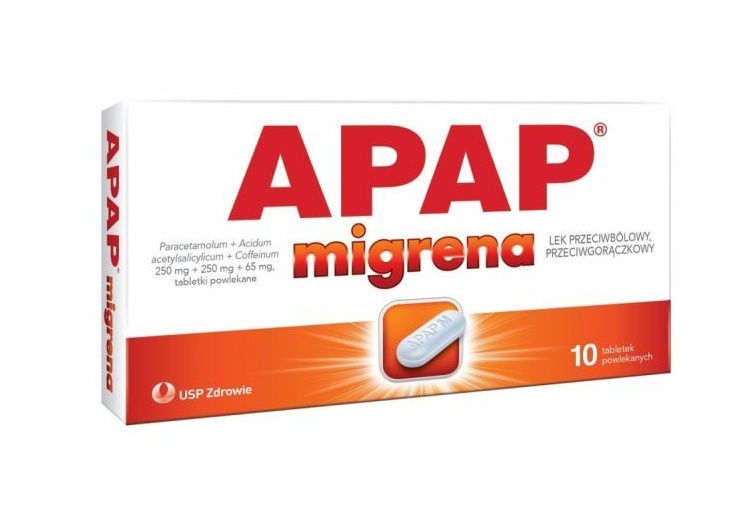
Apap migrena
Ask a doctor about a prescription for Apap migrena




How to use Apap migrena
Leaflet attached to the packaging: Patient information
APAP migraine, 250 mg + 250 mg + 65 mg, coated tablets
Paracetamol + Acetylsalicylic acid + Caffeine
You should carefully read the contents of the leaflet before using the medicine, as it contains important information for the patient.
This medicine should always be used exactly as described in the patient leaflet or as directed by your doctor or pharmacist.
- You should keep this leaflet, so you can read it again if you need to. If you need advice or more information, you should ask your pharmacist.
- If you experience any side effects, including any possible side effects not listed in the leaflet, you should tell your doctor or pharmacist. See section 4.
- If after 3 days of treatment for migraine and 4 days of treatment for headache, there is no improvement or you feel worse, you should contact your doctor.
Table of contents of the leaflet:
- 1. What is APAP migraine and what is it used for
- 2. Important information before taking APAP migraine
- 3. How to take APAP migraine
- 4. Possible side effects
- 5. How to store APAP migraine
- 6. Contents of the pack and other information
1. What is APAP migraine and what is it used for
Each APAP migraine coated tablet contains three active substances: paracetamol, acetylsalicylic acid, and caffeine. Paracetamol and acetylsalicylic acid reduce pain and fever. Acetylsalicylic acid also has an anti-inflammatory effect. Caffeine is a mild stimulant and increases the effect of acetylsalicylic acid and paracetamol.
APAP migraine is used for the acute treatment of headache and migraine attacks (such as headache, nausea, hypersensitivity to light and sound, and disturbances in daily functioning) with or without aura.
APAP migraine is intended for adults over 18 years of age.
2. Important information before taking APAP migraine
When not to take APAP migraine
- if you are hypersensitive (allergic) to acetylsalicylic acid, paracetamol, caffeine, or any of the other ingredients of APAP migraine listed in section 6.
- if you have ever had allergic reactions to other painkillers, anti-inflammatory drugs, or antipyretics, such as acetylsalicylic acid and salicylates or other non-steroidal anti-inflammatory drugs (NSAIDs) such as diclofenac or ibuprofen. Symptoms of an allergic reaction may include: asthma, wheezing, shortness of breath, hives, or
angioedema; runny nose. If you are in doubt, you should consult your doctor or pharmacist.
- in patients with stomach or intestinal ulcers, or if you have had ulcers in the past,
- if you have blood in your stool or black stools (symptoms of bleeding or gastrointestinal perforation),
- in case of hemophilia or other blood disorders,
- in severe heart, liver, or kidney diseases,
- while taking more than 15 mg of methotrexate per week (see section APAP migraine and other medicines),
- during the third trimester of pregnancy (see section Pregnancy, breastfeeding, and fertility).
Warnings and precautions
APAP migraine contains paracetamol. You should not take more than the recommended dose, as this may cause serious liver damage.
Acetylsalicylic acid may cause bleeding. If you experience unusual bleeding, you should inform your doctor.
APAP migraine may not be suitable for every patient with the following conditions. You should consult your doctor before taking the medicine if:
- you have not been diagnosed with migraine before, as other potentially serious brain or nervous system disorders should be ruled out before taking the medicine.
- your migraine is so severe that you need to go to bed, or if your pain is different from your usual migraines, or if your migraines are accompanied by vomiting.
- you have headaches after injury or caused by injury to the head, fatigue, coughing, or bending.
- you have chronic headaches (15 or more days per month for more than 3 months) or if your headaches started after the age of 50.
- you have liver or kidney problems, are underweight, are malnourished, or regularly drink alcohol. It may be necessary to completely stop taking the medicine or limit the amount of paracetamol taken.
- you should immediately inform your doctor if you have severe diseases, including severe kidney or liver disorders, sepsis (when bacteria and their toxins circulate in the blood, leading to organ damage), or malnutrition, chronic alcoholism, or if you are also taking flucloxacillin (an antibiotic). In these situations, patients taking paracetamol regularly for a long time or taking paracetamol with flucloxacillin have reported a serious condition called metabolic acidosis (a blood and body fluid disorder). Symptoms of metabolic acidosis may include: severe breathing difficulties, including rapid deep breathing, drowsiness, nausea (nausea) and vomiting.
- you have a hereditary deficiency of glucose-6-phosphate dehydrogenase, which affects red blood cells. As a result, after consuming certain foods and taking other anti-inflammatory drugs (including acetylsalicylic acid), anemia, jaundice, splenomegaly, or other diseases may develop.
- you have had gastrointestinal disorders, such as stomach ulcers, gastrointestinal bleeding, or black stools. If you have had discomfort in your stomach or heartburn after taking painkillers or anti-inflammatory drugs.
- you have bleeding disorders or abnormal bleeding from the reproductive tract other than menstrual bleeding (e.g., abnormally heavy and prolonged menstrual bleeding).
- you have recently undergone surgery (including minor surgery such as dental surgery) or will undergo surgery within the next 7 days.
- you have asthma, hay fever, nasal polyps, chronic obstructive pulmonary disease, or symptoms indicating an allergy (skin reactions, itching, hives).
- you have gout, diabetes, hyperthyroidism, arrhythmias, uncontrolled hypertension, kidney or liver disorders.
- you have problems with alcohol abuse (see section Taking APAP migraine with food and drink).
- you are currently taking other medicines containing acetylsalicylic acid or paracetamol, or taking other medicines, as some medicines may interact with the ingredients of APAP migraine and cause side effects (see section APAP migraine and other medicines).
- you are at risk of dehydration (e.g., due to vomiting, diarrhea, before or after major surgery).
- you are under 18 years old. There may be a link between acetylsalicylic acid given to children and adolescents and the development of Reye's syndrome. Reye's syndrome is a disease that causes changes in the brain and liver and, although it is very rare, can lead to death. Therefore, without a doctor's recommendation, APAP migraine should not be given to children and adolescents under 18 years old.
Other warnings
As with other medicines used to treat headaches, taking APAP migraine too frequently (for 10 days or more in a month) for chronic headache (for 15 days or more in a month) lasting more than 3 months may worsen the headache or migraine. If you think this is happening to you, you should consult your doctor. Stopping APAP migraine may improve the situation.
APAP migraine may reduce the severity of infection symptoms (e.g., headache, fever), making it more difficult to diagnose. Therefore, if you feel unwell, you should remind your doctor that you are taking APAP migraine.
APAP migraine may also affect the results of some laboratory tests, so if you are having a blood test, urine test, or other laboratory test, you should remind your doctor that you are taking APAP migraine.
The medicine contains 0.24 mg of propylene glycol and 0.05 mg of benzoic acid in one tablet.
Benzoic acid may increase the risk of jaundice (yellowing of the skin and eyes) in newborns (up to 4 weeks of age).
APAP migraine and other medicines
You should tell your doctor or pharmacist if you are taking or have recently taken any other medicines, including those obtained without a prescription.
In particular, you should tell your doctor if you are taking any of the following medicines:
- other medicines containing paracetamol, acetylsalicylic acid, or any other painkillers and/or antipyretics;
- anticoagulant medicines (blood thinners) such as oral anticoagulants (e.g., warfarin), heparin, thrombolytic agents (e.g., streptokinase), or other antiplatelet agents (e.g., ticlopidine, clopidogrel, cilostazol);
- corticosteroids (used to treat inflammation);
- barbiturates and benzodiazepines (treatment of anxiety and insomnia);
- lithium, selective serotonin reuptake inhibitors, or fluvoxamine (treatment of depression);
- sulfonylureas or insulin (treatment of diabetes);
- methotrexate (treatment of certain types of cancer and arthritis);
- certain medicines used to treat infections (e.g., rifampicin, isoniazid, chloramphenicol, ciprofloxacin, or pipemidic acid);
- levothyroxine (treatment of hypothyroidism);
- metoclopramide (treatment of nausea and vomiting);
- medicines used to treat epilepsy;
- medicines used to treat high blood pressure and heart failure;
- diuretics (used to increase urine production and diuretic);
- medicines used to treat gout;
- oral contraceptives;
- zidovudine (treatment of HIV infection);
- medicines that delay gastric emptying, such as propantheline;
- clozapine (treatment of schizophrenia);
- sympathomimetic medicines (increasing low blood pressure and treating nasal congestion);
- antihistamines (preventing or treating allergies);
- theophylline (treatment of asthma);
- terbinafine (treatment of fungal infections);
- cimetidine (treatment of heartburn and stomach ulcers);
- disulfiram (treatment of alcohol dependence);
- nicotine (used to quit smoking);
- cholestyramine (treatment of high cholesterol);
- flucloxacillin (antibiotic), due to the serious risk of blood and body fluid disorders (called metabolic acidosis), which must be treated urgently (see section 2).
Taking APAP migraine with food and drink
Alcohol:
You should ask your doctor if you can take APAP migraine or other painkillers/antipyretics while consuming 3 or more alcoholic beverages per day.
Paracetamol and acetylsalicylic acid can cause liver damage and stomach bleeding.
Caffeine:
The amount of caffeine in the recommended dose of APAP migraine is equivalent to the amount found in about one cup of coffee.
While taking APAP migraine, you should limit your intake of medicines, foods, or drinks containing caffeine, as excessive intake may cause nervousness, irritability, insomnia, and in some cases, increased heart rate.
Pregnancy, breastfeeding, and fertility
This medicine is not recommended during pregnancy. Before taking any medicine, you should consult your doctor or pharmacist.
If you are pregnant, think you may be pregnant, or plan to have a baby, you should tell your doctor and not take APAP migraine. It is very important not to take APAP migraine during the last three months of pregnancy, as it may harm the fetus or cause difficulties during delivery.
You should not take APAP migraine while breastfeeding, as it may be harmful to the baby.
APAP migraine belongs to a group of non-steroidal anti-inflammatory drugs (NSAIDs), which may affect fertility. This effect is reversible after stopping NSAIDs.
Driving and using machines
There is no data confirming the effect of APAP migraine tablets on the ability to drive and use machines.
If you experience dizziness or drowsiness, you should not drive or operate machinery. You should immediately inform your doctor if you experience any of these events.
3. How to take APAP migraine
APAP migraine should be taken as described in the leaflet or as directed by your doctor or pharmacist. If you are in doubt, you should consult your doctor or pharmacist.
Adults (over 18 years old):
Treating headache
If you experience a headache, you should take 1 tablet and wash it down with a full glass of water.
If necessary, you can take another tablet after 4-6 hours from the first intake.
In case of more intense headache, you can take 2 tablets at once, and if necessary, you can take another 2 tablets after 4-6 hours from the intake of the first two tablets.
You should not take APAP migraine for headache for more than 4 days without consulting your doctor.
Treating migraine
If you experience migraine symptoms or aura, you should take 2 tablets of APAP migraine, washing them down with a glass of water. If necessary, you can take another 2 tablets, maintaining a 4-6 hour interval between doses.
You should not take APAP migraine for more than 3 days for migraine without consulting your doctor.
Both for headache and migraine, you should not take more than 6 tablets in 24 hours. This corresponds to a dose of 1500 mg of acetylsalicylic acid, 1500 mg of paracetamol, and 390 mg of caffeine.
Long-term use of the medicine without medical supervision can be harmful to your health.
You should not exceed the recommended dose. You should use the lowest effective dose for the shortest possible time.
Children and adolescents:
APAP migraine should not be taken by children and adolescents under 18 years old (see section Warnings and precautions).
Elderly:
There are no special recommendations for dosing APAP migraine in the elderly. If you are an older adult with low body weight, you should consult your doctor or pharmacist.
Patients with kidney or liver disorders:
You should inform your doctor about liver and kidney diseases. Your doctor may prescribe different intervals between APAP migraine doses or a different treatment duration.
You should not take APAP migraine if you have severe kidney or liver failure.
Taking a higher dose of APAP migraine than recommended
The medicine contains acetylsalicylic acid and paracetamol. While taking APAP migraine, you should not take more than the recommended dose of the medicine and should not take other medicines containing any of its ingredients or other medicines used to treat pain, inflammation, or fever (non-steroidal anti-inflammatory drugs).
If you take too much APAP migraine, you should contact your doctor, pharmacist, or go to the nearest hospital and contact the poison control center.
Immediate medical attention is necessary due to the risk of irreversible liver damage from paracetamol. You should not wait for overdose symptoms to appear, as they may be unnoticed at first.
If overdose symptoms occur, they may include:
- For acetylsalicylic acid: dizziness, ringing in the ears, hearing loss, excessive sweating, hyperventilation, fever, nausea, vomiting, headache, confusion, or nervousness, cardiovascular collapse, or respiratory failure.
- For paracetamol: the first symptoms that may occur are nausea, vomiting, loss of appetite, pallor, lethargy, excessive sweating, later abdominal pain.
- For caffeine: anxiety, nervousness, insomnia, excitement, tremors, confusion, hyperglycemia (elevated blood sugar), tachycardia (rapid heart rate), and arrhythmias.
Even if the above symptoms do not occur or have disappeared, immediate medical attention is necessary.
Missing a dose of APAP migraine
You should take the missed dose as soon as possible, but you should not take a double dose of the medicine to make up for the missed dose. You should not take more than 6 tablets in 24 hours.
If you are in doubt about taking the medicine, you should consult your doctor or pharmacist.
4. Possible side effects
Like all medicines, APAP migraine can cause side effects, although not everybody gets them.
You should stop taking APAP migraine and tell your doctor immediately if you experience any of the following side effects:
- Allergic reactions such as swelling of the face, lips, mouth, tongue, or throat. These symptoms may make swallowing difficult, cause wheezing, breathing difficulties, a feeling of chest tightness (a symptom of asthma), and may also include hives, itching, and fainting.
- Redness of the skin, blisters on the lips, conjunctiva, or mouth, peeling of the skin, or mouth ulcers.
- Gastrointestinal bleeding or stomach ulcers. These symptoms may be accompanied by severe abdominal pain, bloody or black stools, or bloody vomiting. These symptoms may not be preceded by warning signs and may occur during the use of all NSAIDs, at any stage of treatment, and may lead to death. This risk is particularly high in older adults.
- Yellowing of the skin or eyes (symptoms of liver failure).
- Dizziness or a feeling of "light-headedness" (a symptom of low blood pressure).
- Irregular heartbeat.
- If you have had breathing problems after taking acetylsalicylic acid or non-steroidal anti-inflammatory drugs and have had a similar reaction to this product.
- Bruises or bleeding of unknown cause.
- Increased frequency of nosebleeds or bruising.
- Swelling or fluid retention.
- Ringing in the ears or temporary hearing loss.
- Changes in behavior, nausea, and vomiting (may be a sign of Reye's syndrome).
The following side effects have been reported in 16 clinical trials involving over 4800 people. You should contact your doctor if you experience any of the following symptoms:
Common (occurring in 1 in 10 patients)
- Nervousness, dizziness;
- Nausea, abdominal discomfort.
Uncommon (occurring in 1 in 100 patients)
- Insomnia, tremors, numbness, headache;
- Ringing in the ears;
- Dry mouth, diarrhea, vomiting;
- Fatigue, feeling anxious;
- Rapid heartbeat.
Rare (occurring in 1 in 1000 patients)
- Sore throat, difficulty swallowing, numbness and tingling around the mouth, excessive salivation;
- Decreased appetite, taste disorders;
- Anxiety, euphoric mood, feeling tense;
- Attention disorders, memory loss, coordination disorders;
- Pain in the forehead and cheek area;
- Eye pain, vision disturbances;
- Hot flashes, peripheral vascular disorders (e.g., in hands or feet);
- Nosebleeds, slow breathing, runny nose;
- Bloating, belching;
- Excessive sweating, itching, itchy rash, increased skin sensitivity;
- Muscle stiffness, bone or joint pain, neck pain, back pain, muscle cramps;
- Weakness, feeling unwell.
The following side effects have been reported after the medicine was placed on the market. It is difficult to estimate their frequency:
- Anxiety, feeling unwell or unusual;
- Drowsiness, migraine;
- Redness of the skin, rash, very rare cases of severe skin reactions have been reported;
- Palpitations, shortness of breath, sudden difficulty breathing, feeling of chest tightness, wheezing, or cough (symptoms of asthma);
- Abdominal pain, gastrointestinal disorders occurring after meals;
- Increased liver enzyme activity;
- Nasal congestion and irritation;
- Kidney problems.
Frequency not known (cannot be estimated from available data):
- A serious condition that can cause acidification of the blood (called metabolic acidosis), in patients with severe illness taking paracetamol (see section 2).
Reporting side effects
If you experience any side effects, including any possible side effects not listed in this leaflet, you should tell your doctor or pharmacist or nurse. Side effects can be reported directly to the Department of Drug Safety Monitoring of the Office for Registration of Medicinal Products, Medical Devices, and Biocidal Products: Warsaw Al. Jerozolimskie 181C, 02-222 Warsaw;
Phone: (22) 49 21 301; Fax: (22) 49 21 309;
Website: https://smz.ezdrowie.gov.pl
Side effects can also be reported to the marketing authorization holder.
By reporting side effects, you can help provide more information on the safety of this medicine.
5. How to store APAP migraine
Store out of sight and reach of children.
Do not take APAP migraine after the expiry date stated on the blister and carton. The expiry date refers to the last day of the month.
Do not store above 25°C.
Medicines should not be disposed of via wastewater or household waste. You should ask your pharmacist how to dispose of medicines that are no longer needed. This will help protect the environment.
6. Contents of the pack and other information
What APAP migraine contains:
The active substances of APAP migraine are acetylsalicylic acid, paracetamol, and caffeine. Each coated tablet contains 250 mg of acetylsalicylic acid, 250 mg of paracetamol, and 65 mg of caffeine.
Other ingredients of the medicine are microcrystalline cellulose, low-substituted hydroxypropyl cellulose, stearic acid 50. Coating:Forcoat White W010 (hypromellose, titanium dioxide (E 171), propylene glycol, benzoic acid), carnauba wax.
What APAP migraine looks like and contents of the pack
White, elongated tablets, coated, with a notch "APAP M" on one side.
Blister pack of OPA/Aluminum/PVC/Aluminum foil containing 10 tablets in a cardboard box.
10 pieces - 1 blister of 10 tablets.
20 pieces - 2 blisters of 10 tablets.
Marketing authorization holder and manufacturer
US Pharmacia Sp. z o.o.
Ziębicka 40, 50-507 Wrocław
To obtain more detailed information about this medicine, you should contact the representative of the marketing authorization holder:
USP Zdrowie Sp. z o.o.
Poleczki 35
02-822 Warsaw
phone: +48 (22) 543 60 00
Date of last revision of the leaflet: February 2025
- Country of registration
- Active substance
- Prescription requiredNo
- Manufacturer
- ImporterUS Pharmacia Sp. z o.o.
- This information is for reference only and does not constitute medical advice. Always consult a licensed doctor before taking any medication. Oladoctor is not responsible for medical decisions based on this content.
- Alternatives to Apap migrenaDosage form: Tablets, 325 mg + 30 mg + 10 mgActive substance: paracetamol, combinations excl. psycholepticsManufacturer: Polfarmex S.A.Prescription not requiredDosage form: Granulate, 500 mg + 200 mg + 4 mgActive substance: paracetamol, combinations excl. psycholepticsManufacturer: Natur Produkt Pharma Sp. z o.o.Prescription not requiredDosage form: Tablets, 500 mg + 200 mg + 4 mgActive substance: paracetamol, combinations excl. psycholepticsManufacturer: Natur Produkt Pharma Sp. z o.o.Prescription not required
Alternatives to Apap migrena in other countries
The best alternatives with the same active ingredient and therapeutic effect.
Alternative to Apap migrena in Hiszpania
Alternative to Apap migrena in Ukraina
Online doctors for Apap migrena
Discuss dosage, side effects, interactions, contraindications, and prescription renewal for Apap migrena – subject to medical assessment and local rules.




Get updates and exclusive offers
Be the first to know about new services, marketplace updates, and subscriber-only promos.

