


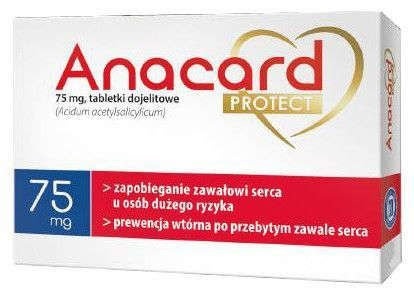
Anacard protect
Ask a doctor about a prescription for Anacard protect




How to use Anacard protect
Leaflet attached to the packaging: patient information
ANACARD protect
150 mg, enteric-coated tablets
Acetylsalicylic acid
Read the leaflet carefully before taking the medicine, as it contains
important information for the patient.
This medicine should always be taken exactly as described in the patient leaflet or as directed by a doctor or pharmacist.
- This leaflet should be kept in case it needs to be read again.
- If advice or additional information is needed, a pharmacist should be consulted.
- If the patient experiences any side effects, including any possible side effects not listed in the leaflet, they should inform their doctor or pharmacist. See section 4.
- If there is no improvement or the patient feels worse, they should contact their doctor.
Table of contents of the leaflet:
- 1. What is ANACARD protect and what is it used for
- 2. Important information before taking ANACARD protect
- 3. How to take ANACARD protect
- 4. Possible side effects
- 5. How to store ANACARD protect
- 6. Contents of the pack and other information
1. What is ANACARD protect and what is it used for
The active substance of the medicine is acetylsalicylic acid, which inhibits platelet aggregation.
ANACARD protect is intended for long-term use in diseases that threaten the formation of blood clots and thrombi in blood vessels.
The enteric-coated tablet of ANACARD protect has a coating and does not dissolve in the stomach, which reduces the irritating effect of acetylsalicylic acid on the gastric mucosa.
Indications for use
Ischaemic heart disease (coronary artery disease) and all clinical situations where platelet aggregation inhibition is desirable:
- prevention of myocardial infarction in patients at high risk,
- recent myocardial infarction or suspected recent myocardial infarction,
- history of unstable coronary artery disease,
- secondary prevention in patients who have had a myocardial infarction,
- state after coronary artery bypass grafting, coronary angioplasty,
- prevention of transient ischaemic attacks (TIA) and ischaemic stroke in patients with TIA,
- after ischaemic stroke in patients with TIA,
- in patients with atherosclerotic peripheral artery disease,
- prevention of venous thrombosis and pulmonary embolism in patients who are bedridden for a long time, e.g. after major surgical procedures, as a supplement to other methods of prophylaxis.
Note: in recent myocardial infarction or suspected recent myocardial infarction, enteric-coated tablets may be used when acetylsalicylic acid in immediate-release tablets is not available. In such cases, the enteric-coated tablets should be chewed very thoroughly to
achieve rapid absorption.
The decision to start treatment and the dose of the medicine is made by a doctor.
2. Important information before taking ANACARD protect
When not to take ANACARD protect:
if the patient is hypersensitive to the active substance, other salicylates or any of the other ingredients of this medicine (listed in section 6),
if the patient has a bleeding disorder (tendency to bleed),
if the patient has active peptic ulcer disease of the stomach and/or duodenum,
if the patient has severe heart failure or severe liver or kidney failure,
if the patient has had asthma attacks caused by the administration of salicylates or substances with similar effects, especially non-steroidal anti-inflammatory drugs (NSAIDs),
if the patient is taking methotrexate (used, among other things, in cancer) at doses of 15 mg per week or higher,
if the patient is in the third trimester of pregnancy,
in children and adolescents under 16 years of age with viral infections (e.g. flu or chickenpox), due to the risk of liver and brain damage (Reye's syndrome).
Warnings and precautions
Before starting treatment with ANACARD protect, the patient should discuss it with their doctor or pharmacist.
Acetylsalicylic acid should be used with caution:
if the patient is in the first or second trimester of pregnancy,
if the patient is breastfeeding,
if the patient is hypersensitive to non-steroidal anti-inflammatory and anti-rheumatic drugs or other allergenic substances,
if the patient is taking anticoagulant drugs (e.g. coumarin derivatives, heparin),
if the patient has impaired liver or kidney function,
if the patient has a history of peptic ulcer disease or gastrointestinal bleeding,
if the patient has a genetic disorder characterized by a deficiency of glucose-6-phosphate dehydrogenase.
Acetylsalicylic acid may cause bronchospasm and trigger asthma attacks or other hypersensitivity reactions. Patients with asthma, chronic respiratory diseases, hay fever, nasal polyps, and those who have allergic reactions to other substances (e.g. skin reactions, itching, urticaria) are particularly at risk of such reactions.
Patients undergoing surgical procedures (including minor procedures, e.g. tooth extraction) should inform their doctor about taking ANACARD protect. The medicine should not be taken for 5 days before a planned surgical procedure (including minor procedures, e.g. tooth extraction).
Acetylsalicylic acid, even in small doses, reduces the excretion of uric acid from the body. In patients with a tendency to reduced uric acid excretion, the medicine may cause a gout attack.
In elderly patients, there is an increased risk of adverse reactions, including gastrointestinal bleeding and perforation of peptic ulcers.
Children and adolescents
ANACARD protect should not be used in children and adolescents under 16 years of age.
ANACARD protect and other medicines
The patient should tell their doctor or pharmacist about all medicines they are currently taking or have recently taken, as well as any medicines they plan to take.
Acetylsalicylic acid should not be taken at the same time as methotrexate at doses of 15 mg per week or higher, as it increases the toxic effects of methotrexate on the bone marrow.
Taking methotrexate at doses lower than 15 mg per week requires special caution.
ANACARD protect:
with anticoagulant drugs (e.g. coumarin derivatives, heparin), thrombolytic drugs, and drugs that dissolve blood clots (e.g. streptokinase, urokinase) and inhibit platelet aggregation (e.g. ticlopidine), may prolong bleeding time and cause bleeding,
with glucocorticoids, NSAIDs increase the risk of peptic ulcer disease and gastrointestinal bleeding (except for hydrocortisone used as replacement therapy in Addison's disease). Concurrent use of glucocorticoids with acetylsalicylic acid increases the risk of salicylate overdose after corticosteroid therapy,
with digoxin, increases its serum concentration,
enhances the effects of antidiabetic drugs (e.g. insulin, sulfonylurea derivatives),
enhances the toxic effects of valproic acid, which in turn enhances the anti-aggregatory effect of acetylsalicylic acid,
with lithium, may increase its serum concentration,
enhances the toxic effects of cyclosporine and tacrolimus,
with serotonin reuptake inhibitors (SSRIs, e.g. sertraline or paroxetine), increases the risk of gastrointestinal bleeding,
reduces the effect of drugs used to treat gout (e.g. probenecid, benzbromarone),
reduces the effect of diuretics,
reduces the effect of some antihypertensive drugs (e.g. captopril, enalapril).
Taking ANACARD protect and ibuprofen or metamizole at the same time may reduce the effect of low doses of acetylsalicylic acid on platelet aggregation.
ANACARD protect can be taken with the above-mentioned drugs only after consulting a doctor.
ANACARD protect with food, drink, and alcohol
Alcohol may increase the risk of adverse reactions related to the gastrointestinal tract caused by acetylsalicylic acid, such as bleeding, ulcers.
The medicine should be swallowed whole.
Pregnancy and breastfeeding
If the patient is pregnant or breastfeeding, thinks they may be pregnant, or plans to have a child, they should consult their doctor or pharmacist before taking this medicine .
ANACARD protect is contraindicated in the third trimester of pregnancy, as it may cause complications during the perinatal period, both in the mother and the newborn.
In the first and second trimester, the medicine should be used only after consulting a doctor.
Breastfeeding women should consult their doctor before taking the medicine.
Driving and using machines
ANACARD protect does not affect the ability to drive and use machines.
The medicine contains sodium
The medicine contains less than 1 mmol (23 mg) of sodium per enteric-coated tablet, which means that the medicine is considered "sodium-free".
The medicine contains azo dyes
ANACARD protect contains azo dyes. The medicine may cause allergic reactions.
3. How to take ANACARD protect
This medicine should always be taken exactly as described in the patient leaflet or as directed by a doctor or pharmacist. In case of doubt, the patient should consult their doctor or pharmacist.
The patient should consult their doctor before starting treatment with ANACARD protect.
The doctor will recommend the dose of the medicine suitable for the patient and determine the duration of treatment.
The medicine is taken orally.
Unless the doctor recommends otherwise, 1 tablet (150 mg) once a day. The tablets should be swallowed whole, not chewed (except in the case of myocardial infarction!).
Recent myocardial infarction or suspected recent myocardial infarction:
2 tablets (300 mg) at once.
The tablets should be chewed very thoroughly to achieve rapid absorption.
Note:in acute myocardial infarction or suspected acute myocardial infarction, enteric-coated tablets may be used when acetylsalicylic acid in immediate-release tablets is not available.
The decision to start long-term treatment with acetylsalicylic acid and the dose of the medicine should be made by a doctor.
Taking a higher dose of ANACARD protect than recommended
In case of taking a higher dose of the medicine than recommended, the patient should consult their doctor or pharmacist, and in case of severe poisoning, the patient should be taken to hospital immediately.
The first symptoms of poisoning are: dizziness, tinnitus, hearing loss, excessive sweating, nausea and vomiting, headache, confusion (disorders of consciousness with disorientation, thinking and speech disorders, hallucinations, delirium, anxiety, and psychomotor agitation), rapid breathing, too deep breathing, and blurred vision, fainting.
In case of severe poisoning, the following symptoms may also occur: high fever, respiratory disorders (up to respiratory arrest and suffocation), cardiac disorders and blood vessel disorders (from irregular heartbeat, low blood pressure to cardiac arrest), fluid and electrolyte loss (from dehydration, oliguria (reduced urine output below 400-500 ml in adults) to renal failure), increased or decreased blood glucose levels (especially in children), ketosis (increased ketone levels in the blood), gastrointestinal bleeding, coagulation disorders, neurological disorders manifesting as lethargy, confusion, and coma, and seizures.
Missing a dose of ANACARD protect
In case of missing a dose, the patient should take the next dose of ANACARD protect. A double dose should not be taken to make up for the missed dose.
In case of any further doubts about taking this medicine, the patient should consult their doctor or pharmacist.
4. Possible side effects
Like all medicines, this medicine can cause side effects, although not everybody gets them.
Common (in 1 to 10 patients in 100):
abdominal pain, heartburn, nausea, vomiting, indigestion.
Rare (in 1 to 10 patients in 10,000):
gastrointestinal inflammation, potentially life-threatening gastrointestinal bleeding: overt (coffee ground vomiting, melena) or occult (more frequent with higher doses); peptic ulcer disease of the stomach and/or duodenum, perforation, transient liver function disorders (increased aminotransferase activity), cerebral haemorrhage (especially in patients with uncontrolled hypertension and/or concomitant use of other anticoagulant drugs) potentially life-threatening, after long-term use of high doses of acetylsalicylic acid, renal papillary necrosis and interstitial nephritis have been reported.
Very rare (less than 1 in 10,000 patients):
severe allergic reactions, including anaphylactic shock.
Additionally, the following have been reported:
dizziness and tinnitus, which are usually symptoms of overdose,
increased risk of bleeding, haemorrhages (postoperative, nasal, gingival, genitourinary), haematomas, prolonged bleeding time, prothrombin time, thrombocytopenia (thrombocytopenia). The consequence of bleeding may be the occurrence of acute or chronic iron deficiency anaemia or acute posthaemorrhagic anaemia, manifesting as asthenia (exhaustion, weakness), pallor, hypoperfusion (reduced blood flow), as well as abnormal laboratory test results,
hypersensitivity reactions with clinical symptoms and abnormal laboratory test results, such as asthma, mild to moderate reactions involving the skin, respiratory system, and cardiovascular system with symptoms such as: rash, urticaria, angioedema (including angioedema), respiratory disorders, and cardiac disorders,
bronchial asthma.
If there are coffee ground vomiting or black, tarry stools, the medicine should be discontinued and a doctor consulted.
A symptom of severe hypersensitivity may be: facial and eyelid oedema, tongue and laryngeal oedema with narrowing of the airways, difficulty breathing, dyspnoea up to asthma attacks, tachycardia, sudden decrease in blood pressure up to life-threatening shock. If any of the above symptoms occur, immediate medical attention should be sought. The above reactions may occur even after the first administration of the medicine.
Long-term use of medicines containing acetylsalicylic acid may cause headache, which worsens with each subsequent dose.
Long-term use of painkillers, especially those containing multiple active substances, may lead to severe kidney function disorders and kidney failure.
Reporting side effects
If any side effects occur, including any side effects not listed in the leaflet, the patient should inform their doctor or pharmacist. Side effects can be reported directly to the Department of Post-Marketing Surveillance of Adverse Reactions to Medicinal Products of the Office for Registration of Medicinal Products, Medical Devices, and Biocidal Products Al. Jerozolimskie 181C, 02-222 Warsaw tel.: +48 22 49 21 301, fax: +48 22 49 21 309 Website: https://smz.ezdrowie.gov.pl Side effects can also be reported to the marketing authorisation holder. By reporting side effects, more information can be collected on the safety of the medicine.
5. How to store ANACARD protect
Store in the original packaging, at a temperature below 25°C.
The medicine should be stored out of sight and reach of children .
The medicine should not be used after the expiry date stated on the carton. The expiry date refers to the last day of the month.
Medicines should not be disposed of via wastewater or household waste. The patient should ask their pharmacist how to dispose of medicines that are no longer needed. This will help protect the environment.
6. Contents of the pack and other information
What ANACARD protect contains
- -The active substance of the medicine is acetylsalicylic acid. One tablet contains 150 mg of acetylsalicylic acid.
- -The other ingredients are: microcrystalline cellulose, maize starch, sodium carboxymethylcellulose (type A), hypromellose, titanium dioxide (E 171), triacetin, methacrylic acid and ethyl acrylate copolymer, red iron oxide (E 172), sodium bicarbonate, sodium lauryl sulfate, orange yellow, lake (E 110), indigo carmine, lake (E 132), macrogol 6000, simethicone.
What ANACARD protect looks like and contents of the pack
ANACARD protect is a pink, round, biconvex, film-coated tablet with a smooth, uniform surface.
One pack of the medicine contains 30 or 60 tablets.
Marketing authorisation holder and manufacturer
“PRZEDSIĘBIORSTWO PRODUKCJI FARMACEUTYCZNEJ HASCO-LEK” S.A.
51-131 Wrocław, ul. Żmigrodzka 242 E
Information about the medicine
tel.: (22) 742 00 22
e-mail: [email protected]
Date of last revision of the leaflet: 10/2021
- Country of registration
- Active substance
- Prescription requiredNo
- Manufacturer
- ImporterPrzedsiębiorstwo Produkcji Farmaceutycznej HASCO-LEK S.A.
- This information is for reference only and does not constitute medical advice. Always consult a licensed doctor before taking any medication. Oladoctor is not responsible for medical decisions based on this content.
- Alternatives to Anacard protectDosage form: Tablets, 75 mgActive substance: acetylsalicylic acidManufacturer: G.L. Pharma GmbH Krka, d.d., Novo mesto TAD Pharma GmbHPrescription not requiredDosage form: Tablets, 100 mgActive substance: acetylsalicylic acidManufacturer: G.L. Pharma GmbH Krka, d.d., Novo mesto TAD Pharma GmbHPrescription not requiredDosage form: Tablets, 160 mgActive substance: acetylsalicylic acidManufacturer: G.L. Pharma GmbH Krka, d.d., Novo mesto TAD Pharma GmbHPrescription not required
Alternatives to Anacard protect in other countries
The best alternatives with the same active ingredient and therapeutic effect.
Alternative to Anacard protect in Hiszpania
Alternative to Anacard protect in Ukraina
Online doctors for Anacard protect
Discuss dosage, side effects, interactions, contraindications, and prescription renewal for Anacard protect – subject to medical assessment and local rules.



Get updates and exclusive offers
Be the first to know about new services, marketplace updates, and subscriber-only promos.

