



AFENIX 5 mg Tablets

Prescription review online
A doctor will review your case and decide whether a prescription is medically appropriate.

Talk to a doctor about this medicine
Discuss your symptoms and possible next steps in a quick online consultation.



How to use Afenix
Contents of the leaflet
- Package Leaflet: Information for the Patient
- Afenix, 5 mg, coated tablets
- Afenix, 10 mg, coated tablets
- What is Afenix and what is it used for
- Important information before taking Afenix
- How to take Afenix
- Possible side effects
- How to store Afenix
- Contents of the pack and other information
Package Leaflet: Information for the Patient
Afenix, 5 mg, coated tablets

Not sure if this medicine is right for you?
Discuss your symptoms and treatment with a doctor online.
Afenix, 10 mg, coated tablets
Solifenacin succinate
Read the package leaflet carefully before taking the medicine, as it contains important information for the patient.
- Keep this leaflet, you may need to read it again.
- If you have any further questions, ask your doctor or pharmacist.
- This medicine has been prescribed for you only. Do not pass it on to others. It may harm them, even if their symptoms are the same as yours.
- If you experience any side effects, including those not listed in this leaflet, tell your doctor or pharmacist. See section 4.
Table of Contents of the Leaflet
- 1. What is Afenix and what is it used for
- 2. Important information before taking Afenix
- 3. How to take Afenix
- 4. Possible side effects
- 5. How to store Afenix
- 6. Contents of the pack and other information
1. What is Afenix and what is it used for
The active substance of Afenix belongs to a group of medicines called anticholinergics. These medicines reduce the activity of an overactive bladder. This action allows for longer intervals between trips to the toilet and increases the amount of urine held in the bladder. Afenix is used to treat symptoms of an overactive bladder. These symptoms include: urgency, which means episodes of sudden, urgent need to urinate, frequent urination, and incontinence related to not being able to get to the toilet in time.

Started taking the medicine and have questions?
Discuss your symptoms and treatment with a doctor online.
2. Important information before taking Afenix
When not to take Afenix:
- if you are allergic to solifenacin succinate or any of the other ingredients of this medicine (listed in section 6);
- if you have difficulty emptying your bladder or cannot empty your bladder (urinary retention);
- if you have severe gastrointestinal disorders (toxic megacolon, a complication of ulcerative colitis);
- if you have a muscle disease called myasthenia gravis, which can cause significant weakness of certain muscles;
- if you have increased pressure in the eyeball with gradual loss of vision (glaucoma);
- if you are undergoing hemodialysis;
- if you have severe liver function disorders;
- if you have severe kidney disease or moderate liver disease and are taking medicines that may delay the elimination of Afenix from the body (e.g., ketoconazole). Your doctor or pharmacist will provide you with information on this.
if you have severe kidney disease or moderate liver disease and are taking medicines that may delay the elimination of Afenix from the body (e.g., ketoconazole). Your doctor or pharmacist will provide you with information on this.
Warnings and precautions
Before starting treatment with Afenix, discuss it with your doctor or pharmacist. Before starting treatment with Afenix, tell your doctor if you have or have had any of the following:
- difficulty emptying your bladder or urinating (narrowing of the urethra) because the risk of urine accumulation in the bladder (urinary retention) is much higher;
- gastrointestinal disorders (constipation);
- risk of slowed gastrointestinal movement (gastrointestinal motility). Your doctor will provide you with information on this;
- severe kidney disease;
- moderate liver disease;
- hiatus hernia (a condition where part of the stomach slides up into the chest) which can cause heartburn or acid reflux;
- autonomic nervous system disorders (autonomic neuropathy).
Before starting treatment with Afenix, your doctor will assess whether there are other causes of frequent urination (e.g., heart failure - insufficient strength of the heart muscle to pump blood or kidney disease). If a urinary tract infection occurs, your doctor will prescribe an antibiotic (an antibacterial medicine).
Children and adolescents
Afenix should not be used in children or adolescents under 18 years of age.
Afenix and other medicines
Tell your doctor or pharmacist about all medicines you are taking now or have taken recently, and about any medicines you plan to take. It is especially important to tell your doctor if you are taking:
- other anticholinergic medicines, as taking such a medicine with Afenix may increase both the therapeutic and adverse effects of both medicines;
- cholinergic receptor agonists, as they may weaken the effect of Afenix;
- gastrointestinal motility enhancers, such as metoclopramide and cisapride, as Afenix may weaken their effect;
- medicines such as ketoconazole, ritonavir, nelfinavir, itraconazole, verapamil, diltiazem, as they slow down the metabolism of Afenix;
- medicines such as rifampicin, phenytoin, carbamazepine, as they may accelerate the metabolism of Afenix;
- medicines such as bisphosphonates, as they may exacerbate esophagitis.
Afenix with food and drink
Afenix can be taken with or without food.
Pregnancy and breastfeeding
If you are pregnant or breastfeeding, think you may be pregnant or are planning to have a baby, ask your doctor or pharmacist for advice before taking this medicine. You should not take Afenix during pregnancy, unless it is clearly necessary. You should not take Afenix during breastfeeding, as solifenacin passes into breast milk.
Driving and using machines
Afenix may cause blurred vision, sometimes drowsiness, and fatigue. If you experience these side effects, do not drive or operate any machinery.
Afenix contains lactose monohydrate, sodium
If you have been told that you have an intolerance to some sugars, contact your doctor before taking this medicine. The medicine contains less than 1 mmol (23 mg) of sodium per coated tablet, which means it is essentially 'sodium-free'.
3. How to take Afenix
Always take this medicine exactly as your doctor has told you. If you are not sure, ask your doctor or pharmacist. Adults
- The usual dose is 5 mg once a day, unless your doctor advises you to take a dose of 10 mg once a day.
- Swallow the tablet whole with a drink of water. You can take Afenix with or without food. Do not crush the tablets.
Children and adolescents Afenix should not be used in children or adolescents under 18 years of age.
If you take more Afenix than you should
If you have taken too many Afenix tablets or a child has accidentally taken some, contact your doctor or pharmacist immediately. Symptoms of overdose may include: headache, dry mouth, dizziness, drowsiness, and vision disturbances, seeing things that are not there (hallucinations), excessive excitement, seizures, breathing difficulties, rapid heartbeat (tachycardia), and urinary retention.
If you forget to take Afenix
If you miss a dose, take the next dose as soon as possible, unless it is almost time for your next dose. Do not take more than one dose in 24 hours. If you are unsure, ask your doctor or pharmacist.
If you stop taking Afenix
If you stop taking Afenix, your overactive bladder symptoms may return or worsen. If you want to stop treatment, consult your doctor. If you have any further questions on the use of this product, ask your doctor or pharmacist.
4. Possible side effects
Like all medicines, Afenix can cause side effects, although not everybody gets them. If you experience symptoms of an allergic reaction or severe skin reaction (e.g., blistering and peeling of the skin), contact your doctor immediately. Some patients taking solifenacin succinate have reported angioedema (a type of allergic skin reaction that causes swelling of the tissue just below the skin surface) with swelling of the airways (difficulty breathing, wheezing). If you experience angioedema, stop taking Afenix and contact your doctor, who will provide appropriate treatment. Afenix may cause other side effects, including:
- Very common (more than 1 in 10 people): dry mouth.
Common (less than 1 in 10 people):
- blurred vision,
- constipation, nausea, indigestion with symptoms such as feeling full in the stomach, stomach pain, belching, nausea, and heartburn (dyspepsia), discomfort in the stomach.
Uncommon (less than 1 in 100 people):
- urinary tract infection, cystitis,
- drowsiness,
- taste disturbances,
- dry eye syndrome,
- dry nose,
- gastroesophageal reflux disease (heartburn),
- dry throat,
- dry skin,
- difficulty urinating,
- fatigue,
- fluid accumulation in the legs (edema).
Rare (less than 1 in 1,000 people):
- impaction of large amounts of hard stool in the colon (fecal impaction),
- difficulty urinating despite a full bladder (urinary retention),
- dizziness, headaches,
- vomiting,
- itching, rash.
Very rare (less than 1 in 10,000 people):
- hallucinations, confusion,
- allergic rash.
Frequency not known (frequency cannot be estimated from the available data):
- decreased appetite, increased potassium levels in the blood, which can cause heart rhythm disturbances,
- increased pressure in the eyeball, glaucoma,
- ECG changes, irregular heartbeat (torsade de pointes), atrial fibrillation, palpitations, rapid heartbeat,
- voice disorders,
- liver function disorders,
- muscle weakness,
- kidney function disorders.
Reporting side effects
If you experience any side effects, including those not listed in this leaflet, tell your doctor or pharmacist. You can also report side effects directly to the Department of Drug Monitoring of the Office for Registration of Medicinal Products, Medical Devices, and Biocidal Products, Al. Jerozolimskie 181C, 02-222 Warsaw, Tel.: +48 22 49 21 301, Fax: +48 22 49 21 309, website: https://smz.ezdrowie.gov.pl. You can also report side effects to the marketing authorization holder. By reporting side effects, you can help provide more information on the safety of this medicine.
5. How to store Afenix
Keep this medicine out of the sight and reach of children. Do not store above 30°C. Do not use this medicine after the expiry date which is stated on the carton and blister after EXP. The expiry date refers to the last day of that month. The packaging is labeled with the expiration date (EXP) and batch number (Lot/LOT). Medicines should not be disposed of via wastewater or household waste. Ask your pharmacist how to dispose of medicines no longer required. These measures will help protect the environment.
6. Contents of the pack and other information
What Afenix contains
- The active substance is solifenacin succinate. Afenix 5 mg: each coated tablet contains 5 mg of solifenacin succinate, which corresponds to 3.77 mg of solifenacin. Afenix 10 mg: each coated tablet contains 10 mg of solifenacin succinate, which corresponds to 7.54 mg of solifenacin.
- The other ingredients are: Tablet core: corn starch, lactose monohydrate, sodium stearyl fumarate. Tablet coating: Afenix 5 mg: hypromellose (6 mPas), titanium dioxide (E 171), lactose monohydrate, macrogol (MW 3350), triacetin, yellow iron oxide (E 172). Afenix 10 mg: hypromellose (6 mPas), titanium dioxide (E 171), lactose monohydrate, macrogol (MW 3350), triacetin, yellow iron oxide (E 172), red iron oxide (E 172), black iron oxide (E 172).
What Afenix looks like and contents of the pack
Afenix 5 mg, coated tablets: light yellow, round, biconvex coated tablet. Afenix 10 mg, coated tablets: pink, round, biconvex coated tablet. The tablets are packaged in aluminum/PVC blisters. Pack sizes: 3, 5, 10, 20, 30, 50, 60, 90, 100, 200 coated tablets. Not all pack sizes may be marketed.
Marketing authorization holder
Polpharma S.A., ul. Pelplińska 19, 83-200 Starogard Gdański, tel. +48 22 364 61 01
Manufacturer
Polpharma S.A., ul. Pelplińska 19, 83-200 Starogard Gdański, Polpharma S.A., Production Plant in Nowa Dęba, ul. Metalowca 2, 39-460 Nowa Dęba
Date of last revision of the leaflet
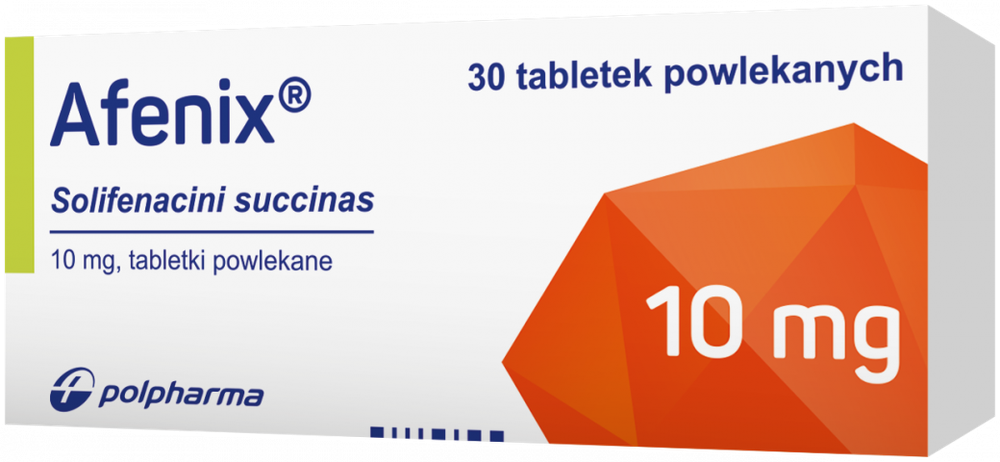
- Country of registration
- Dosage formTablets, 5 mg
- ATC codeG04BD08
- Active substance
- Prescription requiredYes
- Manufacturer
- ImporterZakłady Farmaceutyczne POLPHARMA S.A. Zakłady Farmaceutyczne POLPHARMA S.A. Oddział Produkcyjny w Nowej Dębie
- This information is for reference only and does not constitute medical advice. Always consult a doctor before taking any medication. Oladoctor is not responsible for medical decisions based on this content.
- Alternatives to AfenixDosage form: Tablets, 5 mgActive substance: solifenacinManufacturer: Adamed Pharma S.A. S.C. Zentiva S.A.Prescription not requiredDosage form: Tablets, 10 mgActive substance: solifenacinManufacturer: Adamed Pharma S.A. S.C. Zentiva S.A.Prescription not requiredDosage form: Tablets, 10 mgActive substance: solifenacinManufacturer: Zakłady Farmaceutyczne POLPHARMA S.A. Zakłady Farmaceutyczne POLPHARMA S.A. Oddział Produkcyjny w Nowej DębiePrescription required
Online doctors for Afenix
Discuss questions about Afenix, including use, safety considerations and prescription review, subject to medical assessment and local regulations.


Get Afenix Prescription Online
Fill in a 2-min form
Tell us your symptoms, history, and what medicine you're requesting.
Pick a doctor or let us assign
Choose a specialist or we'll match you with the next available doctor.
Doctor reviews your case
Usually within 30 minutes. They may ask follow-up questions via chat.
Collect from any pharmacy
Electronic prescription sent to your email — valid across Spain.
Frequently Asked Questions
Afenix requires a prescription in Poland. You can check with a doctor online whether this medicine may be appropriate for your situation.
The active ingredient in Afenix is solifenacin. This information helps identify medicines with the same composition but different brand names.
Afenix is manufactured by Zakłady Farmaceutyczne POLPHARMA S.A. Zakłady Farmaceutyczne POLPHARMA S.A. Oddział Produkcyjny w Nowej Dębie. Pharmacy brands and packaging may differ depending on the distributor.
Doctors such as Family doctors, Psychiatrists, Dermatologists, Cardiologists, Endocrinologists, Gastroenterologists, Pulmonologists, Nephrologists, Rheumatologists, Hematologists, Infectious disease physicians, Allergists, Geriatricians, Paediatricians, Oncologists may assess whether Afenix is appropriate, depending on your situation and local regulations. You can book an online consultation to discuss your symptoms and possible next steps.
Spain has a well-developed healthcare infrastructure across major cities such as Madrid, Barcelona, Valencia, and Seville. Pharmacies are widely available and operate under strict regulations, ensuring access to prescribed medications.
You can buy Afenix in Madrid, Barcelona, Seville, or Valencia at any local pharmacy with a valid prescription.
To obtain a prescription, you can use Oladoctor:
Other medicines with the same active substance (solifenacin) include Adablok, Adablok, Afenix. These may have different brand names or formulations but contain the same therapeutic ingredient. Always consult a doctor before switching or starting a new medicine.
