



ADARTREL 2 mg Tablets

Prescription review online
A doctor will review your case and decide whether a prescription is medically appropriate.

Talk to a doctor about this medicine
Discuss your symptoms and possible next steps in a quick online consultation.



How to use Adartrel
Contents of the leaflet
- Leaflet attached to the packaging: information for the user
- Adartrel, 0.25 mg, coated tablets
- Adartrel, 0.5 mg, coated tablets
- Adartrel, 2 mg, coated tablets
- What is Adartrel and what is it used for
- Important information before taking Adartrel
- How to take Adartrel
- Possible side effects
- How to store Adartrel
- Contents of the packaging and other information
- What is Adartrel and what is it used for
- Important information before taking Adartrel
- When not to take Adartrel
- Warnings and precautions
- Adartrel and other medicines
- Tell your doctor or pharmacist about all medicines you are taking now or have taken recently,
- Pregnancy and breastfeeding
- While taking Adartrel
- Driving and operating machinery
- Taking Adartrel and smoking
- Taking Adartrel with food and drink
- If side effects worsen
- Important information about some ingredients of Adartrel
- How to take Adartrel
- What dose of Adartrel should you take?
- Taking the dose of Adartrel
- Take the Adartrel tablet(s) once a day.
- Swallow the Adartrel tablet(s) with a glass of water.
- Taking a higher dose of Adartrel than prescribed
- Missing a dose of Adartrel
- Do not take extra tablets or a double dose to make up for a missed dose. Take the next dose at the usual time.
- Stopping Adartrel
- Do not stop taking Adartrel unless your doctor tells you to.
- Possible side effects
- Very common side effects:
- Common side effects:
- Uncommon side effects:
- Rare side effects:
- In some patients, the following side effects may occur (frequency not known: cannot be estimated from available data):
- The following side effects are possible:
- Consult your doctor if you experience any of these behaviors to discuss ways to limit or eliminate these symptoms.
- Reporting side effects
- How to store Adartrel
- Contents of the packaging and other information
- What Adartrel contains
- The active substance is ropinirole (in the form of hydrochloride).
- What Adartrel looks like and contents of the pack
- Marketing authorization holder and manufacturer
- Marketing authorization holder
- Manufacturer
- This medicine is authorized in the Member States of the European Economic Area and in the United Kingdom (Northern Ireland) under the following names:
Leaflet attached to the packaging: information for the user
Adartrel, 0.25 mg, coated tablets

Not sure if this medicine is right for you?
Discuss your symptoms and treatment with a doctor online.
Adartrel, 0.5 mg, coated tablets
Adartrel, 2 mg, coated tablets
Ropinirole(in the form of hydrochloride)
Read the leaflet carefully before taking the medicine, as it contains important information for the patient.
- Keep this leaflet, so you can read it again if you need to.
- If you have any doubts, consult your doctor or pharmacist.
- This medicine has been prescribed specifically for you. Do not pass it on to others. The medicine may harm another person, even if their symptoms are the same.
- If the patient experiences any side effects, including any side effects not listed in this leaflet, they should tell their doctor or pharmacist. See section 4.
Table of contents of the leaflet

Started taking the medicine and have questions?
Discuss your symptoms and treatment with a doctor online.
1. What is Adartrel and what is it used for
2. Important information before taking Adartrel
3. How to take Adartrel
4. Possible side effects
5. How to store Adartrel
6. Contents of the packaging and other information
1. What is Adartrel and what is it used for
The active substance of Adartrel is ropinirole, which belongs to a group of medicines called dopamine agonists. Dopamine agonists work in the brain in a similar way to a naturally occurring substance called dopamine.
Adartrel is a medicine used to treat moderate to severe restless legs syndrome.
Restless legs syndrome is also known as Ekbom's syndrome. People with restless legs syndrome have an irresistible urge to move their legs, and sometimes their arms and other parts of their body. This is often accompanied by unpleasant sensations in the limbs - sometimes described as "skin suffering" or "tingling" - which can start as soon as the patient sits or lies down and only stop after movement. Patients often have trouble sitting, especially sleeping.
Adartrel alleviates the unpleasant sensations and reduces the urge to move the legs and other limbs.
2. Important information before taking Adartrel
When not to take Adartrel
- if the patient is allergicto ropinirole or any of the other ingredients of this medicine (listed in section 6),
- if the patient has severe kidney disease,
- if the patient has severe liver disease. The treating doctor should be informed in case of these circumstances.
Warnings and precautions
Before starting to take Adartrel, the patient should discuss with their doctor or pharmacist:
- if the patient is pregnantor thinks they may be pregnant,
- if the patient is breastfeeding,
- if the patient is under 18 years old,
- if the patient has liver disease,
- if the patient has severe heart disease,
- if the patient has severe mental disorders,
- if the patient has particular tendencies and (or) behaviors (uncontrolled tendency to gambleor excessive sexual activity),
- if the patient has intolerance to sugars(e.g. lactose monohydrate).
If the patient experiences symptoms such as depression, apathy, anxiety, fatigue, sweatingor pain(called dopamine agonist withdrawal syndrome (DAWS)) after stopping or reducing the dose of ropinirole, they should tell their doctor. If the symptoms persist for more than a few weeks, the doctor may decide to adjust the dose of the medicine.
The treating doctor should be informed if the patient, their family, or caregiver notices the patient experiencing unusual behaviorswhile taking Adartrel (such as uncontrolled tendency to gambleor increased libido and (or)
excessive sexual activity). The doctor may decide to adjust the dose or stop the medicine.
The patient should tell their doctor if they or their family or caregiver notice the patient experiencing episodes of excessive restlessness, excitement, or irritability (mania symptoms). These may occur with or without symptoms of impulse control disorders (see above). The doctor may decide to adjust the dose or stop the medicine.
The treating doctor should be informedin case of these circumstances.
If the doctor decides that the patient can take Adartrel, they may recommend additional monitoring during treatment.
Adartrel and other medicines
Tell your doctor or pharmacist about all medicines you are taking now or have taken recently,
including herbal medicines and medicines without a prescription, as well as other medicines you plan to take. Remember to inform your doctor or pharmacist about starting to take another medicine while taking Adartrel.
Some medicines may affect the action of Adartrel or increase the risk of side effects. Adartrel may also affect the action of other medicines.
These medicines include:
- fluvoxamine (an antidepressant)
- medicines used in other mental disorders, such as sulpiride
- metoclopramide, which is used to treat nausea and heartburn
- HRT (hormone replacement therapy)
- antibiotics ciprofloxacin enoxacin
- other medicines that block the action of dopamine in the brain.
Tell your doctorif you are taking or have recently taken any of these medicines.
Additional blood tests should be performedif you are taking the following medicines with Adartrel:
- Medicines from the group of vitamin K antagonists (used to reduce blood clotting), such as warfarin (Coumadin).
Pregnancy and breastfeeding
Adartrel is not recommended during pregnancy, unless the doctor decides that the benefits of taking Adartrel outweigh the risks to the unborn child. Adartrel is not recommended during breastfeeding, as it may affect milk production in the patient.
Tell your doctor immediately if you are pregnant, think you may be pregnant, or plan to become pregnant. Your doctor will also advise you if you are breastfeeding or plan to breastfeed. The doctor may recommend stopping Adartrel.
While taking Adartrel
Tell your doctor if you or a family member notice the patient experiencing unusual behaviorswhile taking Adartrel (such as uncontrolled tendency to gambleor increased libido and (or)
excessive sexual activity). The doctor may recommend adjusting the dose or stopping the medicine.
Driving and operating machinery
Adartrel may cause drowsiness. In very rare cases, uncontrolled drowsiness may occur, and sometimes sudden and unexpected sleep attacks, not preceded by drowsiness.
If the patient experiences hallucinations, they should not drive or operate machinery.
If it is suspected that such symptoms may occur: do not drive, do not operate machinery, or perform activities where drowsiness or falling asleep may put the patient or others at risk of serious injury or death. Do not perform such activities until the symptoms have resolved.
Discuss with your doctorif this situation is a problem for the patient.
Taking Adartrel and smoking
Tell your doctor if you start or stop smoking while taking Adartrel. The doctor may decide to adjust the dose.
Taking Adartrel with food and drink
Taking Adartrel with food may reduce the likelihood of nausea and vomiting. Therefore, it is best to take Adartrel during a meal.
If side effects worsen
In some patients treated with Adartrel, worsening of restless legs syndrome symptoms may occur - for example, symptoms may start earlier than usual or be more intense or affect limbs that were not previously affected, such as arms, or recur in the early morning.
Consult your doctor immediatelyif you experience any of these symptoms.
Important information about some ingredients of Adartrel
Adartrel tablets contain small amounts of sugar called lactose monohydrate.If you have been diagnosed with intolerance to some sugars, you should consult your doctor before taking the medicine.
The medicine contains less than 1 mmol (23 mg) of sodium per tablet, which means the medicine is considered "sodium-free".
3. How to take Adartrel
Always take this medicine exactly as your doctor or pharmacist has told you.If you are not sure, consult your doctor or pharmacist.
Adartrel should not be taken by children. Adartrel is not usually prescribed for patients under 18 years old.
What dose of Adartrel should you take?
Finding the right dose of Adartrel for you may take time.
The usual starting dose is 0.25 mg once a day. After two days, your doctor may increase it to 0.5 mg once a day for the next five days of the first week of treatment.
Then, your doctor may gradually increase the dose over the next 3 weeks to a dose of 2 mg once a day.
If a dose of 2 mg once a day does not provide sufficient control of restless legs syndrome symptoms, your doctor may gradually increase the dose of Adartrel to a maximum dose of 4 mg once a day. After three months of taking Adartrel, your doctor may adjust the dose or recommend stopping treatment.
If you feel that the effect of Adartrel is too strong or too weak, consult your doctor or pharmacist. Do not take more tablets than your doctor has prescribed.
Continue taking Adartrel as your doctor has prescribed, even if you do not feel any improvement. It may take a few weeks for the beneficial effect of Adartrel to appear.
Taking the dose of Adartrel
Take the Adartrel tablet(s) once a day.
Swallow the Adartrel tablet(s) with a glass of water.
Adartrel can be taken with or without food. Taking Adartrel with food may reduce the likelihood of nausea.
Adartrel is usually taken shortly before bedtime, but the dose can be taken up to 3 hours before bedtime.
Taking a higher dose of Adartrel than prescribed
Consult your doctor or pharmacist immediately. If possible, show them the Adartrel packaging.
A person who has taken a higher dose of Adartrel than prescribed may experience: nausea, vomiting, dizziness, drowsiness, fatigue (mental or physical), fainting, hallucinations.
Missing a dose of Adartrel
Do not take extra tablets or a double dose to make up for a missed dose. Take the next dose at the usual time.
If you have not taken Adartrel for more than a few days, consult your doctor about restarting Adartrel.
Stopping Adartrel
Do not stop taking Adartrel unless your doctor tells you to.
Take Adartrel for as long as your doctor has prescribed. Do not stop taking it unless your doctor tells you to.
If you suddenly stop taking Adartrel, your restless legs syndrome symptoms may worsen quickly.
Sudden stopping of the medicine may cause a so-called malignant neuroleptic syndrome, which can be a serious threat to your health. The symptoms include: akinesia (loss of muscle mobility), muscle stiffness, fever, unstable blood pressure, tachycardia (rapid heart rate), confusion, decreased level of consciousness (e.g. coma).
If it is necessary to stop taking Adartrel, your doctor will gradually reduce the dose you are taking.
If you have any further doubts about taking this medicine, consult your doctor or pharmacist.
4. Possible side effects
Like all medicines, Adartrel can cause side effects, although not everybody gets them.
Adartrel's side effects may occur most often when starting treatment or shortly after increasing the dose. Side effects are usually mild and become less troublesome after a short time of taking the dose.
If you experience any side effects, including any side effects not listed in this leaflet, tell your doctor or pharmacist.
Very common side effects:
May affect more than 1 in 10people taking Adartrel.
- nausea
- vomiting.
Common side effects:
May affect up to 1 in 10people taking Adartrel.
- nervousness
- fainting
- drowsiness
- fatigue (mental or physical)
- dizziness
- abdominal pain
- worsening of restless legs syndrome (symptoms may start earlier than usual or be more intense or affect limbs that were not previously affected, such as arms, or recur in the early morning)
- swelling of the feet, ankles, or hands.
Uncommon side effects:
May affect up to 1 in 100people taking Adartrel.
- disorientation
- hallucinations (seeing, hearing, or feeling things that are not there)
- dizziness or fainting, especially when changing position to standing (caused by low blood pressure)
- low blood pressure (hypotension)
- hiccups.
Rare side effects:
Affects a very small number of peopletaking Adartrel (less than 1 in 10,000):
- liver function disorders, indicated by abnormal blood test results
- feeling of uncontrolled drowsiness during the day (excessive daytime sleepiness)
- sudden sleep attacks not preceded by drowsiness.
In some patients, the following side effects may occur (frequency not known: cannot be estimated from available data):
- allergic reactions such as: red, itchy swellings on the skin (hives), swelling of the face, lips, mouth, tongue, or throat, which may cause difficulty swallowing or breathing, rash or intense itching (see section 2)
- other psychotic reactions associated with hallucinations, such as: acute confusion (delirium), irrational thoughts (delusions) or irrational suspicion (paranoia)
- aggression
- excessive use of Adartrel (uncontrolled desire to take large doses of dopaminergic medicines, larger than necessary to control motor symptoms, called dopaminergic dysregulation syndrome)
- after stopping or reducing the dose of Adartrel, the following may occur: depression, apathy, anxiety, lack of energy, sweating, or pain (called dopamine agonist withdrawal syndrome or DAWS)
- spontaneous erection.
The following side effects are possible:
- inability to control impulses or desires to perform certain actions that may be harmful to the patient or others, including:
- uncontrolled tendency to gamble despite serious consequences for the patient or their family.
- changed or increased interest in sex and behavior that worries the patient and others, e.g. increased libido.
- uncontrolled excessive desire to shop and spend money.
- excessive eating (consuming more food than needed in a short time) or compulsive eating (consuming more food than needed).
- episodes of excessive restlessness, excitement, and irritability.
Consult your doctor if you experience any of these behaviors to discuss ways to limit or eliminate these symptoms.
Reporting side effects
If you experience any side effects, including any side effects not listed in this leaflet, tell your doctor or pharmacist. Side effects can be reported directly to the Department of Monitoring of Adverse Reactions to Medicinal Products, Urząd Rejestracji Produktów Leczniczych, Wyrobów Medycznych i Produktów Biobójczych, Al. Jerozolimskie 181C, 02-222 Warszawa, tel.: + 48 22 49 21 301, fax: + 48 22 49 21 309, website: https://smz.ezdrowie.gov.pl
Side effects can also be reported to the marketing authorization holder.
Reporting side effects will help gather more information on the safety of the medicine.
5. How to store Adartrel
Keep the medicine out of the sight and reach of children.
Do not use this medicine after the expiry date stated on the carton and blister after "EXP".
The expiry date refers to the last day of the month.
Do not store Adartrel above 25 °C.
Store in the original packaging to protect from light.
Medicines should not be disposed of via wastewater or household waste. Ask your pharmacist how to dispose of medicines that are no longer needed. This will help protect the environment.
6. Contents of the packaging and other information
What Adartrel contains
The active substance is ropinirole (in the form of hydrochloride).
Each tablet contains 0.25 mg, 0.5 mg, or 2 mg of ropinirole (in the form of hydrochloride).
The other ingredients are:
- tablet core:lactose monohydrate, microcrystalline cellulose, sodium croscarmellose (type A), magnesium stearate
- coating: 0.25 mg tablets:hypromellose, macrogol 400, titanium dioxide (E171), polysorbate 80 (E433) 0.5 mg tablets:hypromellose, macrogol 400, titanium dioxide (E171), yellow iron oxide (E172), red iron oxide (E172), indigo carmine aluminum lake (E132) 2 mg tablets:hypromellose, macrogol 400, titanium dioxide (E171), yellow iron oxide (E172), red iron oxide (E172)
What Adartrel looks like and contents of the pack
Adartrel 0.25 mgis a white, pentagonal, beveled-edged, coated tablet, marked "SB" on one side and "4890" on the other. The pack contains 12 tablets.
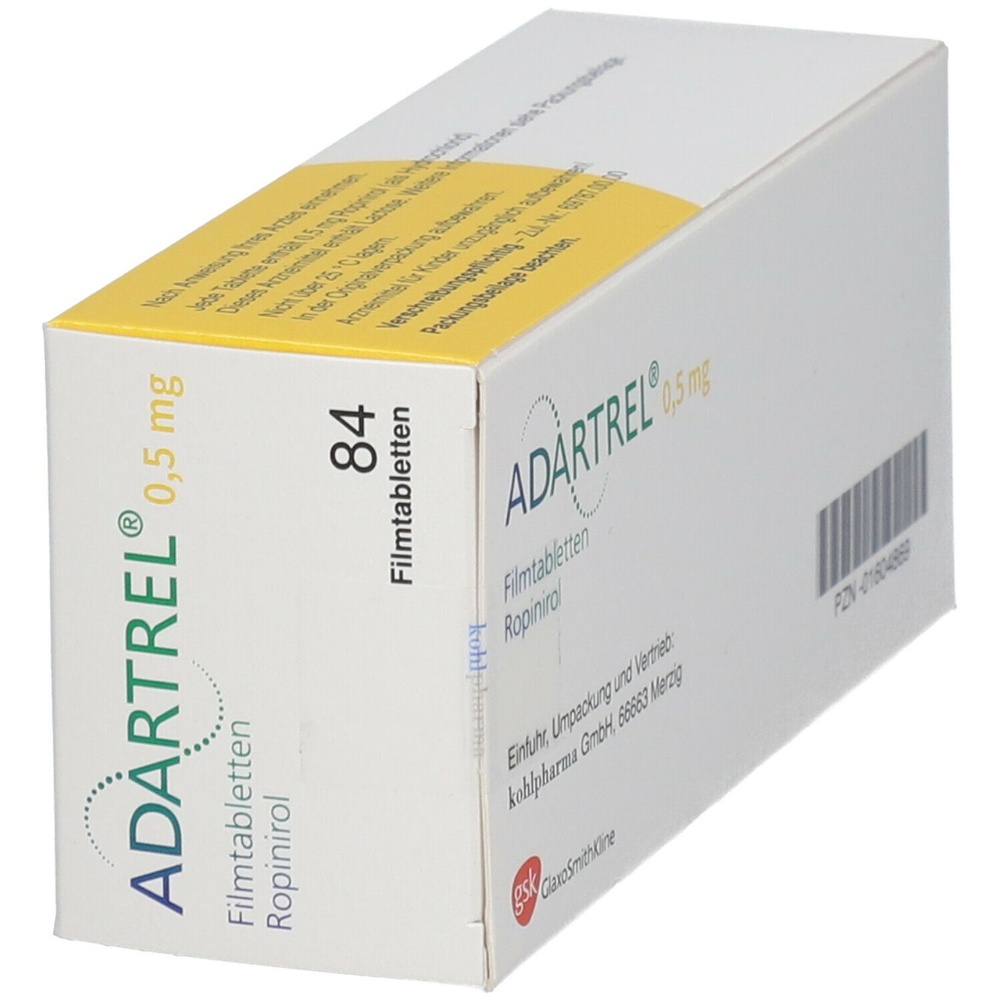
Adartrel 0.5 mgis a yellow, pentagonal, beveled-edged, coated tablet, marked "SB" on one side and "4891" on the other. The pack contains 28 tablets or 84 tablets.
Adartrel 2 mgis a pink, pentagonal, beveled-edged, coated tablet, marked "SB" on one side and "4893" on the other. The pack contains 28 tablets or 84 tablets.
Not all pack sizes may be available.
Marketing authorization holder and manufacturer
Marketing authorization holder
GlaxoSmithKline (Ireland) Limited
12 Riverwalk
Citywest Business Campus
Dublin 24
Ireland
Manufacturer
Glaxo Wellcome S.A.
Avenida de Extremadura 3
09400 Aranda de Duero
Burgos
Spain
This medicine is authorized in the Member States of the European Economic Area and in the United Kingdom (Northern Ireland) under the following names:
France, Germany, Poland, Portugal, Slovakia, Spain, Sweden, and the United Kingdom (Northern Ireland): Adartrel
To obtain more detailed information, please contact the representative of the marketing authorization holder:
GSK Services Sp. z o.o.
tel. + 48 22 576 90 00
Date of last revision of the leaflet:October 2023
- Country of registration
- Dosage formTablets, 2 mg
- ATC codeN04BC04
- Active substance
- Prescription requiredYes
- Manufacturer
- ImporterGlaxo Wellcome S.A.
- This information is for reference only and does not constitute medical advice. Always consult a doctor before taking any medication. Oladoctor is not responsible for medical decisions based on this content.
- Alternatives to AdartrelDosage form: Tablets, 0.25 mgActive substance: ropiniroleManufacturer: Glaxo Wellcome S.A.Prescription requiredDosage form: Tablets, 0.5 mgActive substance: ropinirolePrescription requiredDosage form: Tablets, 8 mgActive substance: ropinirolePrescription required
Online doctors for Adartrel
Discuss questions about Adartrel, including use, safety considerations and prescription review, subject to medical assessment and local regulations.



Get Adartrel Prescription Online
Fill in a 2-min form
Tell us your symptoms, history, and what medicine you're requesting.
Pick a doctor or let us assign
Choose a specialist or we'll match you with the next available doctor.
Doctor reviews your case
Usually within 30 minutes. They may ask follow-up questions via chat.
Collect from any pharmacy
Electronic prescription sent to your email — valid across Spain.
Frequently Asked Questions
Adartrel requires a prescription in Poland. You can check with a doctor online whether this medicine may be appropriate for your situation.
The active ingredient in Adartrel is ropinirole. This information helps identify medicines with the same composition but different brand names.
Adartrel is manufactured by Glaxo Wellcome S.A.. Pharmacy brands and packaging may differ depending on the distributor.
Doctors such as Family doctors, Psychiatrists, Dermatologists, Cardiologists, Endocrinologists, Gastroenterologists, Pulmonologists, Nephrologists, Rheumatologists, Hematologists, Infectious disease physicians, Allergists, Geriatricians, Paediatricians, Oncologists may assess whether Adartrel is appropriate, depending on your situation and local regulations. You can book an online consultation to discuss your symptoms and possible next steps.
Spain has a well-developed healthcare infrastructure across major cities such as Madrid, Barcelona, Valencia, and Seville. Pharmacies are widely available and operate under strict regulations, ensuring access to prescribed medications.
You can buy Adartrel in Madrid, Barcelona, Seville, or Valencia at any local pharmacy with a valid prescription.
To obtain a prescription, you can use Oladoctor:
Other medicines with the same active substance (ropinirole) include Adartrel, Adartrel, Aparxon Pr. These may have different brand names or formulations but contain the same therapeutic ingredient. Always consult a doctor before switching or starting a new medicine.
