



ACESAN 30 mg Tablets

Prescription review online
A doctor will review your case and decide whether a prescription is medically appropriate.

Talk to a doctor about this medicine
Discuss your symptoms and possible next steps in a quick online consultation.



How to use Acesan
Contents of the leaflet
- Package Leaflet: Information for the User
- ACESAN, 30 mg, tablets
- What is ACESAN and what is it used for
- Important information before taking ACESAN
- How to take ACESAN
- Possible side effects
- The patient should stop taking ACESAN and contact their doctor immediately if they experience the first symptoms of hypersensitivity (e.g., facial swelling, lip swelling, tongue swelling, throat swelling, causing difficulty breathing or swallowing) or if bleeding occurs, e.g., gastrointestinal bleeding (symptoms: black stools) or hemorrhages. The doctor will then assess the severity of the symptoms and decide on further action.
- Reporting side effects
- How to store ACESAN
- Contents of the pack and other information
Package Leaflet: Information for the User
ACESAN, 30 mg, tablets
Acetylsalicylic acid
Read the package leaflet carefully before taking the medicine, as it contains important information for the patient.
This medicine should always be taken exactly as described in this package leaflet for the patient or as advised by a doctor or pharmacist.
- Keep this leaflet, you may need to read it again.
- If you need advice or additional information, consult a pharmacist.
- If the patient experiences any side effects, including any possible side effects not listed in this leaflet, they should inform their doctor or pharmacist. See section 4.
- If there is no improvement or the patient feels worse, they should contact their doctor.
Table of Contents of the Leaflet
- 1. What is ACESAN and what is it used for
- 2. Important information before taking ACESAN
- 3. How to take ACESAN
- 4. Possible side effects
- 5. How to store ACESAN
- 6. Contents of the pack and other information

Not sure if this medicine is right for you?
Discuss your symptoms and treatment with a doctor online.
1. What is ACESAN and what is it used for
The active substance of ACESAN is acetylsalicylic acid, which inhibits the ability of blood platelets to aggregate and form blood clots. Acetylsalicylic acid belongs to the group of nonsteroidal anti-inflammatory drugs (NSAIDs). Its action is based on inhibiting the activity of the cyclooxygenase enzyme (COX), necessary for the synthesis of thromboxane A2 (TXA2), the main factor causing platelet aggregation.
- Prevention of myocardial infarction in patients with multiple risk factors
- Prevention of thromboembolic complications after vascular interventions (aortocoronary bypass - CABG)
- Prevention of stroke
- In angina pectoris
- Prevention of thromboembolic complications after a recent myocardial infarction
2. Important information before taking ACESAN
When not to take ACESAN:
- if the patient is hypersensitive to the active substance - acetylsalicylic acid, other salicylates, or any of the other ingredients of this medicine (listed in section 6),
- in patients with bleeding disorders,
- in patients with active gastric or duodenal ulcers,
- in patients with severe liver failure,
- in patients with severe kidney failure,
- in patients with severe heart failure,
- in patients who have had asthma attacks in the past, caused by the administration of salicylates or substances with similar effects, especially nonsteroidal anti-inflammatory drugs,
- concomitantly with methotrexate at doses of 15 mg per week or higher,
- if the patient is in the last three months of pregnancy, doses higher than 100 mg per day should not be taken (see "Pregnancy and breastfeeding"),
- in children under 12 years of age with viral infections, such as flu or chickenpox, due to the risk of Reye's syndrome - a rare but serious disease that causes liver and brain damage.
Warnings and precautions
Before starting treatment with ACESAN, the patient should discuss it with their doctor or pharmacist. Acetylsalicylic acid should be used with caution:
- in the first and second trimester of pregnancy,
- during breastfeeding,
- in case of hypersensitivity to nonsteroidal anti-inflammatory and anti-rheumatic drugs or other allergizing substances,
- during concomitant use of anticoagulant drugs,
- in patients with impaired renal function,
- in patients with impaired liver function,
- in patients who have had gastric or duodenal ulcers or gastrointestinal bleeding in the past,
- in patients with glucose-6-phosphate dehydrogenase deficiency,
- before planned surgery, due to the risk of bleeding.
ACESAN should not be used as a pain reliever or antipyretic. Acetylsalicylic acid may cause bronchospasm and trigger asthma attacks or other hypersensitivity reactions. Such reactions are particularly common in patients with asthma, chronic respiratory diseases, hay fever with nasal polyps, and those who experience allergic reactions (e.g., skin reactions, itching, hives) to other substances.
Patients undergoing surgical procedures (including minor procedures, e.g., tooth extraction) should inform their doctor about taking ACESAN. It is usually recommended to discontinue the medicine 5-7 days before the planned surgical procedure. Acetylsalicylic acid, even in small doses, reduces the excretion of uric acid from the body. In patients with a tendency to reduced uric acid excretion, the medicine may cause gout attacks.
ACESAN and other medicines
The patient should tell their doctor or pharmacist about all medicines they are currently taking or have recently taken, as well as any medicines they plan to take. Acetylsalicylic acid increases:
- the toxic effect of methotrexate on the bone marrow. Acetylsalicylic acid should not be taken concomitantly with methotrexate at doses of 15 mg per week or higher; concomitant use of methotrexate at doses less than 15 mg per week requires special caution;
- the effect of anticoagulant drugs (e.g., coumarin derivatives, heparin), thrombolytic drugs (dissolving blood clots, e.g., streptokinase, urokinase), and platelet aggregation inhibitors (e.g., ticlopidine), which may increase the risk of prolonged bleeding time and bleeding;
- the risk of gastric ulcer disease and gastrointestinal bleeding when taken concomitantly with corticosteroids, other nonsteroidal anti-inflammatory drugs, including other salicylates in high doses, or if alcohol is consumed during treatment.
After discontinuing systemic corticosteroids (except for hydrocortisone used as replacement therapy in Addison's disease), the risk of salicylate overdose increases;
- the risk of gastrointestinal bleeding when taken concomitantly with antidepressant drugs from the group of selective serotonin reuptake inhibitors (e.g., sertraline, paroxetine);
- the effect of digoxin, as it increases its serum concentration;
- the effect of antidiabetic drugs, e.g., insulin, sulfonylurea derivatives;
- the toxic effect of valproic acid, which in turn increases the anti-aggregatory effect of acetylsalicylic acid.
Acetylsalicylic acid reduces the effect of:
- anti-gout drugs used to treat gout, which increase uric acid excretion from the body (e.g., benzbromarone, probenecid), which may increase gout symptoms;
- diuretic drugs;
- some antihypertensive drugs (from the group of so-called angiotensin-converting enzyme inhibitors, e.g., captopril, enalapril).
Concomitant use of ibuprofen weakens the cardioprotective effect of acetylsalicylic acid. Concomitant use of metamizole with acetylsalicylic acid may reduce the inhibitory effect of acetylsalicylic acid on platelet aggregation. Therefore, metamizole should be used with caution in patients taking acetylsalicylic acid in low doses for protective effects on the cardiovascular system. ACESAN can be taken concomitantly with the above-mentioned drugs only after consulting a doctor (except for methotrexate at doses of 15 mg per week or higher, when taking ACESAN is contraindicated).
ACESAN with food and drink
The medicine should be taken during a meal, with a large amount of fluid.
Pregnancy and breastfeeding
If the patient is pregnant or breastfeeding, thinks they may be pregnant, or plans to have a child, they should consult their doctor or pharmacist before taking this medicine.
Pregnancy
If the patient continues or starts treatment with ACESAN during pregnancy in accordance with the doctor's recommendations, they should take ACESAN as recommended by the doctor and not take a dose higher than recommended.
Pregnancy - last trimester
ACESAN should not be taken in a dose higher than 100 mg per day during the last three months of pregnancy, as it may harm the unborn child or cause complications during delivery. Taking ACESAN may cause kidney and heart function disorders in the unborn child. This may affect the patient's and child's tendency to bleed and may cause delayed or prolonged delivery. If the patient takes ACESAN in low doses (up to 100 mg per day), close obstetric monitoring is necessary according to the doctor's recommendations.
Pregnancy - first and second trimester
ACESAN should not be taken during the first six months of pregnancy, unless it is absolutely necessary and has been recommended by a doctor. If the patient requires treatment during this period or is trying to conceive, they should take the lowest possible dose for the shortest possible time. If ACESAN is taken for a longer period than a few days from the 20th week of pregnancy, it may cause kidney function disorders in the unborn child, leading to a decrease in the amount of amniotic fluid surrounding the fetus (oligohydramnios) or narrowing of the arterial duct (ductus arteriosus) in the child's heart. If treatment is necessary for a longer period, the doctor may recommend additional monitoring.
Breastfeeding
Acetylsalicylic acid passes into breast milk in small amounts. Before taking the medicine, the patient should consult their doctor.
Driving and using machines
The medicine does not affect the ability to drive vehicles or operate machines.
ACESAN contains quinoline yellow
Due to the presence of quinoline yellow, the medicine may cause allergic reactions.
ACESAN contains sodium
The medicine contains less than 1 mmol (23 mg) of sodium per tablet, which means it is considered "sodium-free".

Started taking the medicine and have questions?
Discuss your symptoms and treatment with a doctor online.
3. How to take ACESAN
This medicine should always be taken exactly as described in this package leaflet for the patient or as advised by a doctor or pharmacist. In case of doubt, the patient should consult their doctor or pharmacist. The dose of ACESAN is determined by the doctor based on the patient's medical history. Usually, one tablet is taken once a day. The tablets should be taken orally, preferably during a meal, with a large amount of fluid.
Taking a higher dose of ACESAN than recommended
In case of taking a higher dose of ACESAN than recommended, the patient should immediately consult their doctor or pharmacist, and in case of severe poisoning, the patient should be taken to the hospital immediately. The first symptoms of poisoning are: dizziness, tinnitus, deafness, excessive sweating, nausea, and vomiting, headache, confusion (disorders of consciousness with disorientation, thinking, and speech disorders, delusions, hallucinations, anxiety, and psychomotor agitation), rapid breathing, deep breathing, and blurred vision, fainting. In case of severe poisoning, the following symptoms may occur: high fever, disorders of heart and blood vessel function (from irregular rhythm, low blood pressure to cardiac arrest), fluid and electrolyte loss (from dehydration, oliguria - decreased urine output below 400-500 mL in adults - to renal failure), increased or decreased blood glucose levels (especially in children), ketoacidosis (increased ketone levels in the blood), gastrointestinal bleeding, coagulation disorders, neurological disorders manifesting as lethargy, confusion, and seizures.
Missing a dose of ACESAN
In case of missing a dose of ACESAN, the patient should take the next dose at the usual time. The patient should not take a double dose to make up for the missed dose. In case of any further doubts about taking this medicine, the patient should consult their doctor or pharmacist.
4. Possible side effects
Like all medicines, ACESAN can cause side effects, although not everybody gets them.
The patient should stop taking ACESAN and contact their doctor immediately if they experience the first symptoms of hypersensitivity (e.g., facial swelling, lip swelling, tongue swelling, throat swelling, causing difficulty breathing or swallowing) or if bleeding occurs, e.g., gastrointestinal bleeding (symptoms: black stools) or hemorrhages. The doctor will then assess the severity of the symptoms and decide on further action.
After taking acetylsalicylic acid, the following have been reported:
- Frequent (in 1 to 10 out of 100 patients): dyspepsia symptoms (heartburn, nausea, vomiting) and abdominal pain.
Rare (in 1 to 10 out of 10,000 patients):
- inflammatory conditions of the stomach and intestines, gastric and duodenal ulcer disease, very rarely leading to bleeding and perforation;
- transient liver function disorders (increased aminotransferase activity).
Rare or very rare:
- serious bleeding, such as gastrointestinal bleeding (symptoms: black stools), cerebral hemorrhage (especially in patients with uncontrolled hypertension and/or during concomitant use of drugs that inhibit bleeding). Bleeding may lead to acute or chronic anemia due to blood loss and/or iron deficiency anemia (symptoms: weakness, pallor).
Very rare (less than 1 in 10,000 patients):
- severe allergic reactions, including anaphylactic shock (symptoms: facial swelling, eyelid swelling, tongue swelling, and throat swelling, significant decrease in blood pressure, and disorders of heart rhythm and breathing);
- kidney function disorders;
- decreased blood glucose levels.
Additionally, the following have been reported:
- dizziness and tinnitus (symptoms of overdose);
- hypersensitivity reactions: rash, urticaria, edema, itching, heart and respiratory disorders (including asthma);
- increased risk of bleeding, prolonged bleeding time, prolonged prothrombin time, decreased platelet count;
- peroperative bleeding, hematomas, bleeding (from the nose, genitourinary tract, gums).
When taking drugs from the group of nonsteroidal anti-inflammatory drugs, edema, hypertension, and heart failure have been reported as side effects.
Reporting side effects
If the patient experiences any side effects, including any side effects not listed in this leaflet, they should inform their doctor or pharmacist. Side effects can be reported directly to the Department of Monitoring of Adverse Reactions to Medicinal Products of the Office for Registration of Medicinal Products, Medical Devices, and Biocidal Products, Al. Jerozolimskie 181C, 02-222 Warsaw, Tel.: +48 22 49 21 301, Fax: +48 22 49 21 309, website: https://smz.ezdrowie.gov.pl. Side effects can also be reported to the marketing authorization holder. By reporting side effects, more information can be collected on the safety of the medicine.
5. How to store ACESAN
The medicine should be stored out of sight and reach of children. Store in a temperature below 25°C. Store in the original packaging to protect from moisture. Do not take ACESAN after the expiry date stated on the packaging. The expiry date refers to the last day of the month. Medicines should not be disposed of via wastewater or household waste. The patient should ask their pharmacist how to dispose of medicines that are no longer needed. This will help protect the environment.
6. Contents of the pack and other information
What ACESAN contains
- The active substance of ACESAN is acetylsalicylic acid. One tablet contains 30 mg of acetylsalicylic acid.
- The excipients are: microcrystalline cellulose, sodium carboxymethylcellulose (type A), stearic acid, quinoline yellow, lacquer (E 104).
What ACESAN looks like and contents of the pack
ACESAN is a yellow, round, biconvex tablet with a smooth surface. Packaging: PVC/PCTFE/Aluminum blisters in a cardboard box. Pack size: 63 tablets
Marketing authorization holder and manufacturer
Marketing authorization holder
SUN-FARM Sp. z o.o., ul. Dolna 21, 05-092 Łomianki, tel. +48 22 350 66 69
Manufacturer
mibe GmbH Arzneimittel, Münchener Straße 15, 06796 Brehna, Germany
Date of last revision of the leaflet:
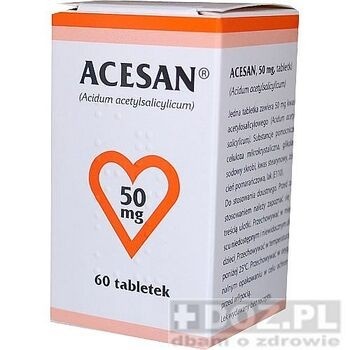
- Country of registration
- Dosage formTablets, 30 mg
- ATC codeB01AC06
- Active substance
- Prescription requiredNo
- Manufacturer
- Importermibe GmbH Arzneimittel
- This information is for reference only and does not constitute medical advice. Always consult a doctor before taking any medication. Oladoctor is not responsible for medical decisions based on this content.
- Alternatives to AcesanDosage form: Tablets, 75 mgActive substance: acetylsalicylic acidManufacturer: G.L. Pharma GmbH Krka, d.d., Novo mesto TAD Pharma GmbHPrescription not requiredDosage form: Tablets, 100 mgActive substance: acetylsalicylic acidManufacturer: G.L. Pharma GmbH Krka, d.d., Novo mesto TAD Pharma GmbHPrescription not requiredDosage form: Tablets, 160 mgActive substance: acetylsalicylic acidManufacturer: G.L. Pharma GmbH Krka, d.d., Novo mesto TAD Pharma GmbHPrescription not required
Online doctors for Acesan
Discuss questions about Acesan, including use, safety considerations and prescription review, subject to medical assessment and local regulations.









Get Acesan Prescription Online
Fill in a 2-min form
Tell us your symptoms, history, and what medicine you're requesting.
Pick a doctor or let us assign
Choose a specialist or we'll match you with the next available doctor.
Doctor reviews your case
Usually within 30 minutes. They may ask follow-up questions via chat.
Collect from any pharmacy
Electronic prescription sent to your email — valid across Spain.
Frequently Asked Questions
Acesan does not require a prescription in Poland. You can check with a doctor online whether this medicine may be appropriate for your situation.
The active ingredient in Acesan is acetylsalicylic acid. This information helps identify medicines with the same composition but different brand names.
Acesan is manufactured by mibe GmbH Arzneimittel. Pharmacy brands and packaging may differ depending on the distributor.
Doctors such as Family doctors, Psychiatrists, Dermatologists, Cardiologists, Endocrinologists, Gastroenterologists, Pulmonologists, Nephrologists, Rheumatologists, Hematologists, Infectious disease physicians, Allergists, Geriatricians, Paediatricians, Oncologists may assess whether Acesan is appropriate, depending on your situation and local regulations. You can book an online consultation to discuss your symptoms and possible next steps.
Spain has a well-developed healthcare infrastructure across major cities such as Madrid, Barcelona, Valencia, and Seville. Pharmacies are widely available and operate under strict regulations, ensuring access to prescribed medications.
You can buy Acesan in Madrid, Barcelona, Seville, or Valencia at any local pharmacy with a valid prescription.
To obtain a prescription, you can use Oladoctor:
Other medicines with the same active substance (acetylsalicylic acid) include Abrea, Abrea, Abrea. These may have different brand names or formulations but contain the same therapeutic ingredient. Always consult a doctor before switching or starting a new medicine.
