



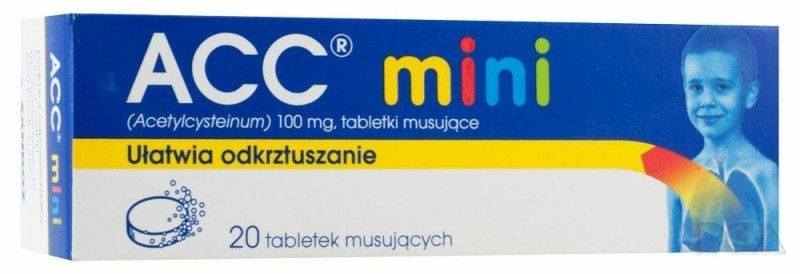
ACC 100 mg Tablets

Prescription review online
A doctor will review your case and decide whether a prescription is medically appropriate.

Talk to a doctor about this medicine
Discuss your symptoms and possible next steps in a quick online consultation.



How to use Acc mini
Contents of the leaflet
- Leaflet attached to the packaging: patient information
- ACC mini, 100 mg, effervescent tablets
- Important information before taking ACC mini
- When not to take ACC mini
- Warnings and precautions
- Children and adolescents
- Other medicines and ACC mini
- ACC mini with food and drink
- Pregnancy and breastfeeding
- Driving and using machines
- ACC mini contains lactose, sodium, sorbitol, and glucose (a component of maltodextrin).
- Lactose
- Sodium
- Sorbitol
- Glucose (a component of maltodextrin)
- How to take ACC mini
- Possible side effects
- How to store ACC mini
- Contents of the pack and other information
Leaflet attached to the packaging: patient information
ACC mini, 100 mg, effervescent tablets
Acetylcysteine
Please read carefully the contents of the leaflet before taking the medicine, as it contains important information for the patient.
This medicine should always be taken exactly as described in this patient leaflet or as directed by a doctor or pharmacist.
- This leaflet should be kept in case it needs to be read again.
- If advice or additional information is needed, a pharmacist should be consulted.
- If the patient experiences any side effects, including any not listed in this leaflet, they should inform their doctor or pharmacist. See section 4.
- If after 4 to 5 days there is no improvement or the patient feels worse, they should contact their doctor.
Table of contents of the leaflet:
- 1. What is ACC mini and what is it used for
- 2. Important information before taking ACC mini
- 3. How to take ACC mini
- 4. Possible side effects
- 5. How to store ACC mini
- 6. Contents of the pack and other information
1 What is ACC mini and what is it used for
ACC mini effervescent tablets contain the active substance acetylcysteine - a medicine that primarily reduces the viscosity of bronchial secretions and facilitates expectoration.
ACC mini is used for a short period as a mucolytic agent for the treatment of respiratory tract disorders and to facilitate expectoration in patients with symptoms of upper respiratory tract infections.

Not sure if this medicine is right for you?
Discuss your symptoms and treatment with a doctor online.
2. Important information before taking ACC mini
When not to take ACC mini
if the patient is allergic to acetylcysteine or any of the other ingredients of this medicine (listed in section 6).
Allergic reactions may include: itching, hives, rash, bronchospasm (shortness of breath),
accelerated heart rate and decreased blood pressure. If any of these symptoms occur, the patient should stop taking ACC mini immediately and consult a doctor.
if the patient has active gastric or duodenal ulcer.
if the patient has acute asthma (exacerbation of bronchial asthma or chronic obstructive pulmonary disease).
The medicine should not be used in children under 3 years of age.
Warnings and precautions
Before taking ACC mini, the patient should discuss it with their doctor or pharmacist if:
they have had or currently have chronic bronchial asthma (since the medicine may cause bronchospasm and shortness of breath). Patients with bronchial asthma must be under close medical supervision during treatment. If bronchospasm occurs, the patient should stop taking the medicine immediately and seek medical help;
they have had a history of peptic ulcer, especially if they are taking other medicines that irritate the mucous membranes of the gastrointestinal tract;
they currently have or have had respiratory failure;
they have a problem with expectoration (physiotherapy may be necessary - the doctor will provide information on what it entails);
they have been diagnosed with histamine intolerance (long-term use of the medicine may cause symptoms of intolerance, such as headache, runny nose, itching);
they are elderly (over 65 years of age).
If skin or mucous membrane changes occur during treatment, the patient should stop taking the medicine and consult a doctor immediately (see section 4).
Children and adolescents
Due to the active substance content, ACC mini should not be used in children under 3 years of age.
Mucolytic agents (which thin out secretions in the respiratory tract and reduce their viscosity) may cause airway obstruction or blockage in children under 2 years of age due to physiological characteristics of the airways and limited ability to expectorate in this age group. Therefore, mucolytic agents should not be used in children under 2 years of age.
Other medicines and ACC mini
The patient should inform their doctor or pharmacist about all medicines they are currently taking or have recently taken, as well as any medicines they plan to take.
ACC mini should not be taken at the same time as cough suppressants, as they may weaken the cough reflex and make expectoration more difficult.
Acetylcysteine (the active substance of ACC mini) may reduce the effectiveness of some antibiotics (especially semi-synthetic penicillins, tetracyclines, cephalosporins, and aminoglycosides). To avoid this, ACC mini should be taken 2 hours after taking an antibiotic. This does not apply to antibiotics such as cefixime, loracarbef, amoxicillin, doxycycline, erythromycin, tiamfenicol, and cefuroxime. In case of doubt, the patient should consult their doctor.
ACC mini may enhance the effect of nitroglycerin and other nitrates (medicines used in cardiovascular diseases and coronary heart disease). During concurrent use of these medicines, the doctor will monitor whether the patient develops hypotension. Headache may occur. If the patient is taking nitroglycerin or another similarly acting medicine from the nitrate group, they should consult their doctor before taking ACC mini.
Large amounts of activated charcoal may reduce the effectiveness of ACC mini.
It is not recommended to dissolve ACC mini in solutions containing other medicines.
Effect of ACC mini on laboratory tests
If the patient is to undergo a blood or urine test for salicylates or a urine test for ketone bodies, they should inform their doctor and medical staff about taking ACC mini.
ACC mini with food and drink
The medicine should be taken after a meal. During treatment, the patient should drink a sufficient amount of fluids (at least 1.5 liters per day).
Pregnancy and breastfeeding
If the patient is pregnant or breastfeeding, thinks they may be pregnant, or plans to have a child, they should consult their doctor or pharmacist before taking this medicine.
ACC mini can be used during pregnancy and breastfeeding only if the doctor considers it necessary.
Driving and using machines
The effect of ACC mini on the ability to drive and use machines is not known.
ACC mini contains lactose, sodium, sorbitol, and glucose (a component of maltodextrin).
Lactose
If the patient has been diagnosed with intolerance to some sugars, they should consult their doctor before taking the medicine.
Sodium
The medicine contains 96 mg of sodium (the main component of table salt) per effervescent tablet. This corresponds to 4.8% of the maximum recommended daily intake of sodium in the diet for adults. If the patient takes 5 or more effervescent tablets per day for a long time, they should consult their doctor or pharmacist, especially if they are controlling their sodium intake.
Sorbitol
The medicinal product contains 0.06 mg of sorbitol (E 420) per effervescent tablet.
Glucose (a component of maltodextrin)
If the patient has been diagnosed with intolerance to some sugars, they should consult their doctor before taking the medicine.
3. How to take ACC mini
This medicine should always be taken exactly as described in this patient leaflet or as directed by a doctor or pharmacist. If in doubt, the patient should consult their doctor or pharmacist.
Usually, the following dosage is used:
Adults and adolescents over 14 years of age
2 ACC mini effervescent tablets 2 or 3 times a day (corresponding to 400 mg to 600 mg of acetylcysteine per day in 2 or 3 divided doses).
Children from 7 to 14 years of age
1 ACC mini effervescent tablet 4 times a day or 2 ACC mini effervescent tablets 2 times a day (corresponding to 400 mg of acetylcysteine per day in 2 or 4 divided doses).
Children from 3 to 6 years of age
1 ACC mini effervescent tablet 2 or 3 times a day (200 mg to 300 mg of acetylcysteine per day in 2 or 3 divided doses).
ACC mini should not be used in children under 3 years of age.
Without a doctor's recommendation, the medicine should not be taken for more than 4 to 5 days.
Method of administration
The medicine should be taken after a meal (see "ACC mini with food and drink"). The tablet should be dissolved in half a glass of water and taken immediately after dissolution.
The effervescent tablet should not be dissolved in solutions containing other medicines.
The medicine should not be taken before bedtime due to difficult expectoration of thinned secretions during sleep. The last dose of ACC mini should be taken no later than 4 hours before bedtime.
After dissolving the tablet, the patient should avoid prolonged contact of the prepared liquid with metals and rubber.
Taking a higher dose of ACC mini than recommended
In case of taking too much medicine, the patient should consult their doctor or pharmacist.
It is possible to experience gastrointestinal symptoms such as nausea, vomiting, and diarrhea.
Missing a dose of ACC mini
If the medicine is taken regularly and it is not long since the missed dose was due to be taken, it should be taken as soon as possible. If it is almost time for the next dose, the patient should take it at the usual time. A double dose should not be taken to make up for a missed dose.
In case of any further doubts about taking this medicine, the patient should consult their doctor or pharmacist.

Started taking the medicine and have questions?
Discuss your symptoms and treatment with a doctor online.
4. Possible side effects
Like all medicines, ACC mini can cause side effects, although not everybody gets them.
If the patient experiences any of the following symptoms, they should stop taking ACC mini and seek medical help immediately:
anaphylactic reaction or a reaction similar to anaphylaxis (a type of severe allergic reaction) with symptoms such as sudden wheezing, difficulty breathing, or dizziness, swelling of the eyelids, face, lips, or throat, hives, itching;
angioedema (a severe allergic reaction) with swelling of the skin and/or mucous membranes, e.g., in the face, limbs, joints;
skin and mucous membrane changes, which may be accompanied by fever and joint pain;
bronchospasm (sudden shortness of breath).
Uncommon side effects (may occur in less than 1 in 100 people):
allergic reactions
headache
tinnitus
accelerated heart rate (tachycardia)
decreased blood pressure
nausea, vomiting, diarrhea, abdominal pain, stomatitis
hives, rash, itching, angioedema
fever
Rare side effects (may occur in less than 1 in 1000 people):
indigestion
shortness of breath, bronchospasm
Very rare side effects (may occur in less than 1 in 10,000 people):
anaphylactic reaction or a reaction similar to anaphylaxis, up to anaphylactic shock (see above)
severe skin and mucous membrane changes, which may indicate Stevens-Johnson syndrome and toxic epidermal necrolysis (see above)
bleeding
Side effects with unknown frequency (frequency cannot be estimated from available data):
facial swelling
Reporting side effects
If the patient experiences any side effects, including any not listed in the leaflet, they should inform their doctor, pharmacist, or nurse. Side effects can be reported directly to the Department of Adverse Reaction Monitoring of Medicinal Products of the Office for Registration of Medicinal Products, Medical Devices, and Biocidal Products: Al. Jerozolimskie 181C, 02-222 Warsaw
tel.: +48 22 49 21 301, fax: +48 22 49 21 309, website: https://smz.ezdrowie.gov.pl
Side effects can also be reported to the marketing authorization holder.
By reporting side effects, more information can be collected on the safety of the medicine.
5. How to store ACC mini
The medicine should be stored out of sight and reach of children.
Store in a temperature below 25°C.
Do not use ACC mini after the expiry date stated on the packaging after: EXP.
The expiry date refers to the last day of the month.
Medicines should not be disposed of via wastewater or household waste. The patient should ask their pharmacist how to dispose of medicines that are no longer needed. This will help protect the environment.
6. Contents of the pack and other information
What ACC mini contains
- The active substance of ACC mini is acetylcysteine. One effervescent tablet contains 100 mg of acetylcysteine.
- The other ingredients of the medicine are: anhydrous citric acid, sodium bicarbonate, anhydrous sodium carbonate, mannitol (E 421), anhydrous lactose, ascorbic acid, disodium citrate dihydrate, sodium saccharin dihydrate, blackcurrant flavor "B" (contains, among others, maltodextrin, propylene glycol (E 1520), mannitol (E 421), and sorbitol (E 420)).
What ACC mini looks like and what the pack contains
A polypropylene tube in a cardboard box contains 20 effervescent tablets.
Marketing authorization holder
Sandoz GmbH
Biochemiestrasse 10
A-6250 Kundl, Austria
Manufacturer
Salutas Pharma GmbH
Otto-von-Guericke-Allee 1
39179 Barleben, Germany
Hermes Pharma GmbH
Hans-Urmiller-Ring 52
82515 Wolfratshausen
Germany
Hermes Pharma Ges.m.b.H.
Schwimmschulweg 1a
A-9400 Wolfsberg
Austria
To obtain more detailed information, the patient should contact:
Sandoz Polska Sp. z o.o.
ul. Domaniewska 50 C
02-672 Warsaw
tel. 22 209 70 00
Date of last revision of the leaflet:
{Sandoz logo }
- Country of registration
- Dosage formTablets, 100 mg
- ATC codeR05CB01
- Active substance
- Prescription requiredNo
- Manufacturer
- ImporterHermes Pharma Ges.m.b.H. Hermes Pharma GmbH Salutas Pharma GmbH
- This information is for reference only and does not constitute medical advice. Always consult a doctor before taking any medication. Oladoctor is not responsible for medical decisions based on this content.
- Alternatives to Acc miniDosage form: Solution, 20 mg/mlActive substance: acetylcysteinePrescription not requiredDosage form: Powder, 100 mg/sachetActive substance: acetylcysteineManufacturer: Salutas Pharma GmbHPrescription not requiredDosage form: Powder, 600 mgActive substance: acetylcysteinePrescription not required
Online doctors for Acc mini
Discuss questions about Acc mini, including use, safety considerations and prescription review, subject to medical assessment and local regulations.









Get Acc mini Prescription Online
Fill in a 2-min form
Tell us your symptoms, history, and what medicine you're requesting.
Pick a doctor or let us assign
Choose a specialist or we'll match you with the next available doctor.
Doctor reviews your case
Usually within 30 minutes. They may ask follow-up questions via chat.
Collect from any pharmacy
Electronic prescription sent to your email — valid across Spain.
Frequently Asked Questions
Acc mini does not require a prescription in Poland. You can check with a doctor online whether this medicine may be appropriate for your situation.
The active ingredient in Acc mini is acetylcysteine. This information helps identify medicines with the same composition but different brand names.
Acc mini is manufactured by Hermes Pharma Ges.m.b.H. Hermes Pharma GmbH Salutas Pharma GmbH. Pharmacy brands and packaging may differ depending on the distributor.
Doctors such as Family doctors, Psychiatrists, Dermatologists, Cardiologists, Endocrinologists, Gastroenterologists, Pulmonologists, Nephrologists, Rheumatologists, Hematologists, Infectious disease physicians, Allergists, Geriatricians, Paediatricians, Oncologists may assess whether Acc mini is appropriate, depending on your situation and local regulations. You can book an online consultation to discuss your symptoms and possible next steps.
Spain has a well-developed healthcare infrastructure across major cities such as Madrid, Barcelona, Valencia, and Seville. Pharmacies are widely available and operate under strict regulations, ensuring access to prescribed medications.
You can buy Acc mini in Madrid, Barcelona, Seville, or Valencia at any local pharmacy with a valid prescription.
To obtain a prescription, you can use Oladoctor:
Other medicines with the same active substance (acetylcysteine) include Acc classic, Acc mini, Acc Optima Active. These may have different brand names or formulations but contain the same therapeutic ingredient. Always consult a doctor before switching or starting a new medicine.
