


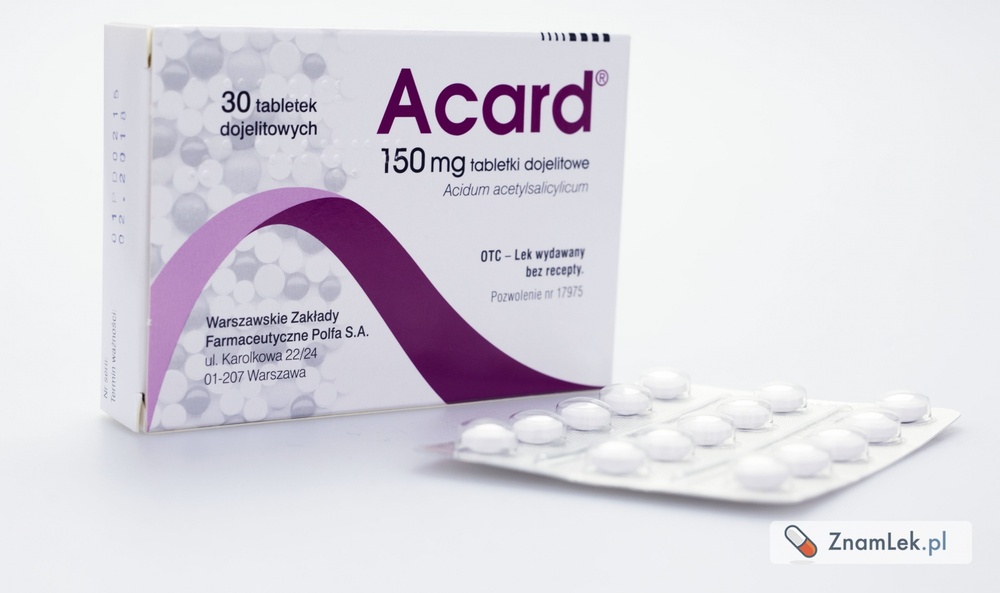
Acard
Ask a doctor about a prescription for Acard




How to use Acard
Leaflet attached to the packaging: patient information
Warning! Keep the leaflet! Information on the immediate packaging in a foreign language.
ACARD (АKАРД), 75 mg, enteric-coated tablets
Acetylsalicylic acid
ACARD and АKАРД are different trade names for the same drug written in Polish and Bulgarian.
You should carefully read the contents of the leaflet before taking the medicine, as it contains
important information for the patient.
This medicine should always be taken exactly as described in the patient leaflet or according to the doctor's or pharmacist's instructions.
- You should keep this leaflet so that you can read it again if you need to.
- If you need advice or additional information, you should consult a pharmacist.
- If the patient experiences any side effects, including any possible side effects not listed in the leaflet, they should tell their doctor or pharmacist. See section 4.
- If there is no improvement or the patient feels worse, they should contact their doctor.
Table of contents of the leaflet
- 1. What is Acard and what is it used for
- 2. Important information before taking Acard
- 3. How to take Acard
- 4. Possible side effects
- 5. How to store Acard
- 6. Contents of the packaging and other information
1. What is Acard and what is it used for
Acard contains acetylsalicylic acid, which inhibits platelet aggregation.
The medicine is intended for long-term, preventive use in diseases that threaten the formation of blood clots and emboli in blood vessels.
Acard is used:
- to prevent heart attacks in people at high risk;
- in recent myocardial infarction or suspected recent myocardial infarction;
- in unstable angina;
- to prevent repeated heart attacks;
- after surgical or interventional procedures on blood vessels, such as coronary artery bypass grafting, coronary angioplasty;
- to prevent transient cerebral ischemic attacks and ischemic strokes, as well as after they have occurred;
- in people with atherosclerosis of peripheral arteries;
- to prevent coronary thrombosis in patients with multiple risk factors;
- to prevent venous thrombosis and pulmonary embolism in patients who are immobilized for a long time.
2. Important information before taking Acard
When not to take Acard
- if the patient is allergic to acetylsalicylic acid, other salicylates, or any of the other ingredients of this medicine (listed in section 6.);
- if the patient has an increased tendency to bleeding and blood coagulation disorders;
- if the patient has gastric or duodenal ulcer disease;
- if the patient has severe kidney or liver problems (severe renal or hepatic insufficiency);
- if the patient has had asthma attacks after taking acetylsalicylic acid or other anti-inflammatory drugs (symptoms: shortness of breath, wheezing);
- if the patient is in the third trimester of pregnancy (the last three months of pregnancy);
- if the patient is taking methotrexate (a medicine used to treat cancer) in doses of 15 mg per week or higher;
- in children under 12 years of age with viral infections (e.g., flu or chickenpox), due to the risk of liver and brain damage (Reye's syndrome).
Warnings and precautions
Before starting to take Acard, you should discuss it with your doctor or pharmacist:
- if the patient is allergic to anti-inflammatory and anti-rheumatic drugs (e.g., naproxen) or other allergens - see "When not to take Acard";
- if the patient has asthma, chronic respiratory diseases, or nasal polyps;
- if the patient has had gastric or intestinal ulcer disease;
- if the patient has a congenital deficiency of glucose-6-phosphate dehydrogenase (a rare hereditary disease);
- if the patient has severe heart failure;
- if the patient has kidney or liver function disorders, as there is a risk of exacerbating the side effects of the medicine.
- Acard should not be taken for at least 5 days before a planned surgical procedure (including minor procedures, e.g., tooth extraction).
Acard and other medicines
You should tell your doctor or pharmacist about all medicines the patient is taking or has recently taken, as well as any medicines the patient plans to take.
- Acard should not be taken at the same time as:
- methotrexate in doses of 15 mg per week or higher;
- ibuprofen.
- Acard can be taken after prior consultation with a doctor with the following medicines:
- anticoagulants (e.g., acenocoumarol, warfarin, heparin);
- other non-steroidal anti-inflammatory drugs, including salicylates;
- medicines used to treat gout (e.g., probenecid, benzbromarone);
- oral antidiabetic drugs (e.g., tolbutamide, glibenclamide) and insulin;
- medicines that inhibit platelet aggregation (e.g., ticlopidine);
- medicines used to treat depression and anxiety (e.g., fluoxetine, paroxetine);
- diuretics (e.g., furosemide);
- systemic glucocorticosteroids;
- antihypertensive drugs (e.g., enalapril, captopril);
- valproic acid (an antiepileptic drug);
- methotrexate in doses less than 15 mg per week;
- digoxin (a cardiac glycoside).
- Metamizole (a substance with analgesic and antipyretic effects) may reduce the effect of acetylsalicylic acid on platelet aggregation (platelet adhesion and clot formation) if these medicines are taken at the same time. Therefore, caution should be exercised when using metamizole in patients receiving acetylsalicylic acid.
- Alcohol may increase the risk of gastrointestinal side effects caused by acetylsalicylic acid.
Pregnancy and breastfeeding
If the patient is pregnant or breastfeeding, thinks they may be pregnant, or plans to have a child, they should consult their doctor or pharmacist before taking this medicine.
Acard can be taken during the first 6 months of pregnancy only after consulting a doctor.
Taking the medicine during the last three months of pregnancy is contraindicated, as it may cause complications in the mother and child.
Short-term use of the medicine by a breastfeeding woman does not pose a significant risk to the breastfed child. However, breastfeeding is not recommended during long-term use of high doses of acetylsalicylic acid.
Driving and using machines
Acard does not affect the ability to drive or operate machinery.
Acard 75 mg contains sodium
The medicine contains less than 1 mmol (23 mg) of sodium per dose, which means the medicine is considered "sodium-free".
3. How to take Acard
This medicine should always be taken exactly as described in the patient leaflet or according to the doctor's or pharmacist's instructions.
You should consult a doctor before starting to take Acard.
Acard is available in two doses: 75 mg and 150 mg. The doctor will prescribe the dose suitable for the patient and determine the duration of treatment.
Take orally.
- Usually, the following dosage is recommended:
1 tablet (75 mg) per day.
Enteric-coated tablets should be taken after a meal - swallow whole, with a small amount of water.
The enteric-coated tablet of Acard has a coating and does not disintegrate in the stomach, which reduces the irritating effect of acetylsalicylic acid on the gastric mucosa.
- In recent myocardial infarction or suspected recent myocardial infarction:
take 4 enteric-coated tablets (300 mg) at once. The tablets should be chewed very thoroughly to accelerate absorption.
Warning:in acute myocardial infarction or suspected acute myocardial infarction, enteric-coated tablets may be used when acetylsalicylic acid in non-coated tablets is not available.
Taking a higher dose of Acard than recommended
In case of overdose, you should contact a doctor, and in case of severe poisoning, the patient should be taken to the hospital immediately.
The first symptoms of poisoning are: tinnitus, rapid breathing, fever, nausea, vomiting, vision disturbances, headaches, dizziness, confusion, skin rashes.
In more severe cases, the following may occur: hallucinations, tremors, shortness of breath, excessive sweating, agitation, coma.
Missing a dose of Acard
You should not take a double dose to make up for a missed dose, but take the next dose as usual.
Stopping treatment with Acard
If you have any further doubts about taking this medicine, you should consult your doctor or pharmacist.
4. Possible side effects
Like all medicines, this medicine can cause side effects, although not everybody gets them.
You should stop taking the medicine and contact your doctor immediately if you experience the first symptoms of hypersensitivity (e.g., facial, lip, tongue, or throat swelling, causing difficulty breathing or swallowing) or if you experience bleeding, e.g., from the gastrointestinal tract (symptoms: black stools), or hemorrhages.
The doctor will assess the severity of the symptoms and decide on further action.
After taking acetylsalicylic acid, the following have been reported:
Common (in 1 to 10 out of 100 people):
- symptoms of indigestion (heartburn, nausea, vomiting) and abdominal pain.
Uncommon (in 1 to 10 out of 10,000 people):
- inflammatory diseases of the stomach and intestines, gastric or duodenal ulcer disease;
- transient liver function disorders.
Rare or very rare:
- serious bleeding, such as gastrointestinal bleeding (symptoms: black stools), cerebral hemorrhage (especially in patients with uncontrolled hypertension and/or during concomitant administration of bleeding-inhibiting drugs). Bleeding can lead to acute or chronic anemia due to blood loss and/or iron deficiency anemia (symptoms: weakness, pallor).
Very rare (less than 1 in 10,000 people):
- severe allergic reactions, including anaphylactic shock (symptoms: facial, eyelid, tongue, and throat swelling, significant drop in blood pressure, and disturbances in heart rhythm and breathing);
- kidney function disorders;
- decreased blood glucose levels.
Additionally, the following have been reported:
- dizziness and tinnitus (symptoms of overdose);
- hypersensitivity reactions: rash, urticaria, edema, itching, heart and respiratory disorders (including asthma);
- increased risk of bleeding, prolonged bleeding time;
- perioperative bleeding, hematomas, bleeding (from the nose, genitourinary tract, gums).
Reporting side effects
If you experience any side effects, including any side effects not listed in the leaflet, you should tell your doctor or pharmacist. Side effects can be reported directly to the Department of Monitoring of Adverse Reactions to Medicinal Products, Office for Registration of Medicinal Products, Medical Devices, and Biocidal Products, Al. Jerozolimskie 181C, 02-222 Warsaw, tel.: +48 22 49 21 301, fax: +48 22 49 21 309, website: https://smz.ezdrowie.gov.pl.
Reporting side effects will help gather more information on the safety of the medicine.
5. How to store Acard
The medicine should be stored out of sight and reach of children.
Do not store above 25°C. Store in the original packaging to protect from moisture.
Do not take Acard after the expiry date stated on the packaging. The expiry date refers to the last day of the given month.
Medicines should not be disposed of via wastewater or household waste. You should ask your pharmacist how to dispose of medicines that are no longer needed. This will help protect the environment.
6. Contents of the packaging and other information
What Acard contains
- The active substance of Acard is acetylsalicylic acid. Each enteric-coated tablet contains 75 mg of acetylsalicylic acid.
- The other ingredients are: cellulose, powder, corn starch, sodium carboxymethylcellulose (type C); coating: hypromellose, triethyl citrate, simethicone emulsion, Acryl Eze-White: methacrylic acid and ethyl acrylate copolymer (1:1), talc, titanium dioxide (E 171), anhydrous colloidal silica, sodium bicarbonate, sodium lauryl sulfate.
What Acard looks like and what the packaging contains
Acard tablets are white or almost white, heart-shaped, biconvex, with a smooth surface.
The packaging contains 30, 60, 90, or 120 enteric-coated tablets.
For more detailed information, you should contact the marketing authorization holder or parallel importer.
Marketing authorization holder in Bulgaria, the country of export:
POLPHARMA S.A. Pharmaceutical Works
Pelplińska 19, 83-200 Starogard Gdański
Manufacturer:
POLPHARMA S.A. Pharmaceutical Works
Production Plant in Nowa Dęba
Metalowca 2, 39-460 Nowa Dęba
POLPHARMA S.A. Pharmaceutical Works
Pelplińska 19, 83-200 Starogard Gdański
Parallel importer:
InPharm Sp. z o.o.
Strumykowa 28/11
03-138 Warsaw
Repackaged by:
InPharm Sp. z o.o. Services sp. k.
Chełmżyńska 249
04-458 Warsaw
Marketing authorization number in Bulgaria, the country of export:20170037
Parallel import authorization number: 19/22 Date of leaflet approval: 05.01.2022
[Information about the trademark]
- Country of registration
- Active substance
- Prescription requiredNo
- Marketing authorisation holder (MAH)Zakłady Farmaceutyczne POLPHARMA S.A.
- This information is for reference only and does not constitute medical advice. Always consult a licensed doctor before taking any medication. Oladoctor is not responsible for medical decisions based on this content.
- Alternatives to AcardDosage form: Tablets, 75 mgActive substance: acetylsalicylic acidManufacturer: G.L. Pharma GmbH Krka, d.d., Novo mesto TAD Pharma GmbHPrescription not requiredDosage form: Tablets, 100 mgActive substance: acetylsalicylic acidManufacturer: G.L. Pharma GmbH Krka, d.d., Novo mesto TAD Pharma GmbHPrescription not requiredDosage form: Tablets, 160 mgActive substance: acetylsalicylic acidManufacturer: G.L. Pharma GmbH Krka, d.d., Novo mesto TAD Pharma GmbHPrescription not required
Alternatives to Acard in other countries
The best alternatives with the same active ingredient and therapeutic effect.
Alternative to Acard in Hiszpania
Alternative to Acard in Ukraina
Online doctors for Acard
Discuss dosage, side effects, interactions, contraindications, and prescription renewal for Acard – subject to medical assessment and local rules.


Get updates and exclusive offers
Be the first to know about new services, marketplace updates, and subscriber-only promos.

